
Maintaining the bird monitoring cameras at Peterson Island
There's always something interesting going on at Casey Station. So sit back, and grab a cuppa Vanessa (and anyone else reading) because we're going on a journey.
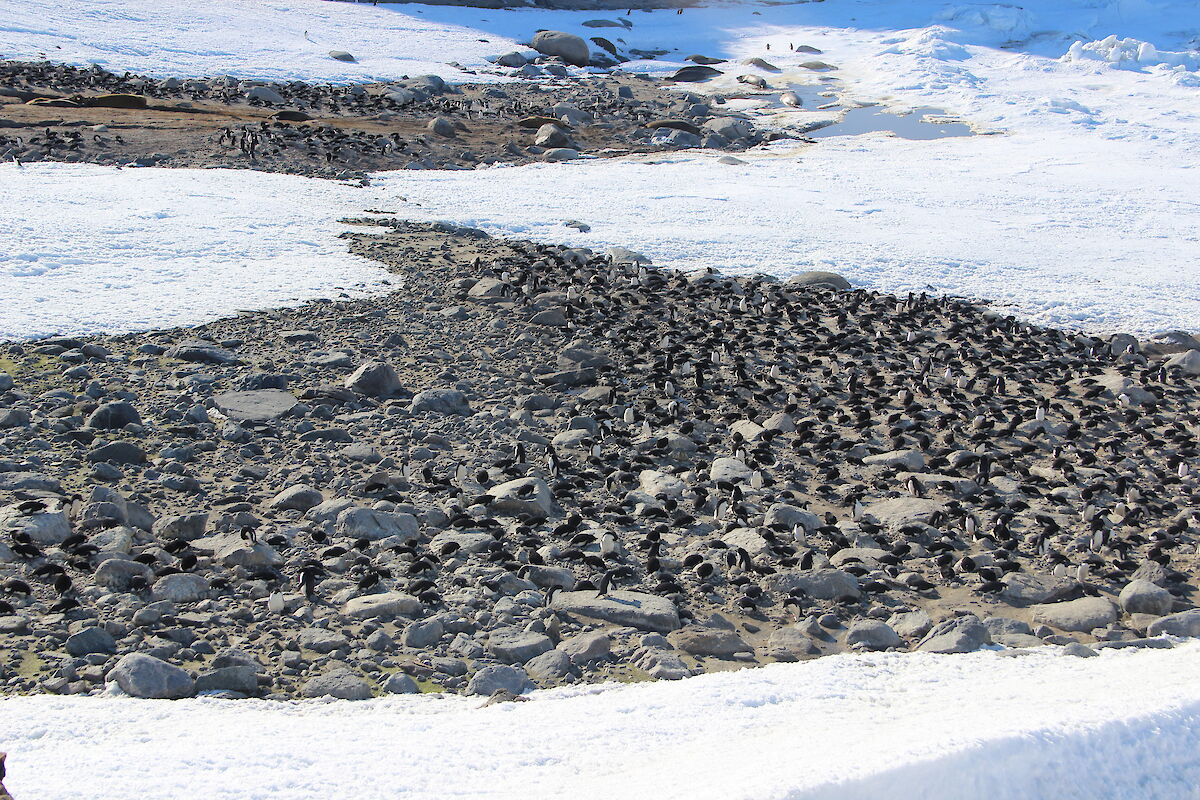
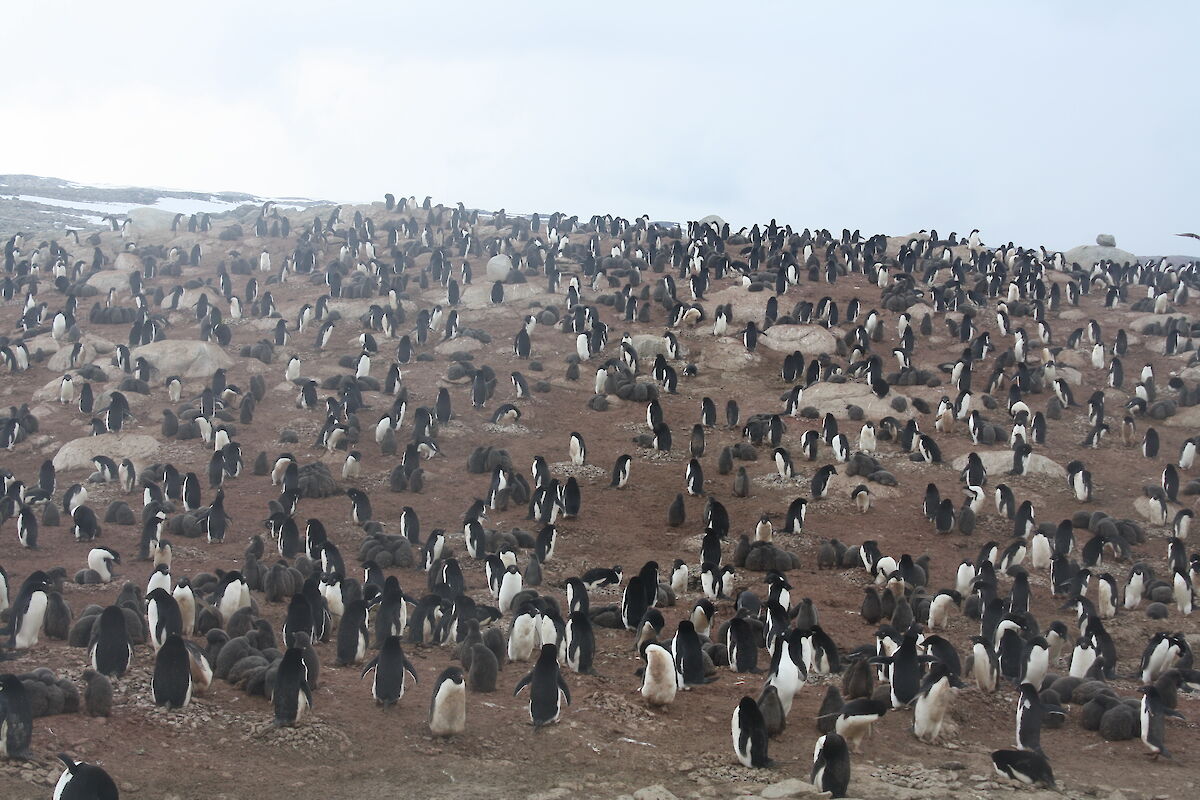
Last week our interesting activity was a trip to Peterson Island to conduct annual maintenance on two permanent seabird monitoring cameras. These are installed at sites around Casey as part of a long term science project to monitor the population of Adelie Penguins and other seabirds.
The maintenance is part of the annual works program for Arno the Senior Field Training Officer, and resident snow hound, and Michael De Lacey, the Communications Technical Officer and hydroponics maestro.
Sometimes others, like me, get to come along and help. While Arno and Michael did all the trip planning and technical tasks, I had 5 simple tasks to do: 1. carry some items to site, 2. pass tools when needed, 3. take some photos, 4. cook a chocolate pudding for dessert and 5. not be a nuisance. All things that I think I can do. Just.
With any good work trip, getting there is half the fun and adventure. And this trip was certainly one of those. Peterson Island lies off the coast of the Browning Peninsula approximately 20 km south of Casey station. Travelling there involves a 57 km journey by Hagglunds to Browning Hut via a segmented route (or arc) that heads south east for 25 km to avoid the crevasse field of the Peterson Glacier that lies between the station and the Browning Peninsula. Then 20 km southwest and finally 12 km to the northwest. The first 45 km are driving into a vast white expanse, if you can see. On this occasion visibility and surface contrast were poor and it was fairly dark, so we needed to drive using the navigation system, which sounds easy but the Hagg tends to wander all over the place. So keeping a nice line can be tricky and tiring with nothing to aim at or gauge your direction.
Once you make the turn back to the northwest there's a stunning view that opens out in front of you. There's the vast Vanderford Glacier to the left, the Browing Peninsula and nearby Islands in front and the Peterson Glacier to the right. It's a magnificent scene if the light or snow conditions allow you to see it. It was late in the day by the time we arrived at Browning Hut, our base for the next 3 days, so we quickly dug out the snowed-in toilet, set up the generator, made a plan for tomorrow and settled in for the night.
The weather forecast at the 8 am radio sched was confirmed to be good for the day and we were pretty well organised, so we set off earlier than our planned departure time so that we could make the most of the limited winter daylight hours. Alas, we travelled 50 metres from the hut and had one of those ah-oh moments when the engine warning light came on in the Hagg.
Michael rummaged around in the dashboard menu and worked out that it was a water–fuel separator fault; meaning the separator was full of water and we shouldn't proceed until we drained the water out. Neither of us were that familiar with the internal goings on of Haggs so it took a little while to work out how to do this, find a suitable container to drain it into, set up a spill kit so we didn't create an environmental mess, and complete the job. There went the advantage of our early departure. Or was that the advantage? Leaving early certainly meant that we were still on track despite having to sort out some problems.
We set off again only to be foiled again 30 minutes later when the snow and ice conditions determined that we couldn't follow the planned route to the Peterson Channel. Back-tracking and finding another suitable route was not going to leave enough time for us to get to Peterson Island and complete the job today. So now it was time for Arno to reveal plan B.
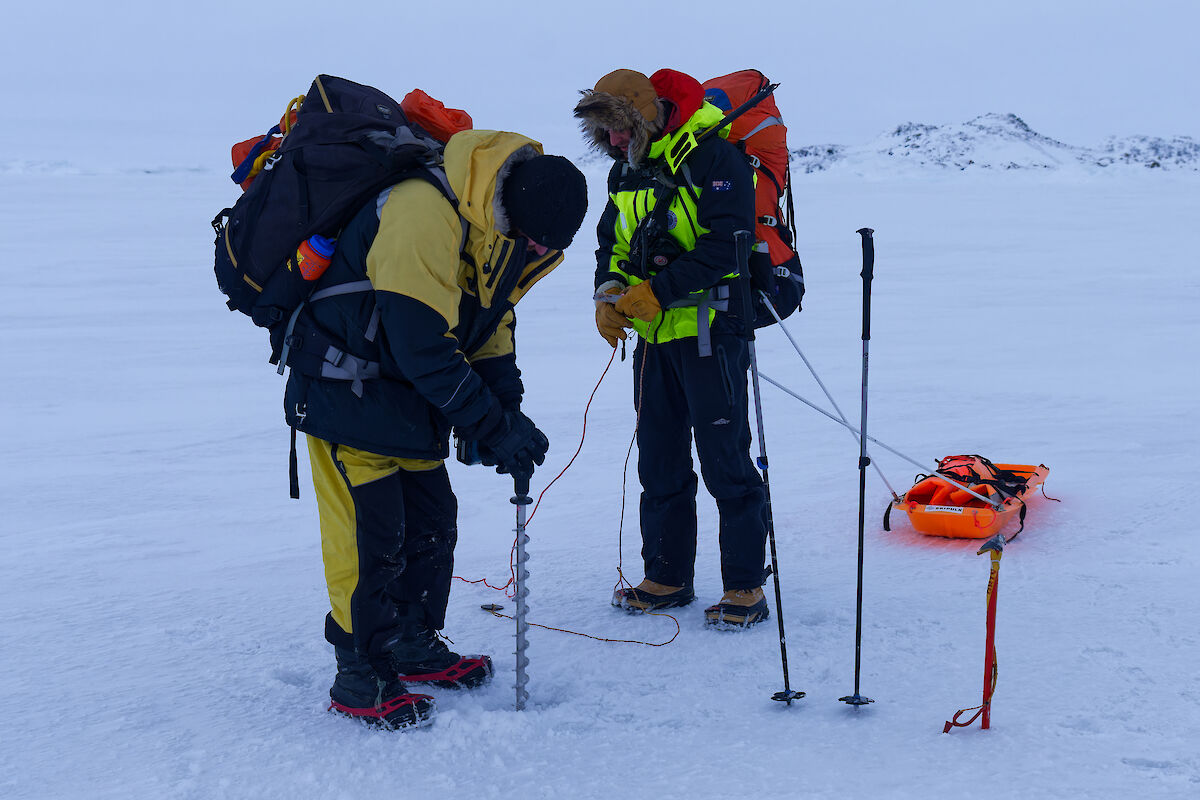
It's always worth having a few contingency plans in your back pocket when travelling or working in remote areas so that you can make the most of the journey when plan A doesn't work out. Today was a good example of that. Arno decided that we'd spend the day scouting out another route and once this was complete we'd spend the remainder of the day testing the sea ice around the peninsula to see if it was safe to travel on. We set off and managed to locate a route to the Peterson Channel and Peterson Island that would be suitable for tomorrow, and spent the rest of the day on a 5 km walk testing the sea ice in the vicinity of Wilson Island. This was time well spent as we were able to determine that the area is safe for sea ice travel with sea ice thickness of between 45 and 200 centimetres. We'd brought along skis, snowshoes and micro-spikes as options for the trip to Peterson Island and decided that snowshoes would be most appropriate for our trip the following day, given the snow and ice conditions that we'd experienced.
Our work was complete for the day so it was back to the hut for the night and time for task 4: cooking a chocolate pudding for dessert. The oven was running a little hot so it was a bit more cooked than it should have been, but nonetheless it was well received after a full day out in the cold (-17 degrees C). It is a recipe for 6 but the suggestion to save the remaining portion for morning tea tomorrow was quickly vetoed by the others who insisted that we should eat the remainder tonight to save washing up in the morning and expedite our departure. Task 4 completed! Only 4 others to go.
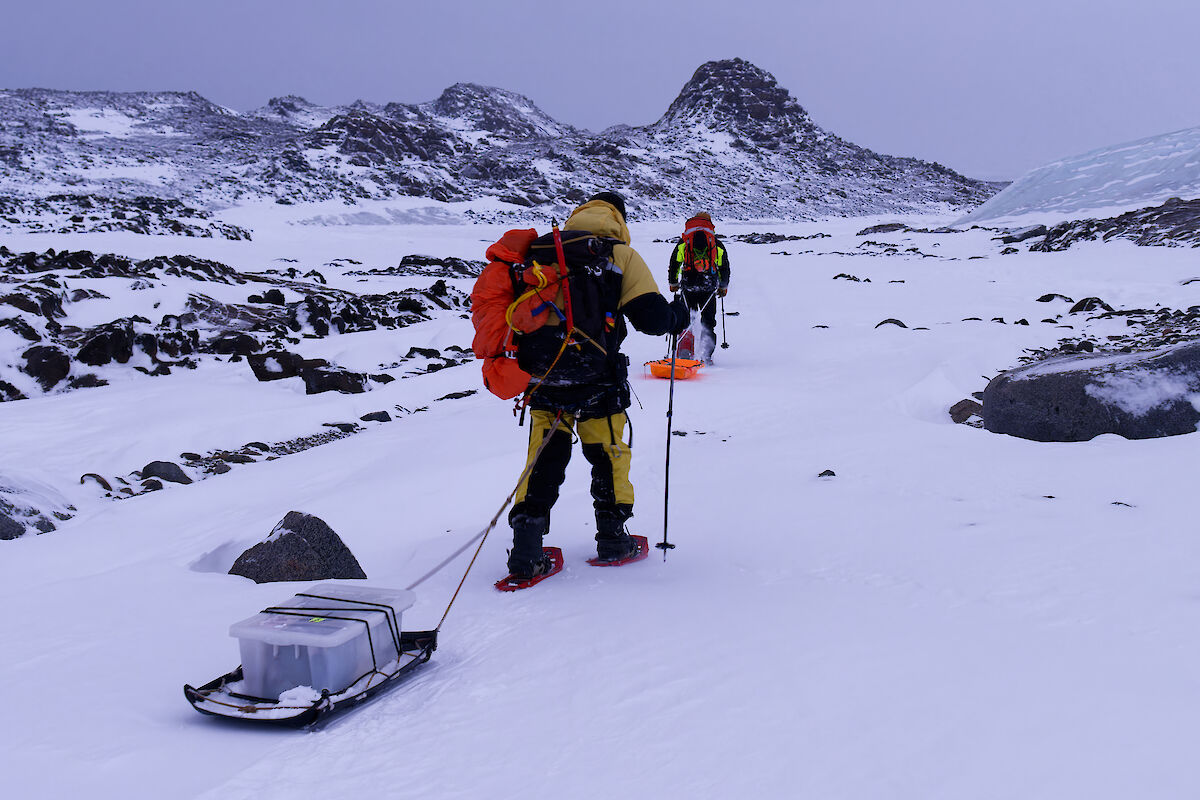
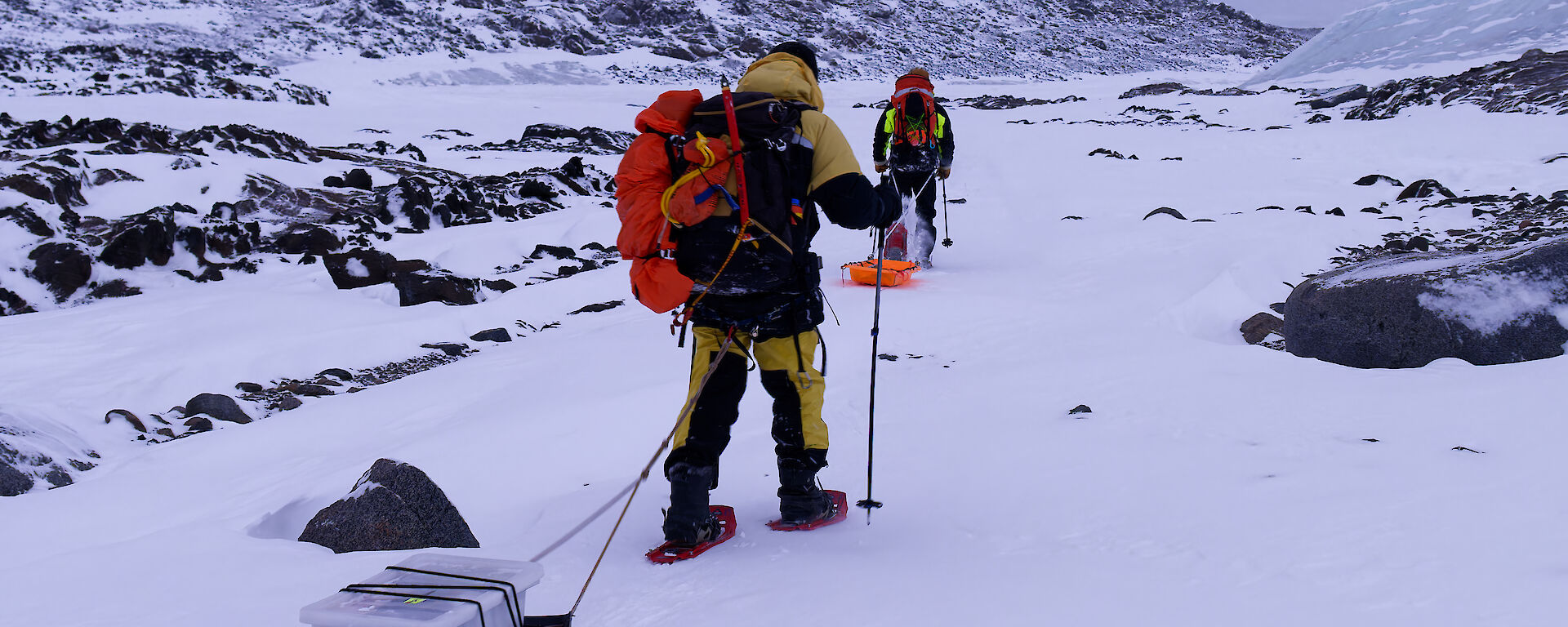
The weather forecast in the morning was good but it was a little more overcast than yesterday. We set off in the Hagg and shortly after arrived at our parking spot from where we'd walk to Peterson Island. We loaded 2 sleds with gear, 1 with ice drilling gear and 1 with camera maintenance gear, donned our snow shoes, and then I had some verbal judo with Michael who had the heaviest load. He was being mean and wouldn't share his toys and let me carry any of the gear so that I could share the load and complete my task 1 (carrying some gear). We arrived at a compromise, and he gave me a thermos of hot water to carry.
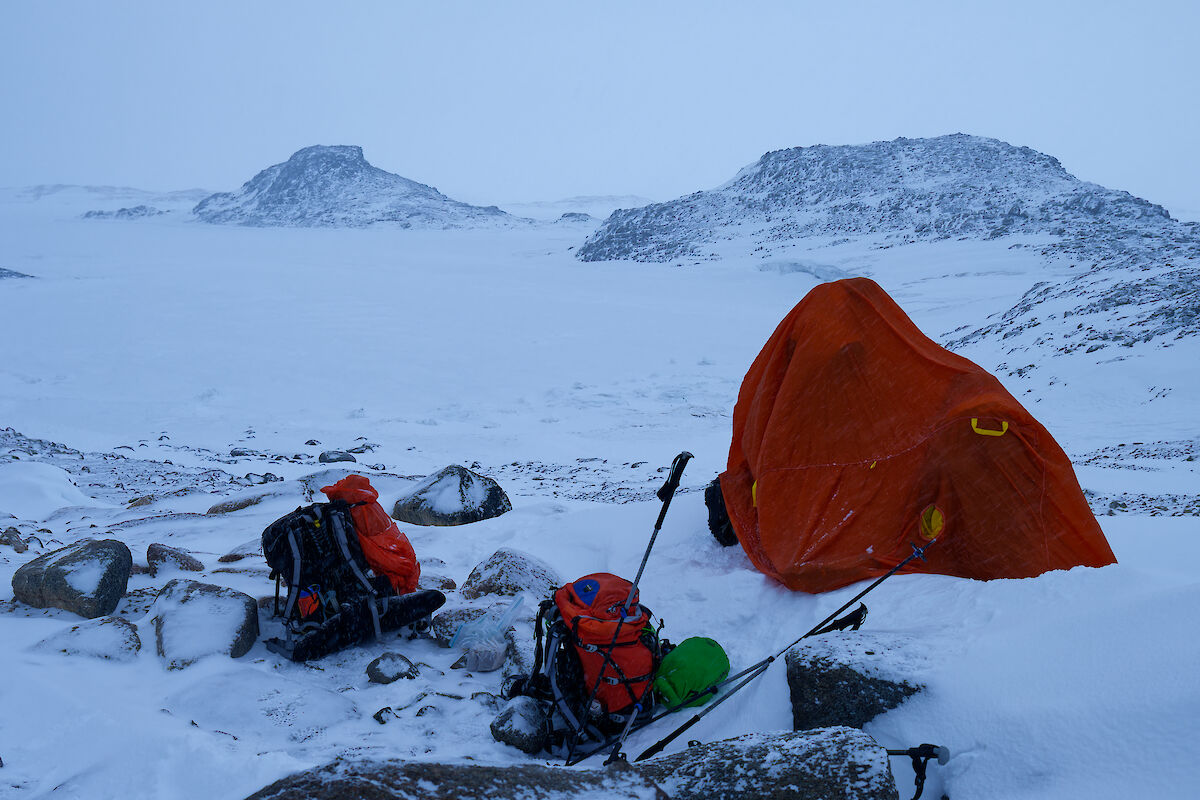
We set off down the snowy valley over frozen lakes half buried in snow, all the while enjoying the diminishing view of the valley, peaks, Peterson Channel and Peterson Island beyond, as the clouds gradually lowered. We reached the end of the valley and Arno quickly assessed the tide crack and the sea ice and determined that it was safe to cross the channel to the island. By the time we reached the other side of the channel it was gently snowing. Here we ditched the snow shoes and sleds and climbed a small ridge to the 1st camera site.
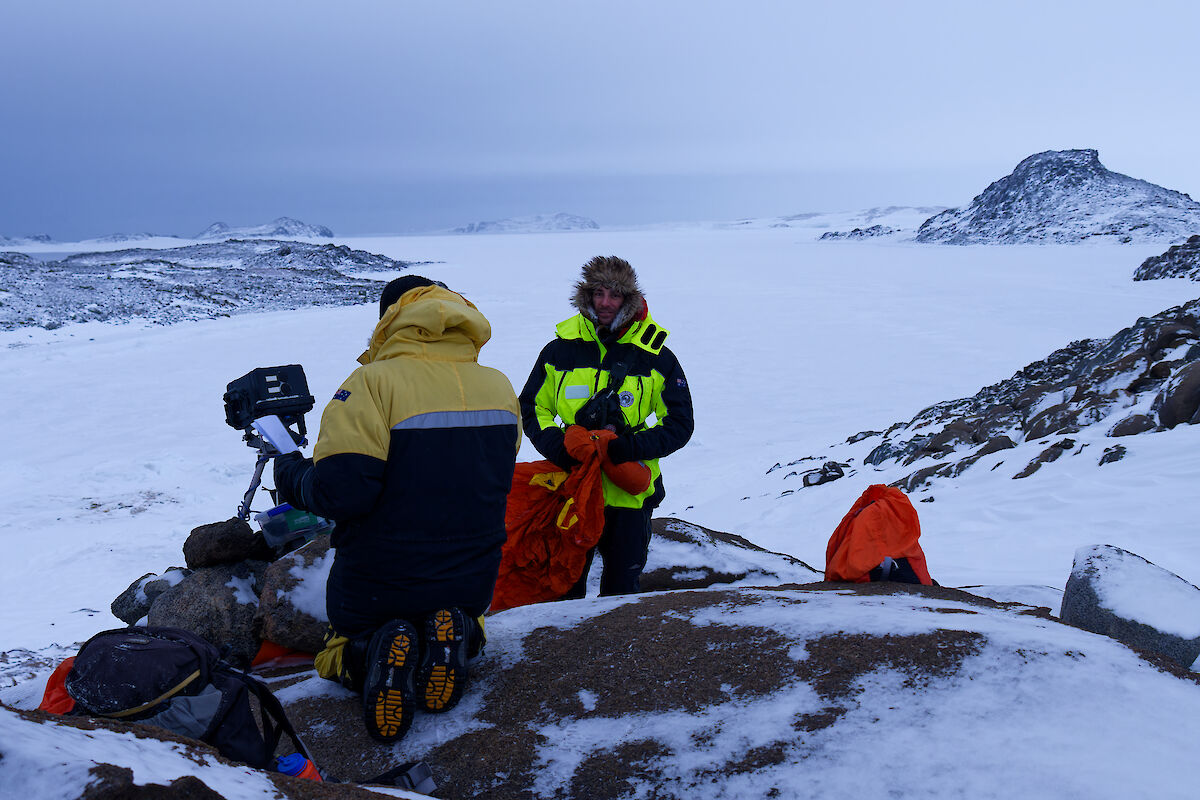
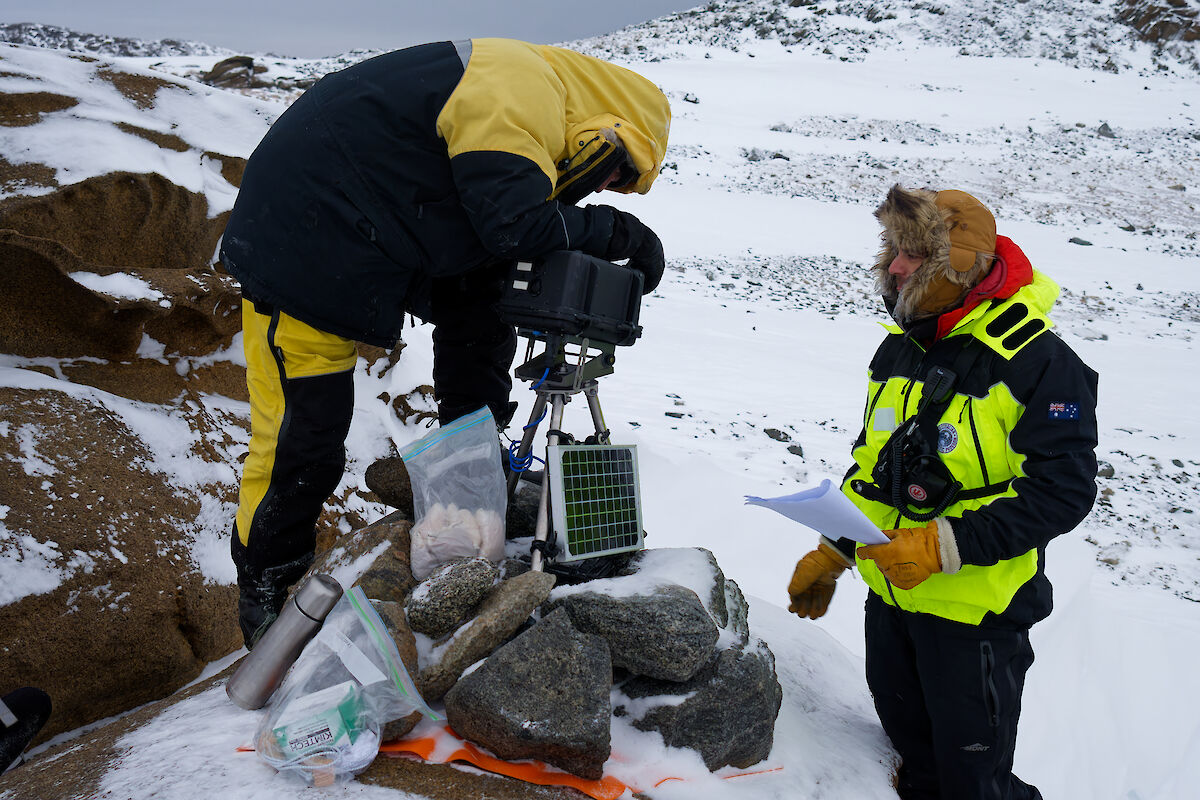
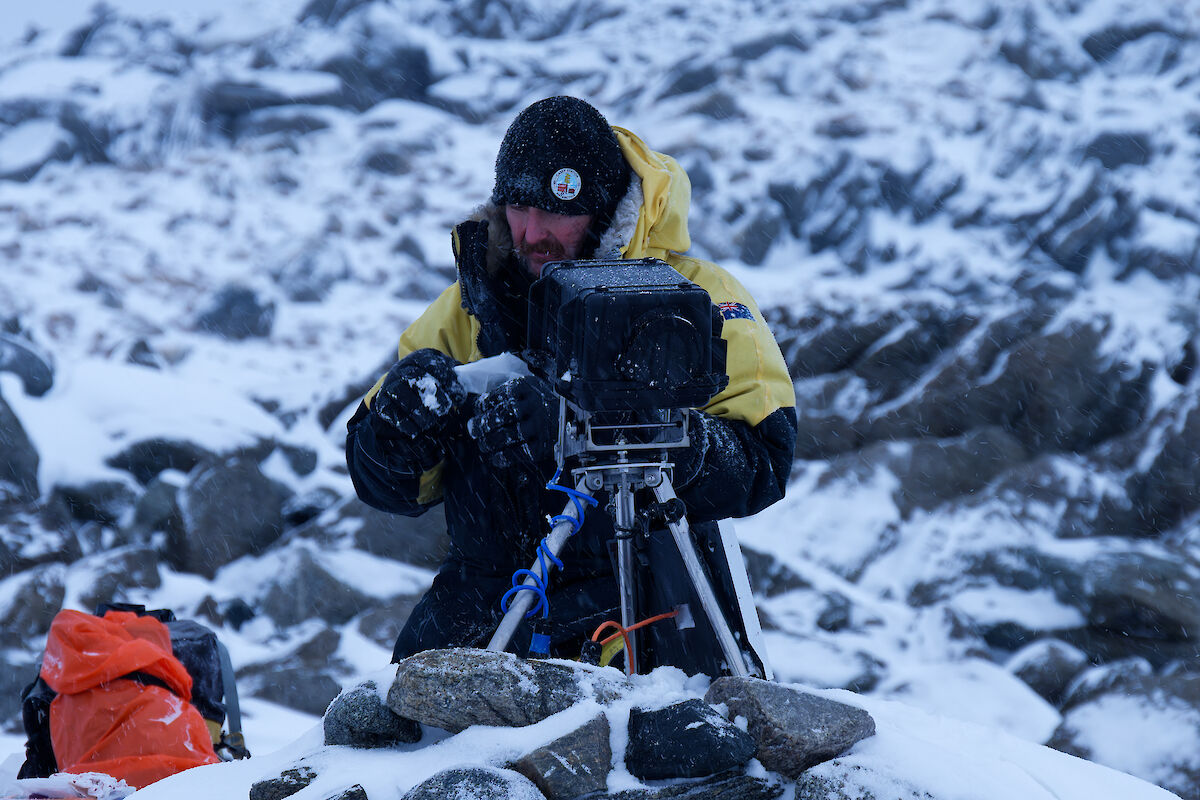
Michael and Arno quickly got to work while I got on with task 3 - taking some photos. It was an easy job for me in one sense as watching these 2 working together on a camera covered in snow and ice in such a beautiful and remote setting was a wonderful thing to see and photograph. It was a bit tricky in another sense as the -17 degree C conditions are brutal on camera batteries and every few minutes I needed to change the battery with one that I kept warm in my pocket.
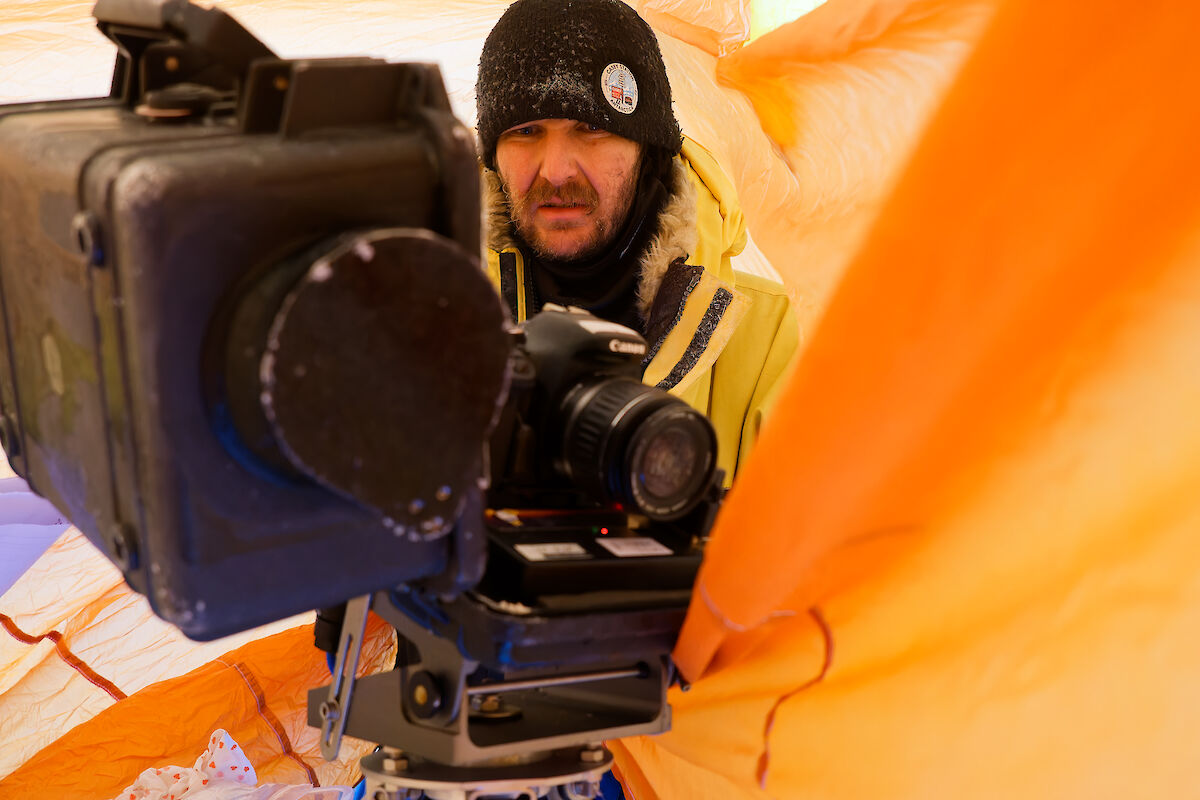
It was now starting to snow a little heavier and Michael needed to open up the protective housing for the camera, so he and Arno pulled out a Bothy Bag to cover themselves and prevent any snow from getting inside the camera housing. It was very funny to watch from the outside as it looked like two boys wrestling inside a cheap 2 person tent. I had to resist my parental urge to tell them to stop mucking about in there, so instead stuck my head inside to see what they were up to and sneak a couple of photos. But before I did that I got to carry out task 2 and pass Michael a thermos of hot water and some wipes that he used to melt the ice on the camera housing before opening it.
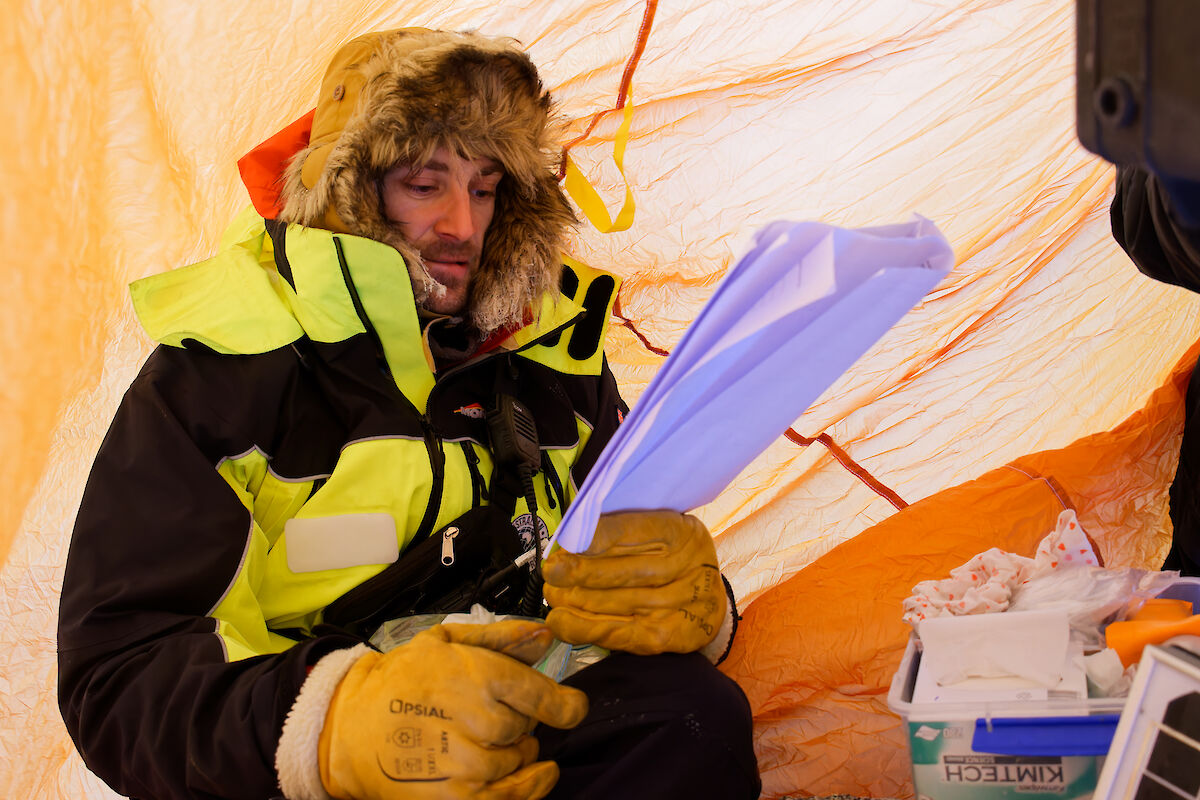
Once inside I could see there wasn't any shenanigans going on at all. Michael was on the right changing the battery, SD card and cleaning the lens, while Arno on the left, looking very official, was reading out instructions on the various camera menu settings.
All was well with the camera, so they quickly finished this task and moved onto the second camera nearby. More shenanigans inside the Bothy Bag, another thermos of hot water and they'd quickly finished this camera as well. None of the spare parts were needed, which was a great outcome, so I'm glad I didn't have to carry them.
We were ahead of time again as the maintenance had gone very well. This left us with time to go and check a nearby search and rescue cache, which was also on Arno's list of jobs to do. The cache was only one kilometre to the northwest, so we arrived there pretty quickly and set about opening the box that the cache of gear is housed in. Inevitably it was a bit snowed in, including snow that had found it's way inside. We dug out the contents and checked them and all was well.
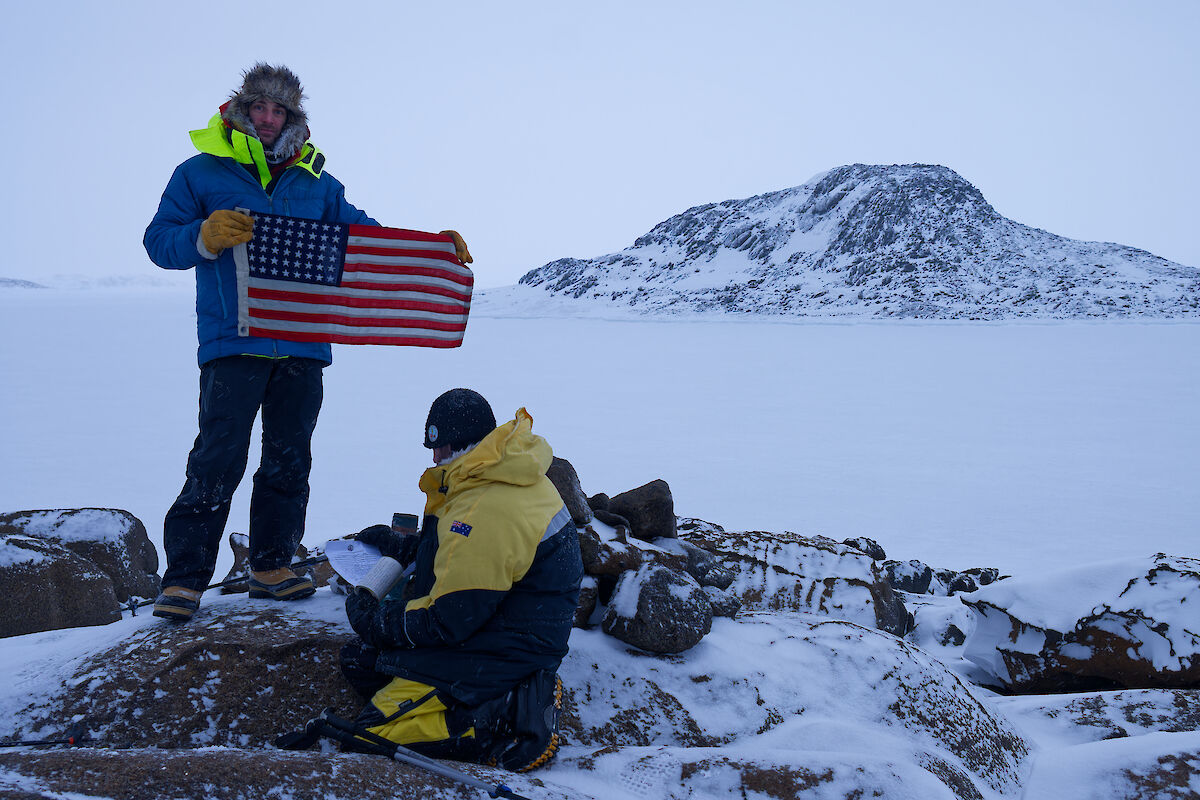
We had a little more daylight left so we made the short trip from the SAR cache across to the Memorial Plaque and Cairn that was established at the northern tip of the island by the Americans in 1948. There's a small pile of rocks that encloses a brass tube containing a miniature American flag, a note from Lieutenant Commander Browning of the US Navy claiming the area for the United States, and a logbook. A fascinating collection of items to find in such a remote, spectacular and beautiful setting.
We made an entry in the logbook, had a quick bite of lunch, retraced our steps back to the cameras, over the ridge to the channel, collected the sleds and snowhoes and returned up the valley to where we'd parked the Hagg completing our 7.5 km journey just on dark.
We congratulated ourselves on completing all of the things that we'd set out to do, warmed up the Hagg and then set off on the 3 hour journey back to station in the dark.
Thanks to Mitch's mum, Vanessa, and all the family and friends that inspire us to share these journeys with you.
Paul Black
Weather Observer and Fire Chief
Casey Station 2026