
Project information
Project aim
This project will coordinate and deliver research, analysis and aligned activities to address the requirements of the Heard Island and McDonald Islands (HIMI) Marine Reserve management plan. It will also deliver management activities relevant to the broader HIMI Territory as set out in relevant legislation and statutory documents, such as the National Recovery Plan for albatrosses and petrels, the Threat Abatement Plan for the impacts of marine debris on vertebrate wildlife for Australia's coasts and oceans, and the UNESCO World Glacier Monitoring Service.
This proposal will act as a foundation for discussions and decisions around the operational model to support a HIMI campaign and the allocation of resources.
While some non-science activities are referenced in this proposal, we anticipate that separate non-science project proposal(s) will be required to cover operational requirements and other non-science activities.
Project milestones
Summary of the season 2024/25
Heard Island and McDonald Islands (HIMI) are an Australian External Territory located in the Southern Ocean about 4000 km south west of mainland Australia and approximately 1700 km north of Antarctica. These sub-Antarctic islands are World Heritage listed for their spectacular beauty and natural values, heritage listed under Australian legislation and are an integral part of the HIMI Marine Reserve. Their location and prevailing weather mean they are rarely visited by humans. This has led to their recognition as one of the world's least modified environments.
The HIMI Marine Reserve supports the HIMI Fishery which targets Patagonian toothfish and Mackerel icefish. The reserve also supports threatened seabirds and marine mammals, migratory species, and a range of endemic species both vertebrate and invertebrate.
The Department of Climate Change, Energy, the Environment and Water is responsible for managing the Territory and the marine reserve. Understanding the current status of the terrestrial and marine environments is critical to managing this important region into the future.
The dedicated environmental management visit to the HIMI Marine Reserve (the HIMI Campaign) is a priority for the Australian Government. The Campaign will address:
- critical assessments and management tasks relating to invasive species, contaminants and heritage
- threatened species population assessments
- terrestrial and marine science activities.
These activities will facilitate the delivery of HIMI-related legislative, statutory and regulatory obligations and commitments.
Since the inception the HIMI Campaign, we have:
- Identified and prioritised management and policy objectives
- Identified and ranked science activities to deliver these objectives
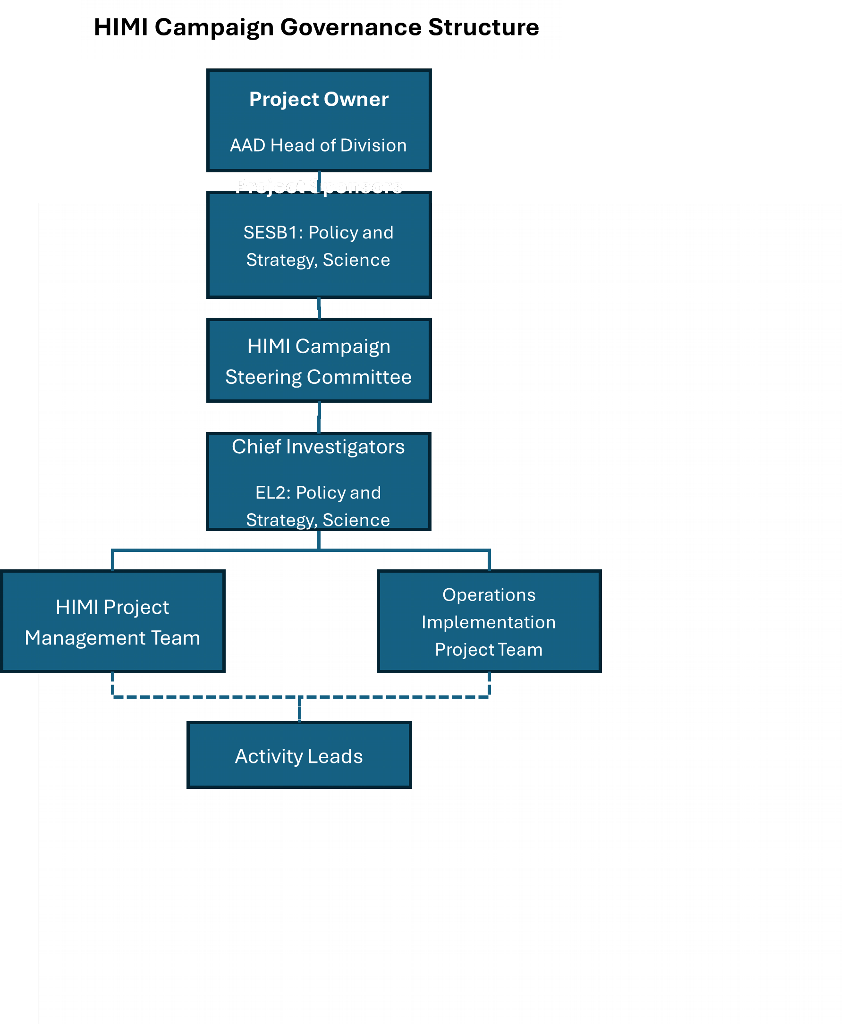
- Developed a project plan and robust planning and governance structure including a steering committee with project oversight
- Developed a Program of Works and associated Concept of Operations to deliver the activities
- Developed a comprehensive Environmental Impact Assessment that covers all aspects of the planned activities, their potential impacts on the environment and the measures that will be undertaken to minimise these impacts
- Developed a Communications Strategy that incorporates all project activities, internal and external to the Division.
In planning this project, the AAD worked closely with multiple stakeholders across government, research institutions and operational partners: Securing Antarctica's Environmental Future (Monash University), Serco, Bureau of Meteorology, University of Tasmania, Institute for Marine and Antarctic Science, Department of Defence, Sydney Institute of Marine Science, Australian Border Force and the Australian Fisheries Management Authority. It is only through the involvement of each of these partners that this ambitious project will be delivered in full. Outcomes from the Campaign will be communicated widely via web stories, print, visual and social media and seminars.