
Project information
Project aim
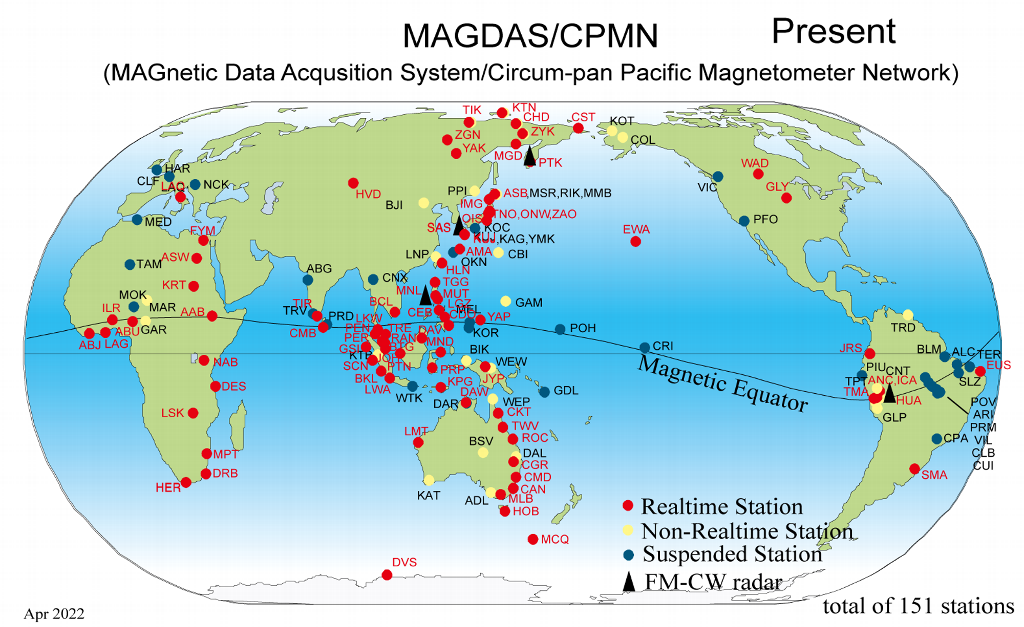
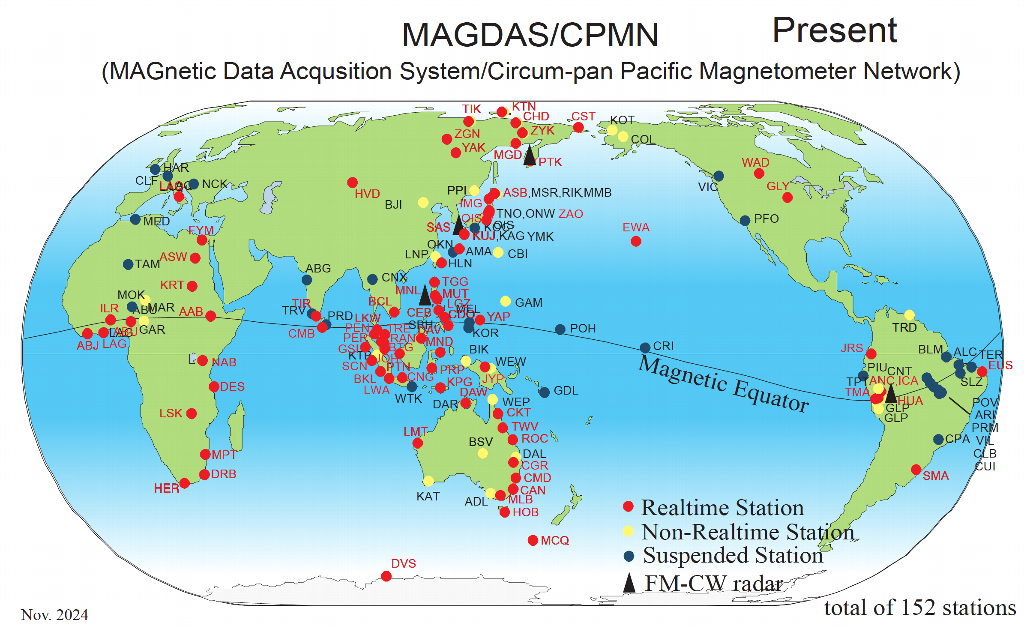
ICSWSE, Kyushu University, has deployed MAGDAS magnetometers at 70 stations mainly along the 210-degree magnetic meridians (MM) and the magnetic Dip equator, and three FM-CW radars along the 210o MM during the Years 2005 through 2021. The scientific objective of the MAGDAS Project is to understand the Sun-Earth couplings from the solar surface to the Earth's lithosphere for study on space weather and space climate. Data from AAD stations at Davis (in Antarctica) and at Macquarie Island are very important for this project. Hence, we wish to continue magnetic observation at these two stations.
Project milestones
Summary of the season 2024/25
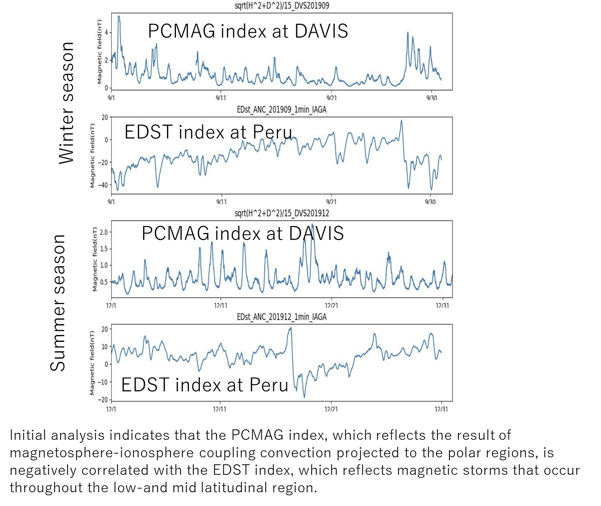
The scientific objective of the MAGDAS Project is to understand the Sun-Earth couplings from the solar surface to the Earth's lithosphere to study the space weather and space climate. The magnetometer installed at Macquarie Island (MCQ) is located inside the auroral oval and enables detailed monitoring of aurora electrojet development and auroral substorm. On the other hand, Davis (DVS) station in Antarctica is located in the Polar cap region, a higher latitude region in the auroral oval, where phenomena occurring in the direct interaction region between the solar wind and the Earth's magnetic field are projected. The Polar cap enables direct monitoring of magnetospheric-ionospheric coupled convection. A real-time convection monitoring index PCMAG using magnetic field data from the DVS station is currently under development. As an initial step, we are investigating the properties of its monitoring accuracy, including differences in sunlight/shade and dependence on magnetic activity level. Therefore, data from MCQ and DVS stations is crucial for this multi-site project, which we seek to continue.
Summary of the season 2023/24
The scientific objective of the MAGDAS Project is to understand the Sun-Earth couplings from the solar surface to the Earth's lithosphere to study the space weather and space climate. The magnetometer installed at Macquarie Island is located inside the auroral oval and enables detailed monitoring of aurora electrojet development and auroral substorm. On the other hand, the DAVIS station is located in the Polar cap region, a higher latitude region in the auroral oval, where phenomena occurring in the direct interaction region between the solar wind and the Earth's magnetic field are projected. The Polar cap enables direct monitoring of magnetospheric-ionospheric coupled convection. A real-time convection monitoring index PCMAG using magnetic field data from the DAVIS base is currently under development. As an initial step, we are investigating the properties of its monitoring accuracy, including differences in sunlight/shade and dependence on magnetic activity level. Data from AAD stations at Davis (in Antarctica) and Macquarie Island are crucial for this multi-site project, which we seek to continue.
Summary of the season 2022/23
The scientific objective of the MAGDAS Project is to understand the Sun-Earth couplings from the solar surface to the Earth's lithosphere for study on space weather and space climate. A new magnetometer has been shipped to Macquarie Island. It is currently in transport and will be installed by our colleagues at AAD. Macquarie Island is located inside the auroral oval and will enable detailed monitoring of aurora electrojet development and auroral substorm. On the other hand, the DAVIS station is located at Polar cap region, a higher latitude region in the auroral oval, where phenomena occurring in the direct interaction region between the solar wind and the Earth's magnetic field are projected. The Polar cap enables direct monitoring of magnetospheric-ionospheric coupled convection. A real-time convection monitoring index PCMAG using magnetic field data from the DAVIS base is currently under development. As an initial step, we are investigating the properties of its monitoring accuracy, including differences in sunlight/shade and dependence on magnetic activity level. Data from AAD stations at Davis (in Antarctica) and at Macquarie Island are very important for this multi-site project, which we seek to continue.