
Project information
Project aim
Robust sea level records are critical for a wide variety of scientific, economic and social purposes. Of particular priority for Australia is its international role in improving the measurements of regional sea-level change and the contributions to this change for the incredibly data sparse Southern Ocean. The goal is to develop and implement international best practice approaches for a sustained network of real-time autonomous sea level monitoring. The network will include permanent installations at Australian Research Stations, Commonwealth Bay and Heard Island and capability for short-term deployments as required. This project will provide a nationally coordinated approach that will allow for an enhanced response to extreme events, including tsunamis, calibration of satellite estimates and mapping, and future sea-level change, as challenges of great importance to the well-being of the World's coastal societies and ecosystems.
Project milestones
Summary of the season 2024/25
Australia's commitment to enhancing sea level measurements in Antarctica and the Southern Ocean is crucial for advancing global climate research, future projections of change, and informing coastal management to protect communities and assets from sea level rise and extreme events, such as storm-driven inundation and tsunamis. Despite ongoing challenges with resources and logistics, modest steps have been taken in 2025 to progress project milestones. These include appointing a project scientist to develop and refine a comprehensive strategic plan, conducting a survey to gather insights from the Southern Ocean Sea Level research community, and hosting a stakeholder workshop in May 2025. The workshop convened national and international agencies to assess the current state of sea level monitoring, identify areas for improvement, address the needs of end users, share best practices, and outline the framework necessary for a successful Southern Ocean Sea Level monitoring program, including data handling and management. Outcomes will be reported within the next year. Measurements at the four Antarctic research stations—Mawson, Davis, Casey, and Macquarie Island—continue to provide valuable data, though they face limitations due to constrained resources and calibration capabilities, and ageing infrastructure that requires upgrading. Instrumentation for the deployment of a remote sea level monitoring station at Heard Island has been developed for deployment on Voyage 1 of 2025/26, which will enhance data collection in the data-sparse Southern Ocean and contribute to a more robust global understanding of sea level changes.
Summary of the season 2023/24
Robust sea level records are critical for a wide variety of scientific, economic and social purposes. Of particular priority for Australia is its international role in improving the measurements of regional sea-level change and the contributions to this change for the incredibly data sparse Southern Ocean. Resourcing and logistics challenges for the project have limited progress at this time.
Summary of the season 2022/23
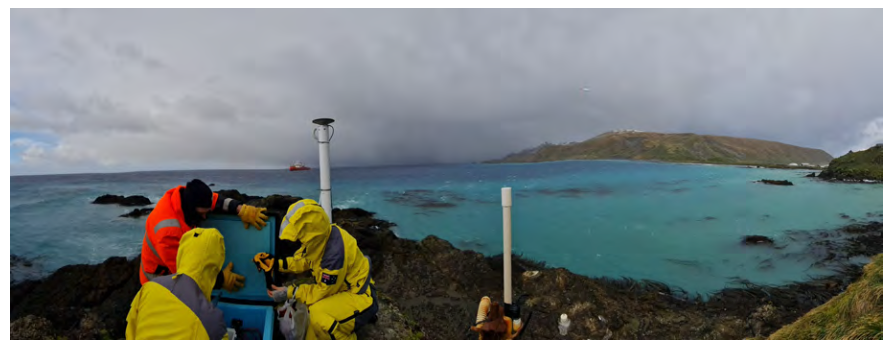
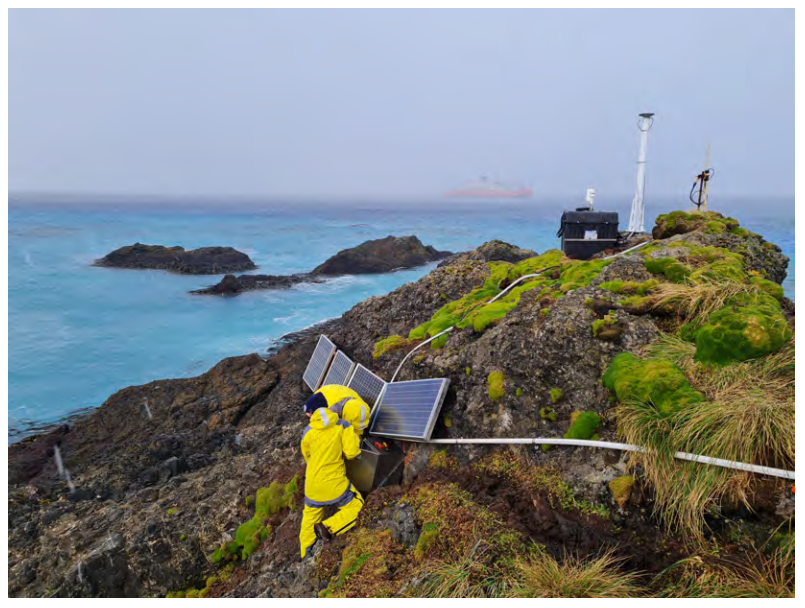
The activity this season focused on the upgrades and repairs to the sea level observing system at Macquarie Island. The tide gauge system was first installed in 1992 and underwent various upgrades and maintenance
over its life. In March 2019 the pressure sensor system was partially decommissioned. In June 2022 a storm damaged the tide gauge, destroying much of the above ground infrastructure. In late 2022 responsibility for the tide gauge was transferred from AAD T&I to the SOSL Monitoring Network project. Aside from restoring the functionality of the tide gauge to the state prior to the storm damage, the project aimed to improve the system reliability, improve data quality to support long term sea level change monitoring and reduce latency of data collection to support tide predictions and tsunami early warnings.