
Project information
Project aim
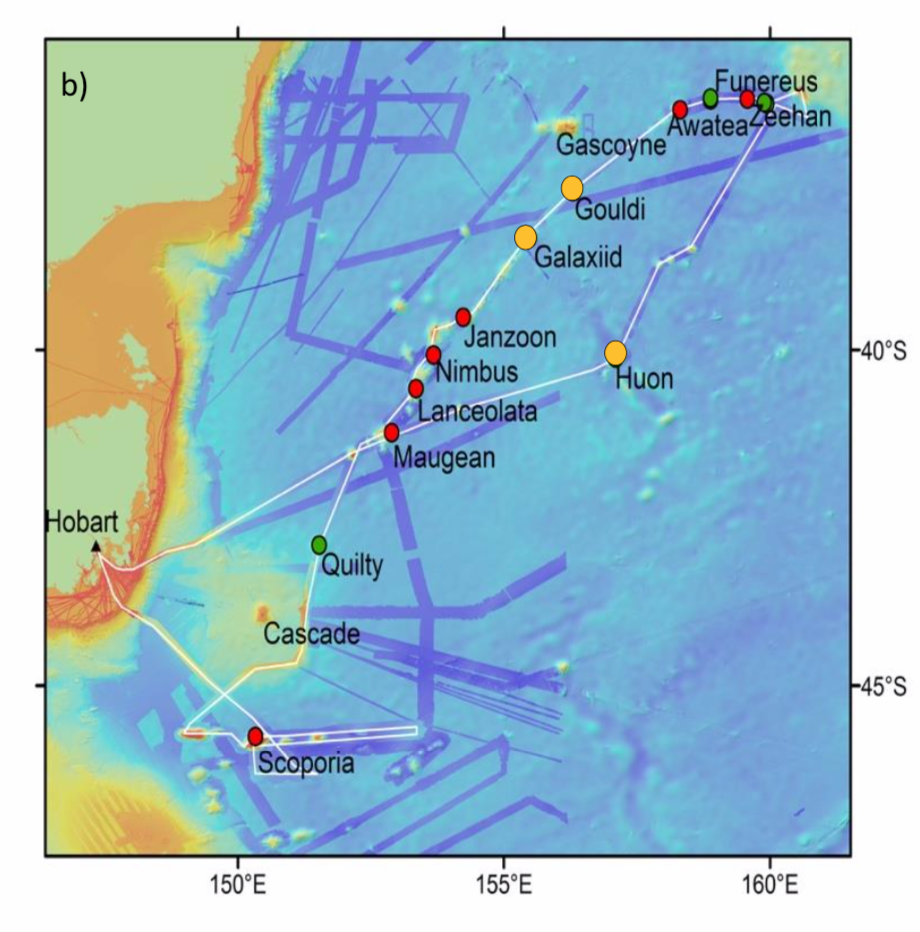
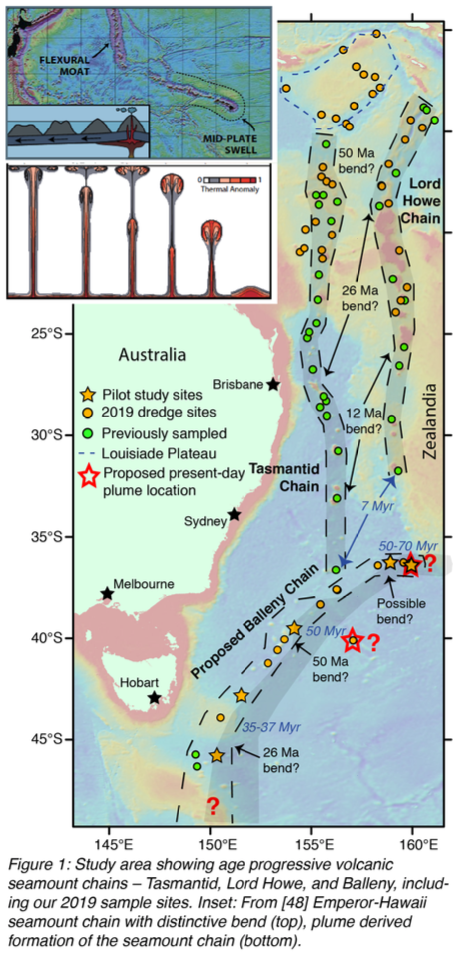
Stationary plumes of buoyant molten rock can rise from deep within the Earth forming chains of volcanoes on the seafloor. The Balleny Plume is thought to have produced a ~1200 km chain of volcanoes to the east of Tasmania, but the timing of volcanism is poorly known. This plume is invoked as the driver of the opening of the Tasman sea ~85 Ma and the separation of Australia Antarctica at 30-50 Ma. A 2018-2019 voyage will collect key rock samples for further age constraints of volcanism and magma chemistry which will inform plate tectonic and solid Earth modeling to reveal the timing of movement and separation of the continents which led to the opening of the Tasman Sea and glaciation of Antarctica. We will test the hypothesis that the Balleny Plume is under Antarctica which will influence Antarctic ice sheet stability models.
Project milestones
Summary of the project achievements 2021/22
A plume of hot rock and magma (name: Balleny plume) is thought to be under Antarctica today and is also thought to have produced a ~1200km linear chain of volcanoes to the east of Tasmania between 70 and 35 million years ago. This mantle plume may have acted as a driver for the separation of the Australia, New Zealand and Antarctica tectonic plates at, or after, 40 million years ago.
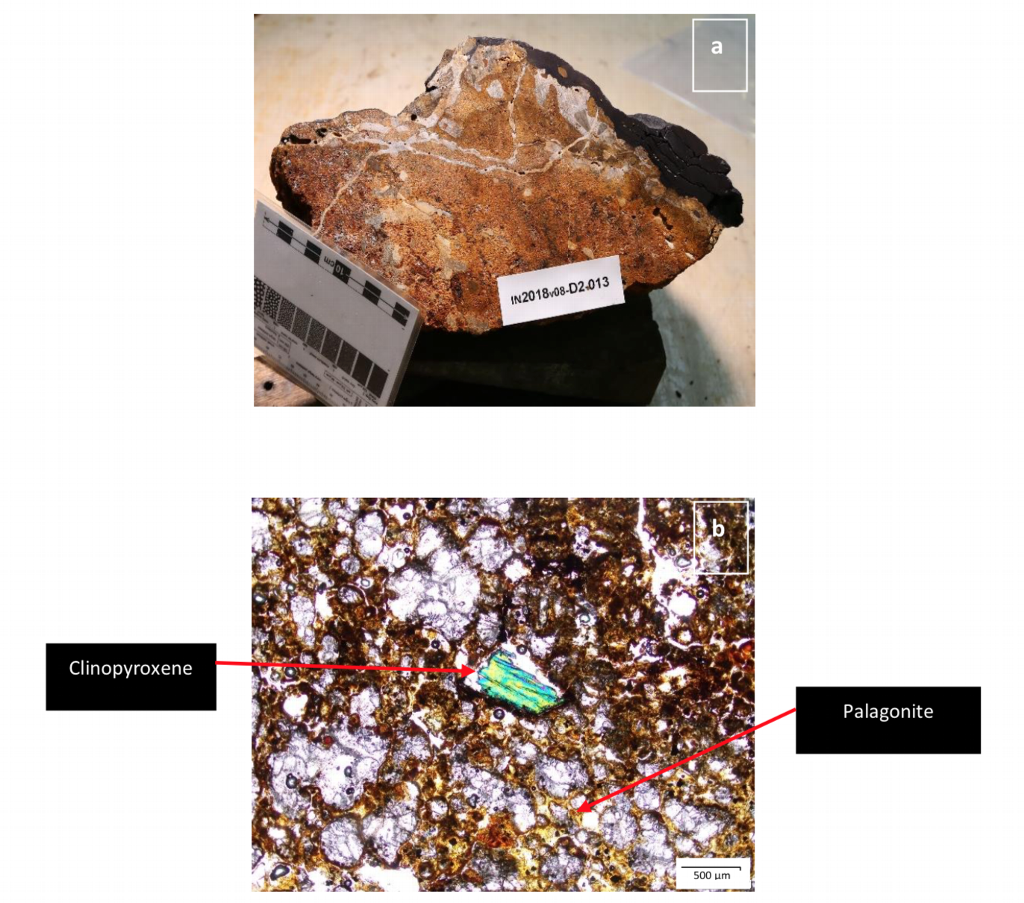
In this project, we used rocks dredged from 18 submarine volcanoes in the Tasman Sea to understand the interaction of hot plumes of rock and magma with tectonic plates and the fragmentation of Australia, New Zealand and Antarctica.
We found that the submarine volcanoes show an age progression from 69 to 25 million years across the Tasman Sea, which is consistent with a stable plume of hot rock and magma beneath moving tectonic plates in this region. The geochemistry of the sampled volcanic rocks from volcanic seamounts in the Tasman Sea is consistent with volcanic rocks on the Balleny Islands in Antarctica. This similarity is strong evidence to support a link between the two volcanic regions.
Our data can now be used to examine and improve current tectonic plate reconstruction models in this region. The tectonic plate reconstruction models can be used for a diverse range of scientific applications, for example the timing and development of the Australian Antarctic Ocean Current which drove glaciation on Antarctica ~35 million years ago.
Summary of the season 2020/21
Plumes of hot rock arriving at the Earth's surface are responsible for island chains like Hawaii and elsewhere. The Balleny Mantle Plume is considered to be responsible for a chain of underwater volcanoes that extend from the Tasman Sea to Antarctica. Age constraints of the volcanoes are critical to understanding the plume's passage and whether the timing is suitable to explain rifting of Australia from Antarctica ~40 million years ago. In year 2 we have conducted the bulk of our analytical program and expect age dates for these volcanoes shortly. The age dates will enable a targeted approach on a smaller analytical program in Year 3 in order to meet our science objectives.