
Project information
Project aim
The Rayner Complex in East Antarctica exposes rocks that formed deep in the Earth’s crust. These rocks are part of a larger terrane that is one of the largest and longest-lived ultra-high temperature (>1000 °C) metamorphic terranes on Earth. The geodynamic setting in which this terrane evolved is poorly understood, but the timing of metamorphism corresponds to the final stages of formation of the Rodinia supercontinent over one billion years ago. Understanding the location of the Rayner Complex within Rodinia is pivotal for reconstructing the geological evolution of the Antarctic continent. In this project we will apply state-of-the-art microanalysis tools to sample the lower crust, now exposed in the Rayner Complex, to answer fundamental questions on mountain-building processes and the role of East Antarctica in the Rodinia supercontinent. In doing so we will leverage a valuable legacy collection of rock samples collected over some 40 years of AAD supported research.
Project milestones
Summary of the season 2021/22
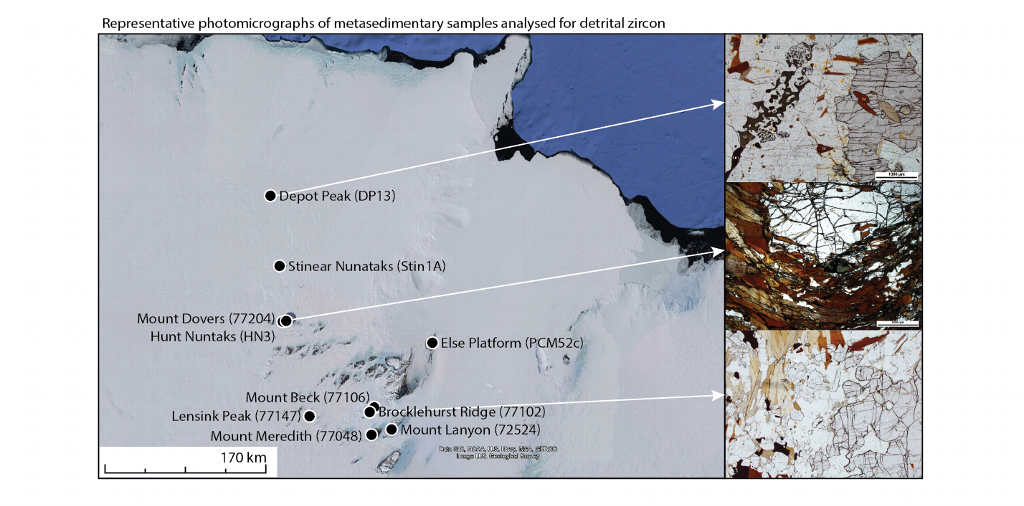
U-Pb zircon geochronology and trace element data has been collected from 10 metasedimentary samples and 15 igneous samples to constrain the protolith history of the northern Prince Charles Mountains (nPCM). Samples extend from Depot Peak in the northernmost part of the nPCM to Mount Lanyon in the south. The data so far suggest that some samples contain Paleoproterozoic protolith ages (>1700 Ma) but the majority of samples have Mesoproterozoic (< 1400 Ma) protolith ages. All samples record to some extent metamorphism during the Rayner Event between c. 950-900 Ma, with rare samples also showing evidence for Cambrian (c. 500 Ma) metamorphism.
Oxygen isotope data was collected from 10 igneous samples to provide further information on the role of mantle v crustal reworking. This will be combined with Hf isotopic data from all samples (still to be collected).
Summary of the season 2020/21
This project proposed to collect new age and isotopic data from legacy samples from the Rayner Complex to better understand the geological history of this region. Zircon grains have been separated from all the samples, with the first batch of analysis booked for May and June 2021. Unfortunately COVID19-related travel restrictions and lab closures have resulted in significant delays to this project.
Summary of the season 2019/20
This project proposed to collect new age and isotopic data from legacy samples from the Rayner Complex to better understand the geological history of this region. Samples have been sourced from approximately half the locations. However, travel restrictions have meant that samples from interstate legacy collections are still to be selected.