
Project information
Project aim
Calcium carbonate deposits formed under the Antarctic Ice Sheet (AIS) at peak glacial conditions contain information about both the existence of life-sustaining environments at the ice-bedrock interface and processes that generate basal meltwater. These dark, cold environments sustained diverse microbial communities thrived because there were diverse energy sources and, astonishingly, sometimes hosted microorganisms commonly associated with hydrothermalism. The subglacial carbonates reveal that subglacial volcanism occurred at glacial maxima and created sub-AIS oases where life thrived. Volcanically-induced basal meltwater discharge may have also contributed to ice sheet destabilization as well contributing to the influx of Fe-laden freshwater into the Southern Ocean. Consequently,the study of well-dated sub-AIS carbonates will increase knowledge of Life on our's and other planets, as well as poorly known subglacial hydrology and processes under the AIS.
Project milestones
Summary of the project achievements 2020/21
The study found that minuscule properties of calcite formed under thick glacier ice (subglacial) in East Antarctica record how the ice waxed and waned in response to global warming and cooling. They also record how the ecosystems changed. During periods of maximum ice thickness, such as the Last Glacial Maximum (LGM), ca. 27,000 to 17,000 years ago, pools of water existed at the ice/bedrock contact and these sustained microbial communities. These pockets that acted as refugia (shelters) for Life, and calcite crystals could grew undisturbed by the stress that commonly the flow of ice over bedrock exerts. These calcites, in fact, have no defects that arise through deformation. With the aid of synchrotron light, we also obtained detailed maps the distribution of trace metals in layers of calcite crystals. The maps revealed how microbes could thrive in the subglacial shelters: they inherited sources of energy ("food") from a previous oasis (ice-free). During relatively warm periods within the last climatic cycle (last c. 120,000 years) ice was absent in areas that are free of ice (oasis) also today, such as Boggs Valley (North Victoria Land). Microbes that use light as source of energy released metals from the rock. These metals, released by bio-weathering during warm periods were then used by the microbes that lived in the subglacial pools during cold periods. Radiocarbon (14C) data obtained from the subglacial calcites indicate that part of Boggs Valley was ice-free ca. 46120 and 57100 years ago.
In Boggs Valley, refugia were likely maintained by volcanic activity, whilst in other regions near the Trans Antarctic Mountains, such as the Elephant Moraine site, hydrothermalism (warm meltwaters) and the presence of old carbon in the bedrock likely sustained the subglacial ecosystems. The Elephant Moraine calcites are too old for ancient DNA study and evidence of Life relies again in microscopic properties of minerals. High Resolution Electron Microscopy revealed the co-existence of little spheres (0.0001 mm) of amorphous calcium carbonate and silica within calcite crystals. These little spheres are commonly associated with what is known as bio-influenced crystallization. Their presence is often associated with microbial extra polymeric substances (EPS). The study advances our understanding about ecosystem processes in extreme environments. It also advances knowledge about traces of life in crystals, which is useful in the exploration of the Universe
Summary of the season 2020/21
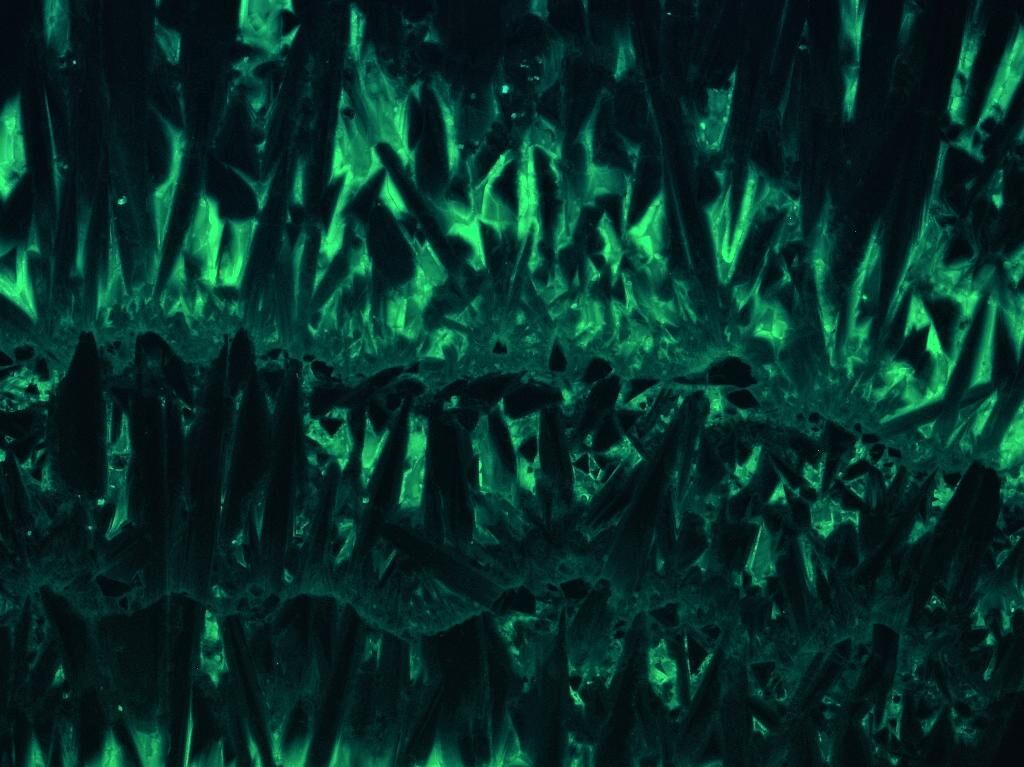
During the last year the effort was concentrated on the analysis of subglacial calcites from Elephant Moraine and Boggs Valley at the microscopic micro to nano-scale. This means that we could even see the atoms in the crystals. The importance is that these samples may shed light on both volcanism and ice loss during warming. We found that the subglacial calcites from Elephant Moraine and Boggs Valley formed from different fluids, with the Elephant Moraine's being rich in amorphous silica.This, and evidence from epifluorescence microscopy (photo 13081-2n2fluo), which shows the presence of organic molecules, supports the hypothesis that bacteria may have greatly contributed in the formation of the Elephant Moraine crusts. That is, there have been microbial colonies living under the ice in the Trans Antarctic Mountains (TAM) region at least for the last 500,000 years. This is the oldest age we obtained for the crusts to date. The Boggs Valley samples are younger and do not provide evidence for a direct influence of microbes in their formation. Rather, they simply document the presence of rich subglacial microbial associations in the TAM region. We also carried out stable isotope ratios analyses of the crusts, which confirm that they formed under the ice from glacial meltwater. Minuscule fluid Inclusions trapped in the crusts yielded contradictory data for the temperature at which the crusts formed, with ranges from 27 degrees C to 100 degrees C.
Summary of the season 2019/20
The project has started late, as I finally received the agreement and established project number from my Research Office in February.
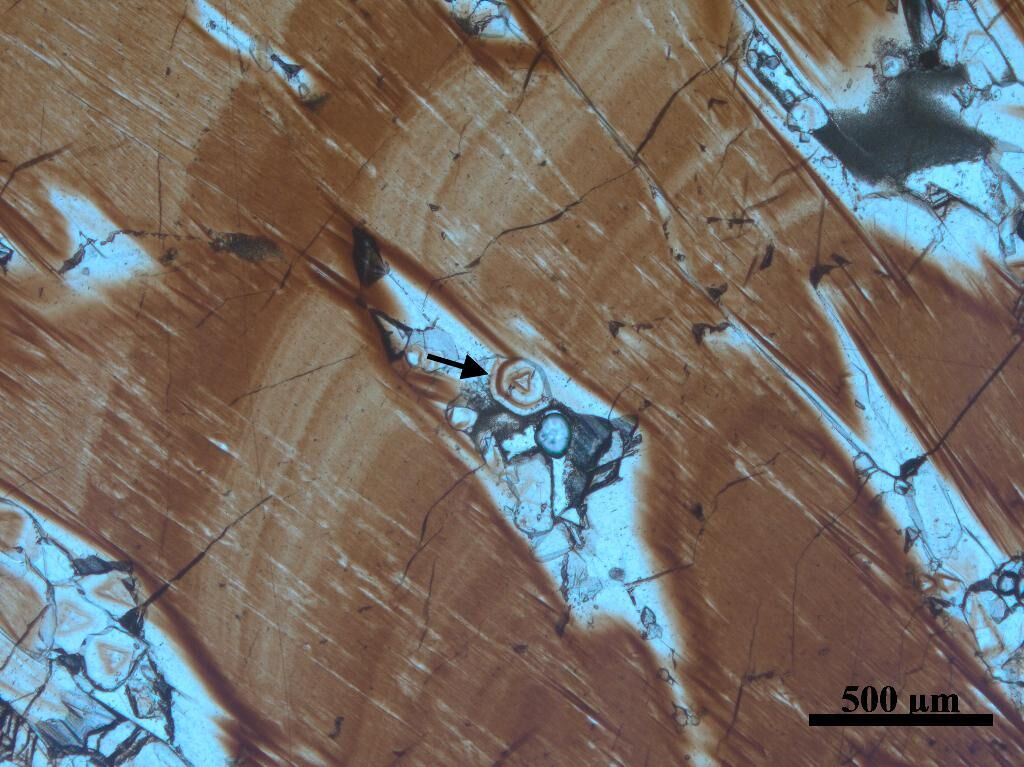
Despite this delay, we started to work on the Elephant Moraine samples (obtained from the archive of the late Prof. G. Faure. These samples were interpreted by Faure et al. (1988) as having precipitated from "aqueous solutions discharged by hydrothermal springs under the East Antarctic Ice Sheet". The calcites (CaCO3) have very negative C isotope ratio signal, which was interpreted as the C originating from coal seams in the bedrock. Our new data obtained by optical, epi-fluorescence, cathodoluminescence and microprobe analyses reveal that crystal have a "spherulitic" growth, which means that they formed in disequilibrium with the aqueous solution. Thus, the isotope data need to be interpreted with a pinch of salt in mind. First of all, the calcite crystals are associated with abundant silica spherulites (cryptocrystalline) which is strongly indicative of microbial processes. Second, the dark portion of the crystals did not yield fluorescence when excited by blue light, which indicates that the dark coloration is due to inorganic material, for example inclusions containing iron or manganese, rather than organic (coal). By contrast, the light-coloured calcite yields fluorescence and, critically, this light part shows calcite with a spherulitic habit. All these data suggesting microbial processes, and, specifically, methanogenesis. Chemical analyses further highlighted the presence of P, Cl and Si, which also suggests the influence of volcanism. The next step is TEM investigation of crystal growth and then a test for DNA extraction.