
Project information
Project aim
Ice cores provide valuable records of past climatic and environmental variability and change. The chemical and isotopic composition of ice and entrapped air bubbles are widely used to reconstruct past climatic conditions and to infer past changes in snowfall, temperature, atmospheric composition, and climate system processes. This project will use existing and recently collected ice cores from East Antarctica to continue the development of new ice core records and climate reconstructions, to explore climate processes and to improve the calibrations and interpretations used in ice core studies. These climate reconstructions include temperature, sea ice extent, volcanic activity, snowfall and Australian rainfall. The project will also engage the climate modelling and ice sheet modelling communities, providing critical information for the evaluation of the models used to predict future climate variability and change.


Project milestones
Summary of the project achievements 2022/23
This project has utilised and analysed ice core material and data from East Antarctic sites to further develop new records and climate reconstructions that explores climate processes and improves the calibration and interpretations used in ice core studies. The project has delivered high resolution East Antarctic climate records using archived ice cores from the Australian Antarctic program; has used high resolution ice core records in conjunction with meteorological records to further calibrate ice core data and validate reanalysis data; has used ice core records from Law Dome, Dome Summit South (DSS), and other data sources to evaluate the use of long-term observational and paleo-proxy reconstructions to improve model projections of Antarctic climate; has contributed to reconstructions of regional, continental and hemispheric climate (e.g. temperature, snow accumulation); used high resolution ice core records to explore, quantify and determine the natural variability of climate processes and climate modes (e.g. rainfall and streamflow reconstructions for Eastern Australia); and has continued to use ice core records to improve the understanding of teleconnections between Antarctic and Australian climate.
The Australian Antarctic Program ice core archive played an important and critical role to facilitate external collaborative use of this material with national and international researchers to further develop new and improved analytical capabilities in the determination and validation of ice core records.
Summary of the season 2022/23
This project aims to use existing and recently collected ice cores from East Antarctica to produce new ice core records and climate reconstructions; to explore climate processes; to improve the calibrations and interpretations used in ice core studies; and to use ice core records in conjunction with other Antarctic ice core proxy data to derive syntheses of regional, continental and hemispheric climate variability.
Progress for the last year includes:
- The Law Dome, Dome Summit South (DSS) sea salt concentration record was compared and correlated with eastern Australian rainfall to show there is a clear alignment with dry and wet periods over eastern Australian.
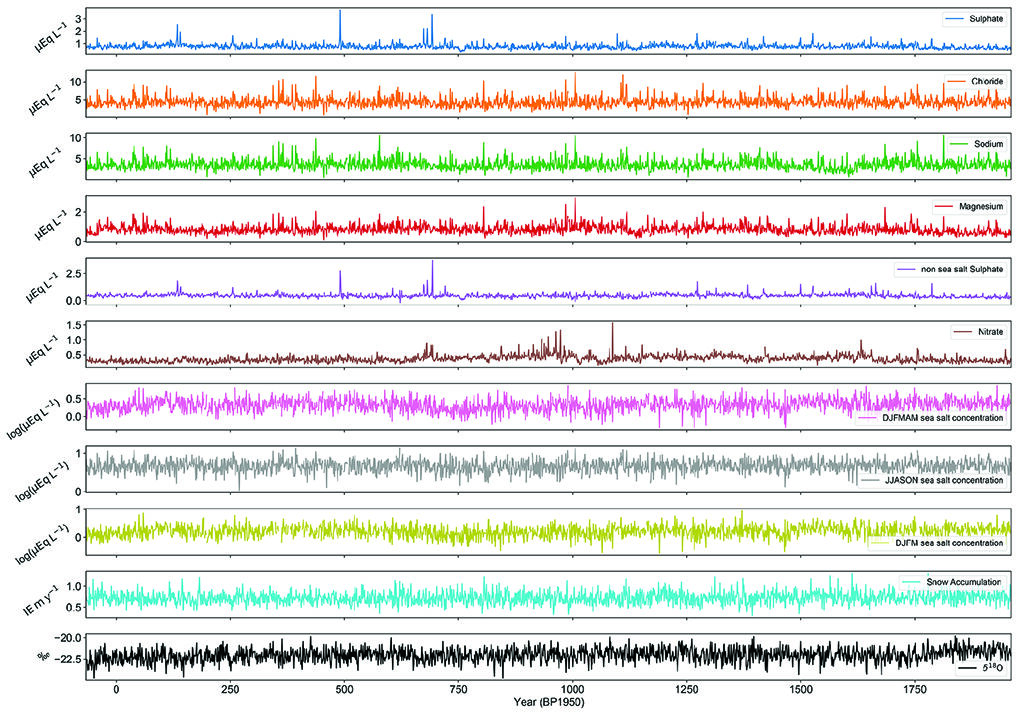
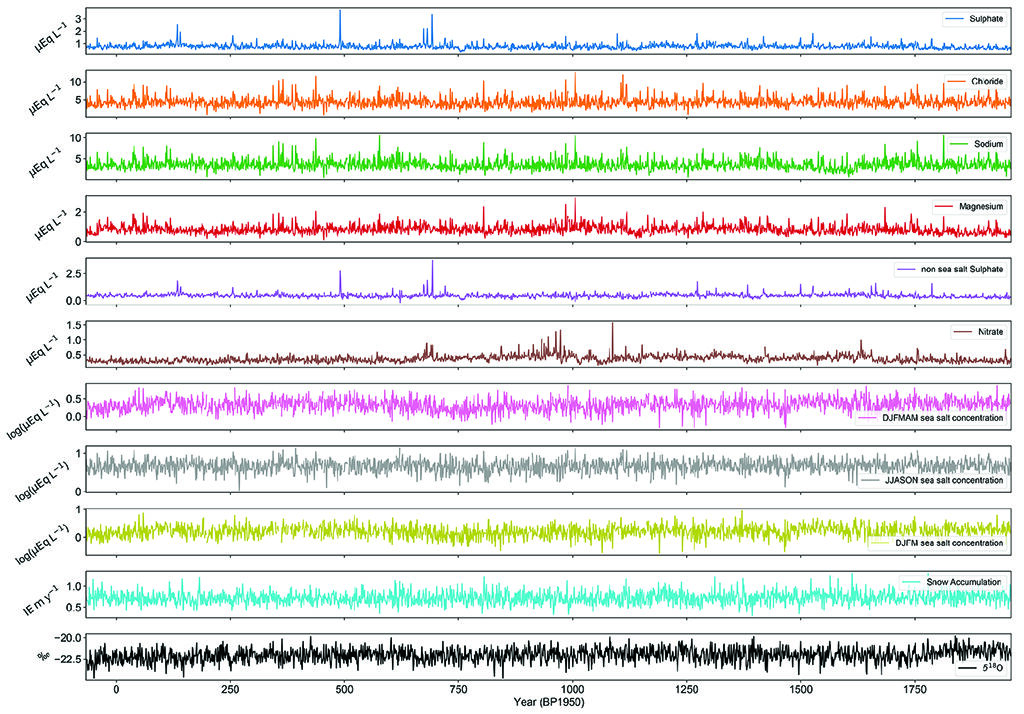
- Publication of 2000 years of annual ice core data from Law Dome, DSS, where ice core chemical and physical measurements update and extend the previously published DSS ice core record with improved and extended annual dating.
- The identification of enhanced deposition of atmospheric soluble iron by the intrusions of marine air masses to East Antarctica.
- To demonstrate nitrate isotopes in ice cores, offers a new way to track past and present changes in Antarctic snowfall and ice sheet mass balance.
- Temperature reconstructions from water isotopes and borehole temperature plus gas isotopes from the same ice core at Aurora Basin North, provides substantially different climate histories for the past 2000 years.
- A future reduction in the size of calcifying phytoplankton in response to environmental changes between Holocene and modern Subantarctic Southern Ocean will have a negative impact on the efficiency of the biological pump through a reduction of carbonate ballasting.
- Submission and delivery of data sets and data products as part of the data management plan for this project.
The Australian Antarctic Program ice core archive also continues to play an important role to facilitate external collaborative use of previously collected ice cores with national and international researchers where the development of new and improved analytical capabilities further enables the determination and validation of ice core records. For example, ice core samples are being used to investigate increased atmospheric production of cosmogenic radionuclides in ice core records at Law Dome; and ice core material from Law Dome, and Aurora Basin North, are being used to add new information, and to validate high-resolution records of atmospheric CO2 and carbon isotopes of CO2 with the aim of constraining the Common Era carbon cycle-climate feedback.
Summary of the season 2021/22
This project aims to use existing and recently collected ice cores from East Antarctica to produce new ice core records and climate reconstructions; to explore climate processes; to improve the calibrations and interpretations used in ice core studies; and to use ice core records in conjunction with other Antarctic ice core proxy data to derive syntheses of regional, continental and hemispheric climate variability.
Progress in this latest reporting period includes:
- The updated Law Dome, Dome Summit South ice cores have been used to compare sea salt concentrations with the recently drilled Mount Brown South ice core to further explore the signal of the El Niño–Southern Oscillation; to extend the snow accumulation record and derive a 2000 year rainfall reconstruction for South West Western Australia; and to enable a comparison of 150 years of observations of the Interdecadal Pacific Oscillation, and to reconstruct a 2000 year IPO index from Antarctic ice core records.
Summary of the season 2020/21
This project aims to use existing and recently collected ice cores from East Antarctica to produce new ice core records and climate reconstructions; to explore climate processes; to improve the calibrations and interpretations used in ice core studies; and to use ice core records in conjunction with other Antarctic ice core proxy data to derive syntheses of regional, continental and hemispheric climate variability.
Progress in this latest reporting period includes:
- The extension of the snow accumulation record at Law Dome to cover the past ~2,000 years, and a derived rainfall reconstruction for South Western Australia over this extended period; a new ice core record from Aurora Basin North that shows specific conditions associated with large snowfall events on East Antarctic Plateau cause a bias in temperature during snow precipitation; and ice core records continue to be used to improve the understanding of teleconnections between Antarctic and Australian climate.
- Our international work through the PAGES2k working group (Iso2k) has published the Iso2k database, a global compilation of previously published datasets from a variety of natural archives that record the isotopic compositions of environmental waters, which reflect hydroclimate changes over the past 2,000 years
The Australian Antarctic Program ice core archive continues to play an important role in the development of new analytical capabilities. For example, new analytical techniques are being applied to ice core samples to better understand if past sea ice and ocean productivity changes can be determined from ice core records.
Summary of the season 2019/20
The project continues to utilise and analyse ice core material from East Antarctic sites for calibration studies of ice core proxies against meteorological records and climate indices.
Our work through the PAGES2k working groups (Clivash2k and Iso2k) continues to contribute towards syntheses of regional, continental and hemispheric climate studies. This includes the Iso2k database, a global compilation of previously published datasets from a variety of natural archives that records the stable oxygen or hydrogen isotopic composition of environmental waters, to reflect hydroclimate changes over the Common Era.
East Antarctic climate records continue to be utilised to explore, quantify and determine natural variability of key climate processes. This includes the use of ice core records from Law Dome, and other data sources to evaluate the use of long-term observational and paleo-proxy reconstructions to improve model projections of Antarctic climate. Ice core records from Aurora Basin North show that specific conditions associated with large snowfall events on East Antarctic Plateau cause a bias in temperature during precipitation and that water stable isotopes in snow record atmospheric conditions during precipitation.
Climate evolution studies continue to improve our understanding of the dynamics of recent glacial cycles, carbon cycle changes on glacial-interglacial timescales and the impacts on the climate system. This includes a reconstruction of 25,000 years of South Ocean carbon chemistry, using microfossils buried in sediments, to show sub-Antarctic waters played a key role in regulating atmospheric carbon dioxide since the Last Glacial Maximum. Our group also contributed to some of the analysis of ice cores, recovered from Patriot Hills in West Antarctica to show early Last Interglacial ocean warming drove substantial ice mass loss from Antarctica, and that sea-ice feedbacks enhanced regional Southern Ocean carbon sink at the Antarctic Cold Reversal.