
Project information
Project aim
Large igneous provinces (LIPs) are formed from massive outpourings of lava in geologically short periods of time (1 to 5 million years). As a result, they are at times associated with extinctions of life on Earth. The Kerguelen LIP, one of Earth’s largest, formed over a much longer geological period than other LIPs, over at least 25 million years. During this time, the volume of magma erupted and intruded could cover Australia in 250-metre-thick lava flows. Despite its enormous volume, the Kerguelen LIP did not result in a mass extinction. This project investigates how processes deep within Earth’s interior interacted with surface motions to form the Kerguelen LIP. The project combines geoscientific data with open-source software to link the deep Earth with surface geological processes. The intended outcome is to provide a clearer understanding of how the internal workings of our planet drive and interact with the Earth’s crust, and how these interactions have impacted life on Earth.
Project milestones
Summary of the project achievements 2020/21
Large igneous provinces are formed from massive outpouring of lava in geologically short periods of time (1 to 5 million years). Due to their significant emissions of greenhouse gases in the atmosphere, they are at times associated with drastic climate crisis and ultimately, the partial extinctions of life on Earth. The Kerguelen province, one of Earth's largest, seems to formed over relatively longer geological period than other LIPs based on sporadic age data, and was thought to be unrelated to any mass extinction or environmental perturbation events.
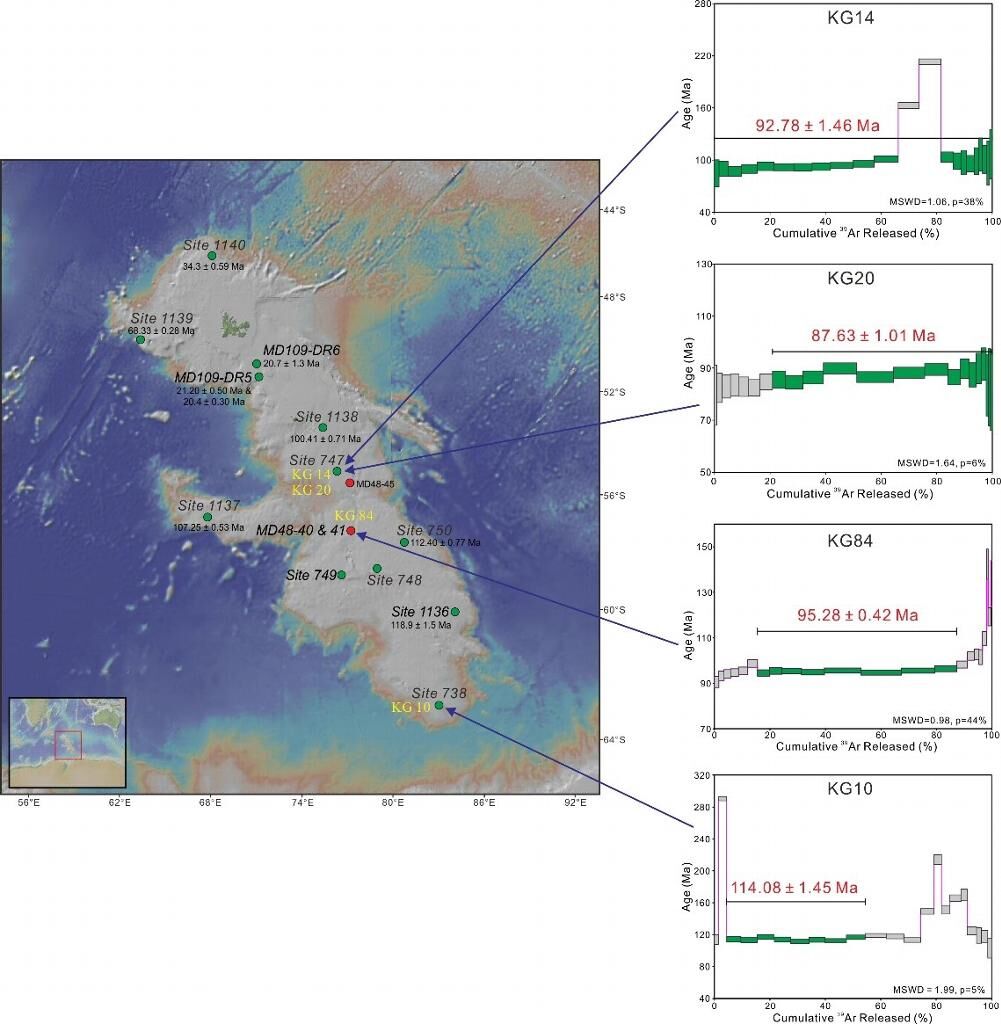
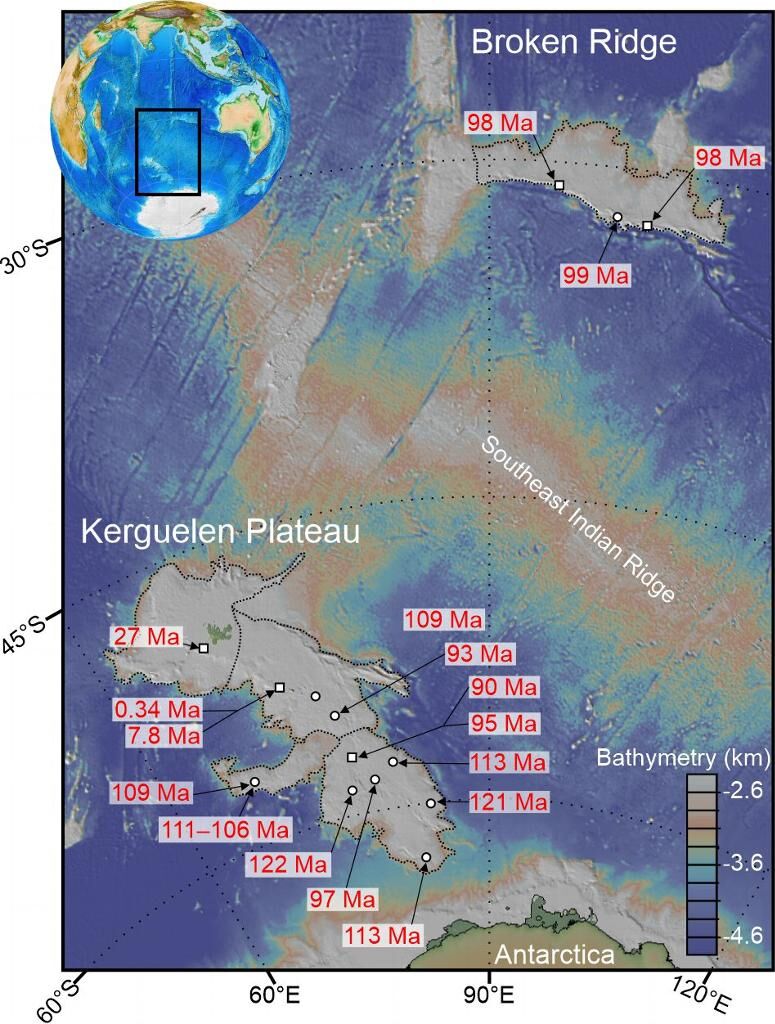
Based on our 40Ar/39Ar ages and geochemical results along with plate reconstructions models, we showed that Kerguelen province was the world's most continuously active, erupting for 38 million years, and fuelled by a constantly moving 'conveyor belt' of magma. We proposed that this conveyor belt was due to long-term mantle plume and mid-ocean ridge interactions helped by by several ridge jumps.
In addition, we calculated the total amount and releasing rate of CO2 associated with the eruptions of the Kerguelen province and compare them with values from extinction-causing large volcanic provinces. We proposed that the lack of obvious environmental consequences associated with the Kerguelen province was because of its low-volume and slow CO2 emissions. Importantly, the severity of environmental perturbations associated with greenhouse gases emissions is controlled by the volume of these emissions, along with the rate at which they are emitted.This demonstrates the critical importance of reducing and slowing down CO2 emissions in preventing disastrous environmental crises.
Summary of the season 2018/19
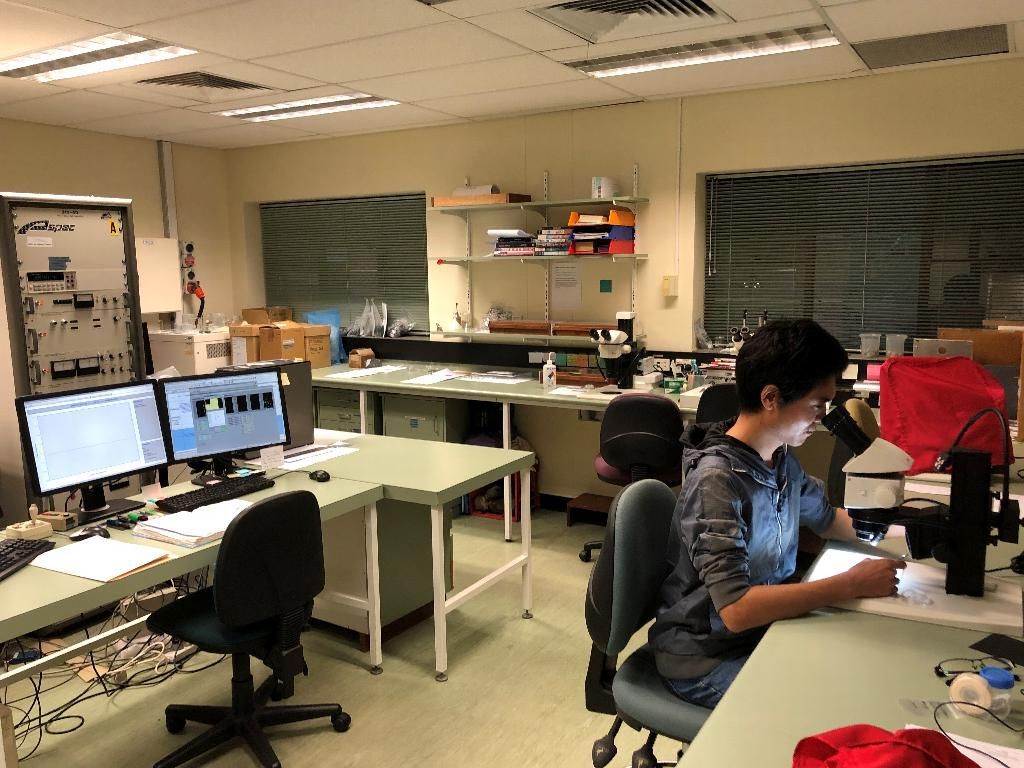
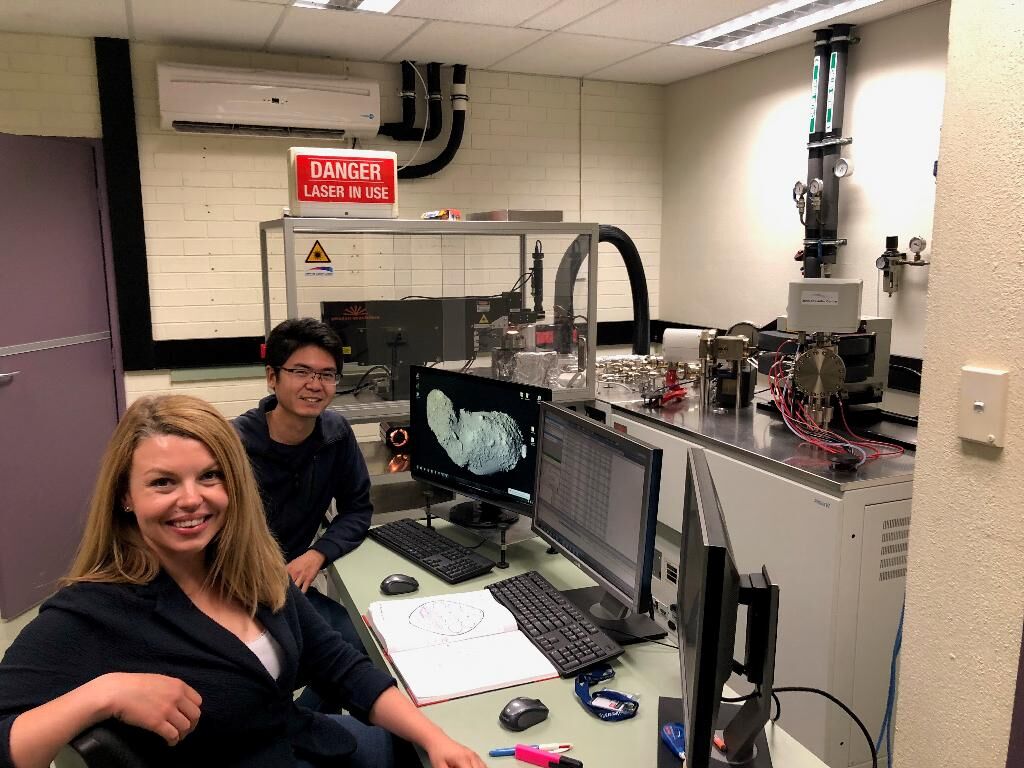
For the last year, we have prepared 90 samples from the Kerguelen Plateau, Broken Ridge and Ninety East Ridge for 40Ar/39Ar geochronology dating. Preliminary 40Ar/39Ar geochronology analyses using the latest state-of-the-art instrumentation at the Western Australian Argon Isotope Facility have revealed some unexpected relatively young ages of ~95–90 Ma for the Southern and Central Kerguelen Plateau. The 40Ar/39Ar geochronology work will be finished in two months and will then give us a full picture of how the Kerguelen Plateau was built up chronologically by the Kerguelen mantle plume. In addition to the geochronological work, we have analysed the Sr, Nd and Pb isotopic compositions of nine basalt samples from the Kerguelen large volcanic province. These new geochemical and geochronological data indicate a lack of role for Kerguelen mantle plume in the breakup of the ancient supercontinent Gondwana. The results were recently published in the top earth science journal — Earth and Planetary Science Letters.
Summary of the season 2017/18
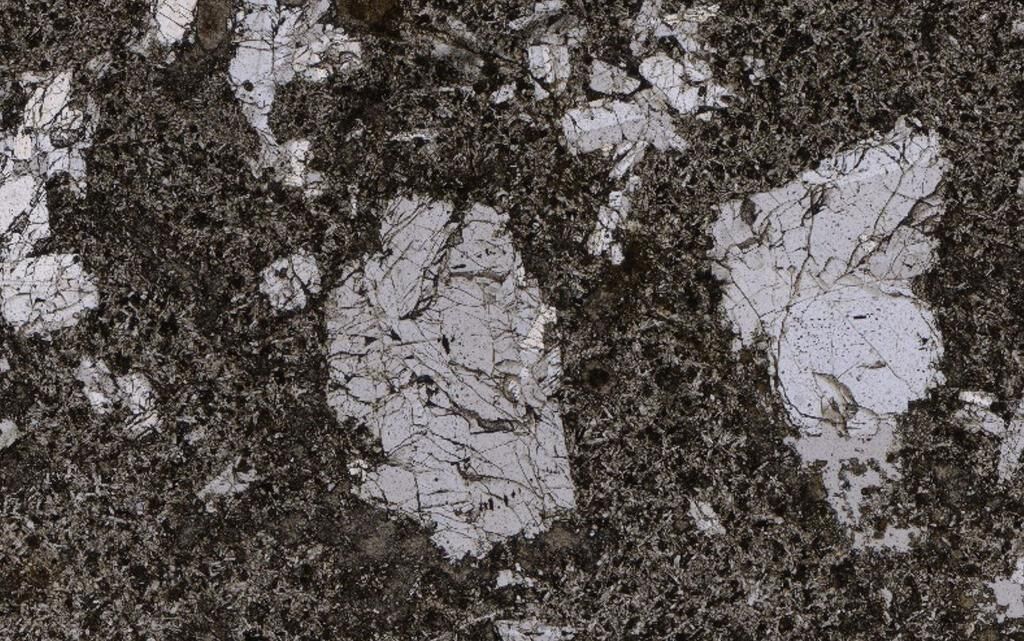
This is a three-year project and our team started working on the project in September 2017. To help us in our task, we have recruited a PhD student whose thesis focuses on a better understanding of sub-Antarctic volcanism. We obtained more than 120 samples from the Kerguelen large volcanic province sourced from collections from the Japanese IODP repository and Paris French museum. Those samples were all obtained several years to tens of years ago by various ODP or dredging cruises. Around 110 thin sections have been made on most of these samples which allowed us to observed fine details of the rocks under the microscope. Based on our observations, we have selected and have conducted sample preparation on a total of (1) 22 preliminary samples fresh enough for age determination and (2) 9 preliminary samples for isotopic analyses. We will send the 22 samples for neutron irradiation early June for expected argon age analyses during the second half of 2018. We have sent the samples for Sr-Nd and Pb geochemical isotopic analyses early April and expect the results during mid-2018. We are anticipating that those initial results will represent the foundation of this project and greatly help us prioritize subsequent samples.