
Project information
Project aim
Melting of grounded ice mass in the Arctic and Antarctic may play a key role in future global sea level rise and Earth's climate system. The Antarctic Ice Sheet is losing ice at an increasing rate, primarily due to ocean-driven melting beneath ice shelves. The physics of these ocean-ice interactions is poorly understood which, along with limited observation constraints, leads to uncertainties in the predictions of future melt rate. We will undertake cutting edge direct numerical simulations to examine the complex dynamics of melting of ice-shelves in the presence of convection and turbulence. The project will provide the knowledge base for improved representation of these Antarctic processes in future global ocean models from which more accurate projections of future climate and sea level will follow.
Project milestones
Summary of the project achievements 2018/19
The Antarctic Ice Sheet loses more than half its mass through ocean-driven melting of its fringing ice shelves. However, the ocean processes governing ice shelf melting are not well understood, contributing to uncertainty in projections of Antarctica's contribution to global sea levels. In this project, we have undertaken cutting edge direct numerical and large eddy simulations to examine the complex dynamics of the melting of ice-shelves in the presence of convection and turbulence. The present study has developed a simple functional relationship that precisely estimates the melting due to various ambient conditions commonly present in many locations beneath the Antarctic ice shelves. Results also show that resolving small scale processes, including convection, is crucial and plays an important role in an accurate description of melting dynamics and the prediction of net mass loss from Antarctica. Computational model code and simulated output data have been publicly available for further scientific investigation. These will further help in developing better global ocean models for more accurate projections of future climate and sea levels.
Summary of the season 2017/18
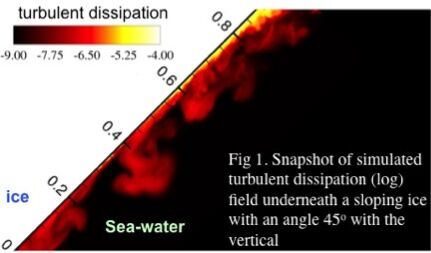
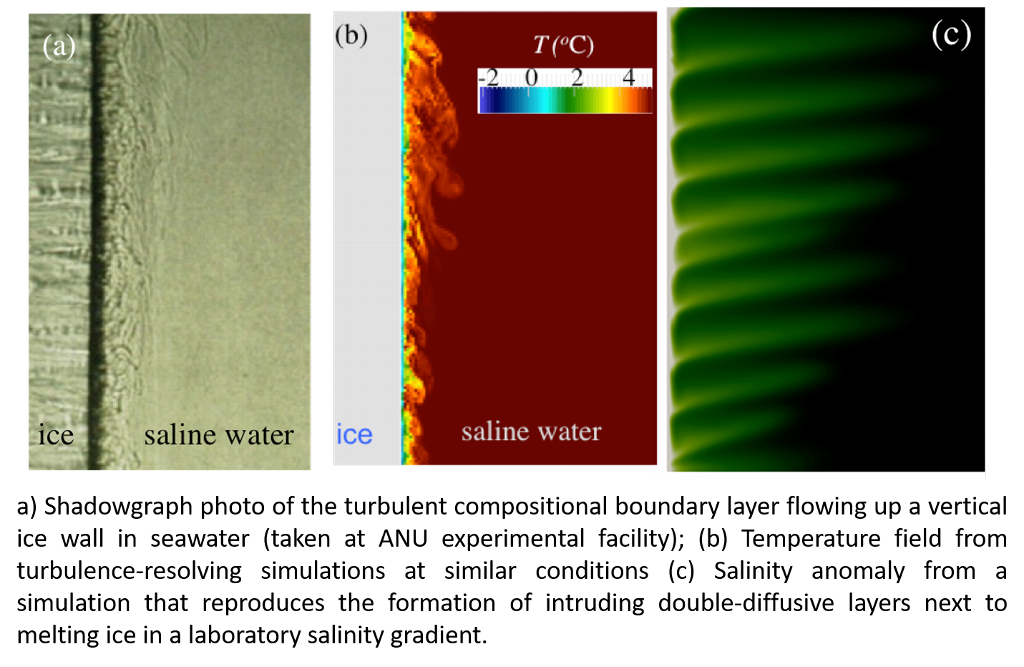
Most of the ice-shelves in Antarctica slope forward into the ocean, forming an ice cavity underneath. Around Antarctica the turbulent transport of salt and heat into the ice interface melts the ice and drives a convective plume adjacent to the ice wall. Along with the turbulent plume, there are additional flows caused by tides and sub-meso scale eddies. In 2017 we completed a series of simulations designed to understand the parameter dependence of melting rate at sloping ice faces beneath Antarctic ice shelves, including both natural convection and ambient currents.
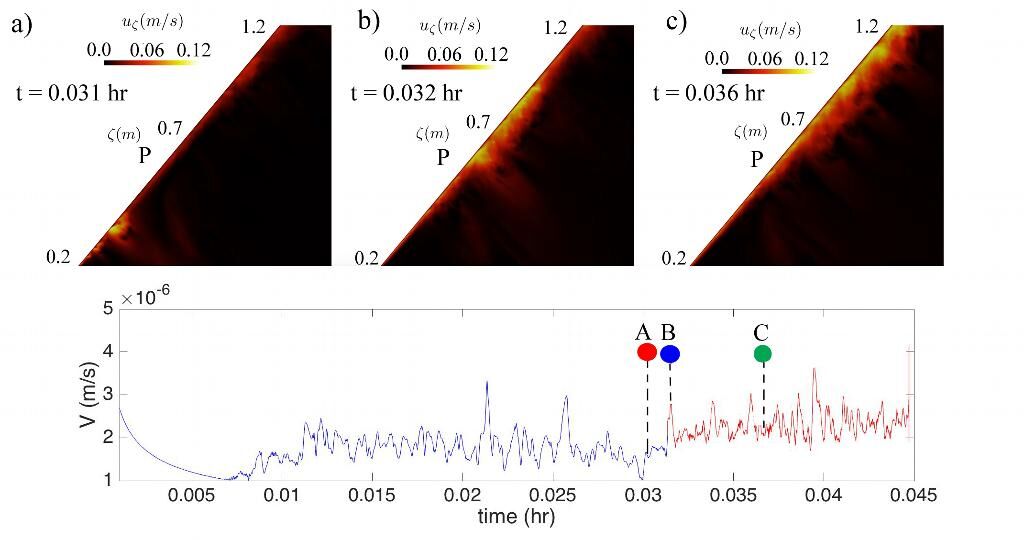
In first phase, we examined the effects of the slope of an ice-seawater interface on the mechanisms and rate of ablation of the ice by natural convection, using turbulence resolving simulations. Solutions are obtained for ice slopes, at fixed ambient salinity and temperature. When the boundary layer is laminar, dissolution-rate varies along the slope-length, which decreases in the upslope direction. Dissolution rate is independent of the upslope direction when the boundary layer becomes turbulent. The release of fresh water develops stratification under the sloping ice-face, which further suppresses turbulent eddies and heat transport hence melt rate.
We also carried out a suite of simulations of a sloping ice face with imposed mean horizontal currents in the far field, parallel to the ice face. We varied the magnitude of the far field current between 0 and 2.0 cm/s, with seawater conditions bracketing those in Antarctic seas. The simulated melt rate was found to be insensitive to the far field current when current strength is low to moderate (less than 0.75cm/s) and the boundary layer flow is still convection dominated. At stronger velocities the effects of convection become negligible and melt rate linearly follows the strength of the flow. The results are an important step toward understanding what controls the melting rate of icesheets around Antarctica.