
Project information
Project aim
Sea ice is a crucial component within the Earth System engaging in numerous ocean-cryosphere-atmosphere processes with wide-ranging impact, i.e., affecting the Southern Ocean [SO] marine ecosystem. To explore the mechanisms driving a regionally variable sea-ice response to external forcing, circum-Antarctic satellite-derived ice properties, including data from the soon-to-be-launched ICESat2, will be co-analysed with atmospheric and oceanic observations and reanalysis data. We will obtain regional scale sustained East Antarctic ice characteristics from a ship-based ice radar as well as in situ data in two SO sectors with contrasting ice regimes. Together these will yield local and near-field information for detailed evaluation of the observed sea-ice changes, such as the overall expanding winter ice extent. This project will enhance our observational capability developing an autonomous systems, which yield data to enable future projections of Antarctic sea ice within the Earth System.
Project milestones
Summary of the project achievements 2018/19
Sea ice is a critical component of Earth System, engaging across a range of polar ocean processes, including the albedo feedback, which drives the largest seasonal change at the surface of Earth, or oceanic biogeochemical cycles. Sea ice responds to external drivers, such as atmospheric forcing and oceanic current, tides or waves, and is also governed by its physical characteristics, such as thickness or concentration, which have profound effect on its mechanical response. The presence of sea ice modifies the complex interactions at the ocean-atmosphere interface, including the energy-, moisture- and particle exchange. The polar sea-ice cover is often covered with snow, which interferes with the ice properties and has a profound effect on numerous processes. An improved understanding of the sea ice as a climate component across a range of scales is required to deliver into satellite-data calibration and analysis, climate science, numerical modelling and forecasting.
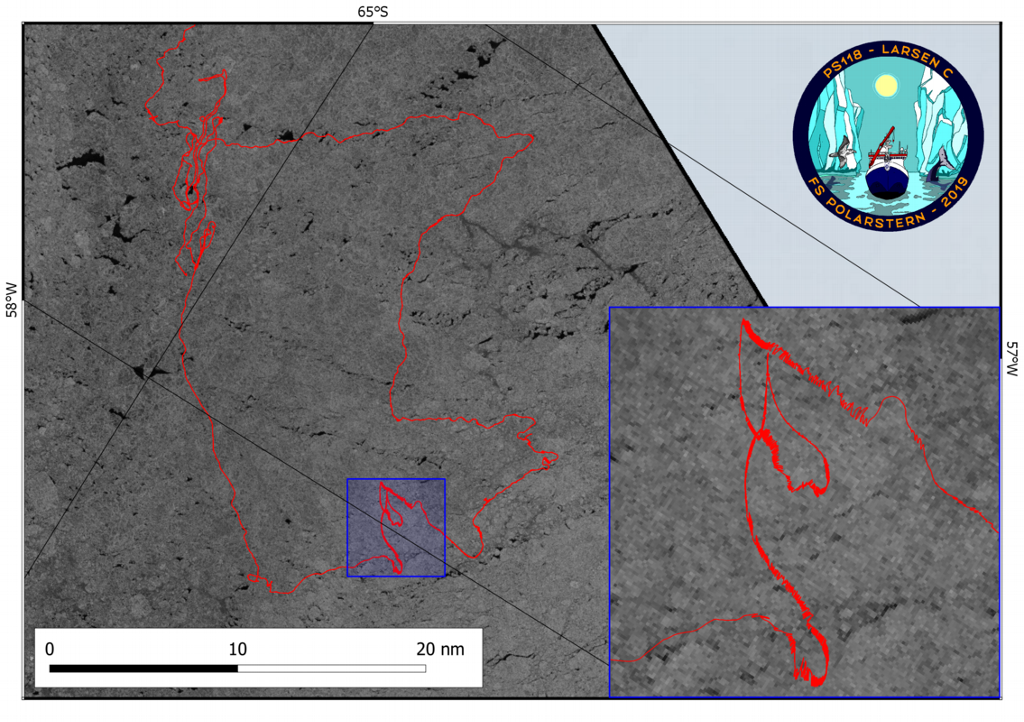
Previously the project team secured logistics support, including support of their "SeaWe(e)d" study on AWI's RV Polarstern voyage PS118 into the Western Weddell Sea during February to April 2019. Our team contributed to the German-led science voyage and delivered into international research programmes, ASPeCt and IPAB. Data from instruments deployed under SeaWe(e)d and previous voyages have been used together with a range of satellite-derived data to assess the physical sea-ice properties across spatial scales. Main limitations to the project are space observational coverage, both from in situ and remote sensing instruments. Nevertheless, progress has been made to deliver against the objectives of our project. Results from this research have 1) revealed the regional sensitivity of the error characteristics of certain sea-ice and snow parameters, knowledge of which is crucial to derive robust relationships between ice and snow properties; 2) obtained in situ ice thickness and freeboard information for the validation of ICESat2 data; and 3) identified typical length-scale dependencies of the dynamic sea-ice response.