
Project information
Project aim
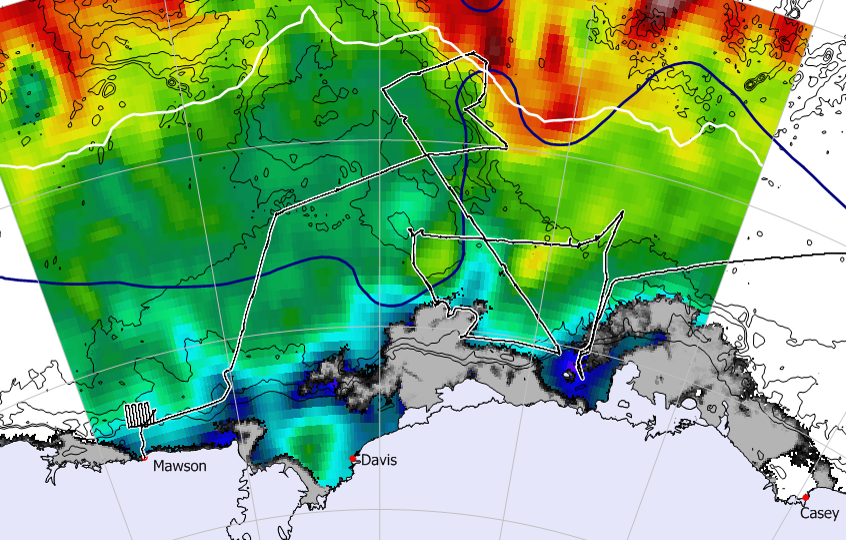
The Southern Ocean is one of the most rapidly changing environments on earth. Australia seeks to sustain marine resources of high fisheries and conservation value that are dependent on the productive ecosystems of the Kerguelen Axis (including Australia’s Territory of Heard Island and McDonald Islands south to the Antarctic continent). The Kerguelen Axis has never been surveyed as a single region to determine the critical relationships between environmental and biogeochemical drivers responsible for the transition between the northern copepod-fish dominated foodweb to the southern krill-based foodweb. This knowledge is essential for ecosystem-based management of fisheries, as well as conservation of whale populations and marine biodiversity. The results will be important for assessing likely responses to change in the ecosystem (from climate or fisheries) as well as change in the global oceans and carbon cycle, which are fundamental to the Earth’s response to climate change.
Project milestones
Summary of the project achievements 2017/18
The Kerguelen Axis voyage was undertaken in January to February 2016. A major outcome of this voyage has been the first whole-of-pelagic-ecosystem view for East Antarctica, including quantitative assessments of the primary components of the physico-chemical environment, phytoplankton-zooplankton assemblages, and the relative importance of Antarctic krill and mesopelagic fish in mid-trophic levels. These data have assisted the construction of food web models, indicating the relative importance of different energy pathways (krill, copepods-mesopelagic fish, or salps). As a result, a clearer assessment of the state of the marine ecosystem in this region will be available. This project found large swarms of krill further north than the boundary previously thought to constrain the bulk of the krill population. It also found that mesopelagic fish are an important component of the food web in this region, substantially overlapping with Antarctic krill in their distribution. The relationships of the dominant taxa with their physical environment are able to be used in ecosystem models to assess future changes in the ecosystem in this region. Highlights of the study have been to assess (i) the productivity potential of Antarctic krill and how this may affect krill predators and fisheries, (ii) the role of salps as competitors with Antarctic krill, and their potential importance in carbon storage, and (iii) the life history and dynamics of pteropods, which are considered to be vulnerable to ocean acidification.
Summary of the season 2016/17
The marine science program for the Kerguelen Axis, promoted as K-axis (http://k-axis.voyage/), was successfully undertaken in January to March 2016. The voyage was successful in most of its objectives. Sample processing is nearing completion and manuscripts are in progress, aiming for manuscripts to be submitted by the end of 2017 for inclusion in a special issue in Deep Sea Research II. Two more workshops have been undertaken with another being planned for the second half of 2017. There are no foreseeable impediments to completing the work as planned in the project description.
Summary of the season 2015/16
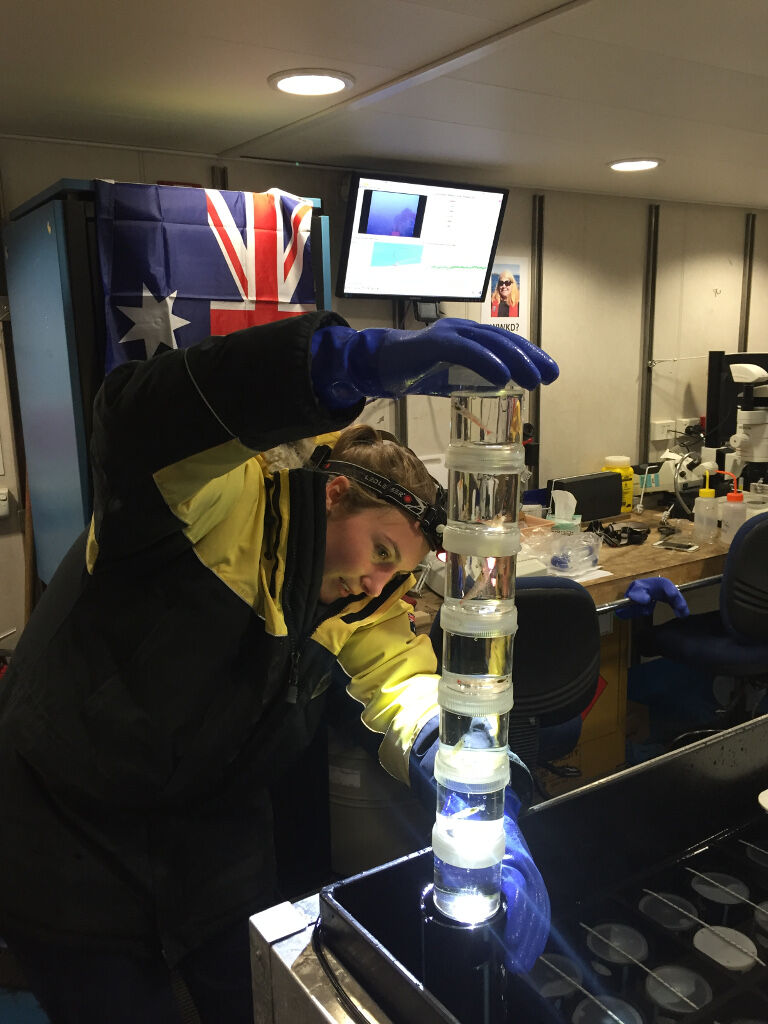
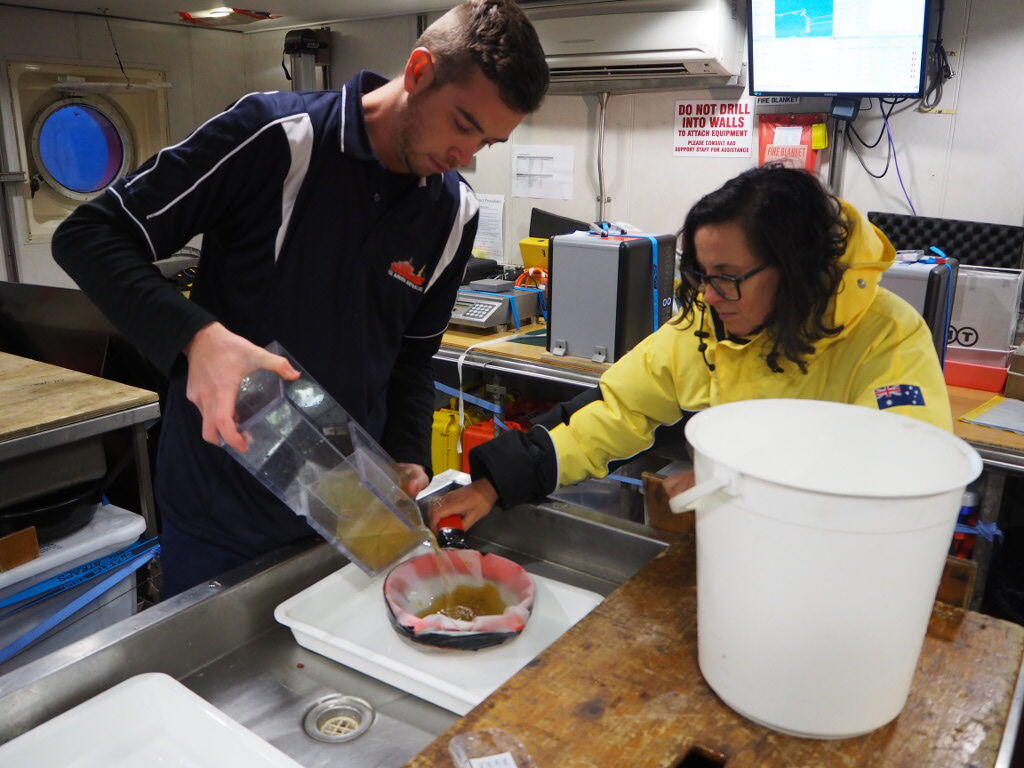
The marine science program for the Kerguelen Axis, promoted as K-axis (http://k-axis.voyage/), was successfully undertaken in January to March 2016 as a collaboration between many partners, including AAD, CSIRO, IMAS, ACE CRC, and the Gateway Partnership. 30 days of marine science yielded considerable data on habitats, phytoplankton, zooplankton, krill, and fish and squid. Habitat data included oceanographic, nutrient and trace metal (iron) observations. The voyage was successful in characterising the distribution of Antarctic krill and its relationship to key habitat variables. It also showed that mesopelagic fish (important prey of many seals, toothed whales and flying birds) are found throughout the region rather than being restricted to the areas beyond the northern distribution of krill. The region is likely to be more productive than originally thought. The international collaboration to measure status and trends of the ecosystem in the Indian Sector as a whole was successful in coordinating activities across 6 vessels in the 2015-2016 season - the Aurora Australis and Investigator (Australia), the Hakuho Maru and Umitaka Maru (Japan), Marion Dufresne (France) and Roger Revelle (USA). The first workshop to coordinate data analysis and synthesis has been undertaken. A voyage report is being finalised and will be published on the internet. There are no foreseeable impediments to completing the work as planned in the project description. Extensive video and photographs are being compiled as a photo record. Video footage by A. Constable was provided and used by the media after the voyage.
Related publications
-
Productivity and Change in Fish and Squid in the Southern Ocean Frontiers in Ecology and Evolution, 2021
(Ref: 16781)
Category 1: Peer-reviewed literature
-
A globally distributed Syndiniales parasite dominates the Southern Ocean micro-eukaryote community near the sea-ice edge ISME journal, 2019
(Ref: 16279)
Category 1: Peer-reviewed literature
-
Antarctic krill are reservoirs for distinct Southern Ocean microbial communities. Frontiers in Microbiology, 2019
(Ref: 16214)
Category 1: Peer-reviewed literature
-
A globally distributed Syndiniales parasite dominates the Southern Ocean micro-eukaryote community near the sea-ice edge The ISME Journal, 2018
(Ref: 16216)
Category 1: Peer-reviewed literature
-
Sustained Upwelling of Subsurface Iron Supplies Seasonally Persistent Phytoplankton Blooms Around the Southern Kerguelen Plateau, Southern Ocean Journal of Geophysical Research: Oceans, 2018
(Ref: 16006)
Authors:Category 1: Peer-reviewed literature