
Project information
Project aim
The fishery for Antarctic krill is managed by the Commission for the Conservation of Antarctic Marine Living Resources (CCAMLR) which takes an ecosystem approach. CCAMLR is developing a feedback management strategy for the krill fishery which will require the collection of information from the CCAMLR Ecosystem Monitoring Program (CEMP), from the fishery and from scientific krill surveys. Predator-performance at CEMP sites in the Atlantic sector have been linked to krill-availability but not in east Antarctica due to lack of data on krill at the right spatiotemporal scales. A cost effective long-term krill survey program is essential to monitor changes in the krill population at the scale relevant to the ongoing CEMP predator monitoring. We plan to develop and implement an integrated predator-prey monitoring program will also ensure Australia can fulfil future CCAMLR requirements.
Project milestones
Summary of the project achievements 2018/19
The fishery for Antarctic krill is managed by the Commission for the Conservation of Antarctic Marine Living Resources (CCAMLR), which takes an ecosystem approach to setting catch limits. CCAMLR is developing a feedback management strategy for the krill fishery; this will require the collection of information from the CCAMLR Ecosystem Monitoring Program (CEMP), from the fishery and from scientific krill surveys. Krill predator-performance at CEMP sites have been linked to krill-availability in the Atlantic sector but not in east Antarctica, due to lack of data on krill at the right spatiotemporal scales. A cost effective long-term krill survey program is essential to monitor changes in the krill population at the scale relevant to the ongoing CEMP predator monitoring.
In 2016 the Australian Government released the Australian Antarctic Strategy which commits to establishing both a comprehensive policy and scientific research program within the AAT and the waters off the AAT to ensure the sustainable management of the Southern Ocean krill fishery by 2021.
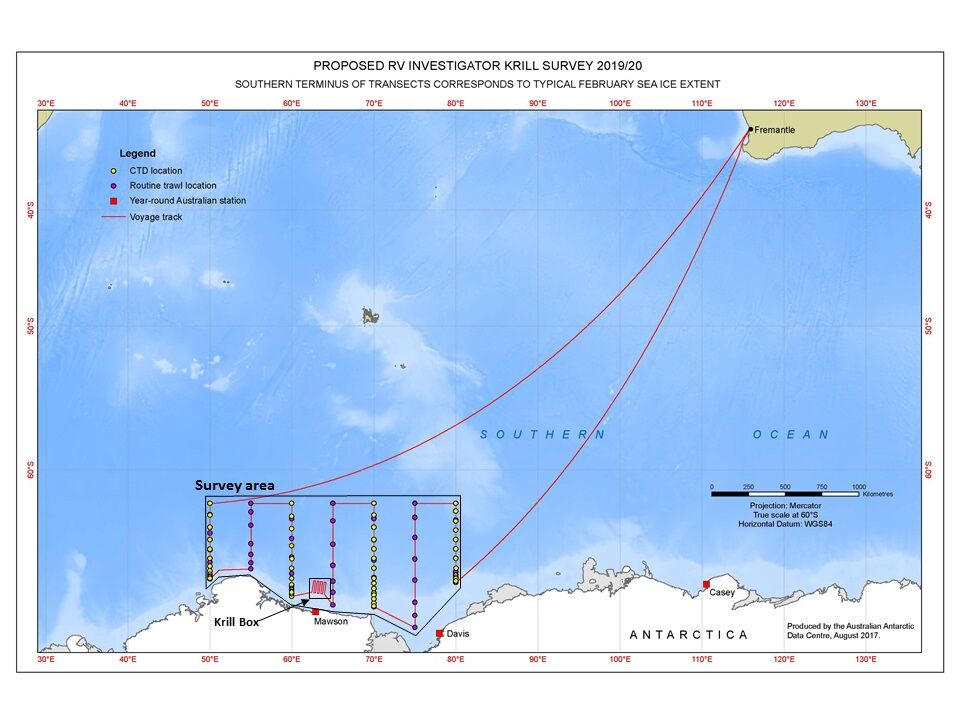
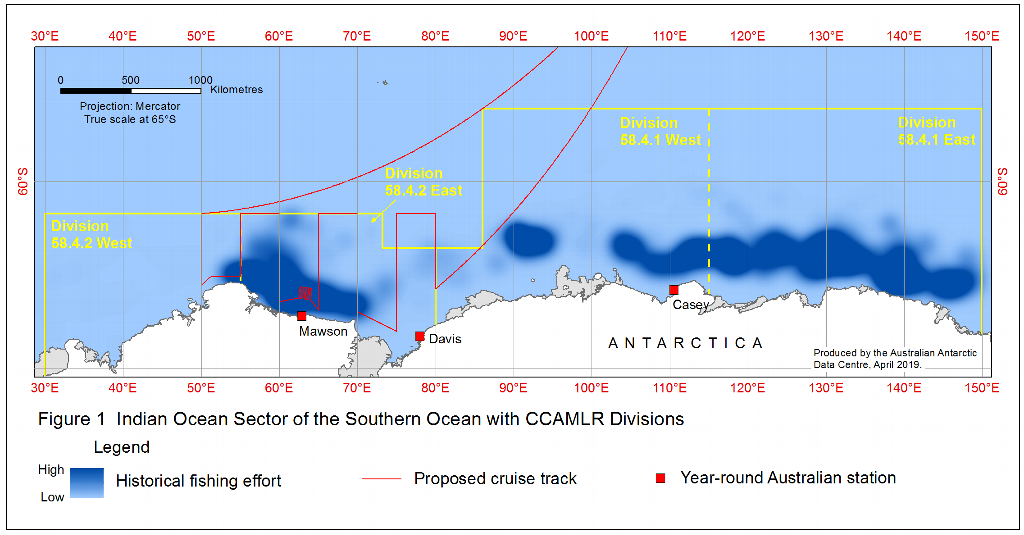
Our project successfully designed a ship-based acoustic line-transect survey for 2021 to estimate krill biomass coupled with observations of krill dependent species (i.e. seabirds and marine mammals) to understand interaction between predator and krill biomass distribution.
This will also ensure that Australia can fulfil future CCAMLR requirements.
Summary of the season 2017/18
The fishery for Antarctic krill is managed by the Commission for the Conservation of Antarctic Marine Living Resources (CCAMLR). CCAMLR takes an ecosystem approach and is developing a feedback management strategy for the krill fishery which will require the collection of information from the CCAMLR Ecosystem Monitoring Program (CEMP), from the fishery and from scientific krill surveys. Predator-performance at CEMP sites in the Atlantic sector have been linked to krill-availability but not in east Antarctica due to lack of data on krill at the right spatiotemporal scales. A cost effective long-term krill survey program is essential to monitor changes in the krill population at the scale relevant to the ongoing CEMP predator monitoring. We plan to develop and implement an integrated predator-prey monitoring program that will also ensure Australia can fullfil future CCAMLR requirements.
Summary of the season 2016/17
The fishery for Antarctic krill is managed by the Commission for the Conservation of Antarctic Marine Living Resources (CCAMLR) which takes an ecosystem approach. CCAMLR is developing a feedback management strategy for the krill fishery which will require the collection of information from the CCAMLR Ecosystem Monitoring Program (CEMP), from the fishery and from scientific krill surveys. Predator-performance at CEMP sites in the Atlantic sector have been linked to krill-availability but not in east Antarctica due to lack of data on krill at the right spatiotemporal scales. A cost effective long-term krill survey program is essential to monitor changes in the krill population at the scale relevant to the ongoing CEMP predator monitoring. We plan to develop and implement an integrated predator-prey monitoring program will also ensure Australia can fulfil future CCAMLR requirements. This year we are currently in progress of pursuing risk assessment for krill fishery to support designing ecosystem monitoring in the region.
Summary of the season 2015/16
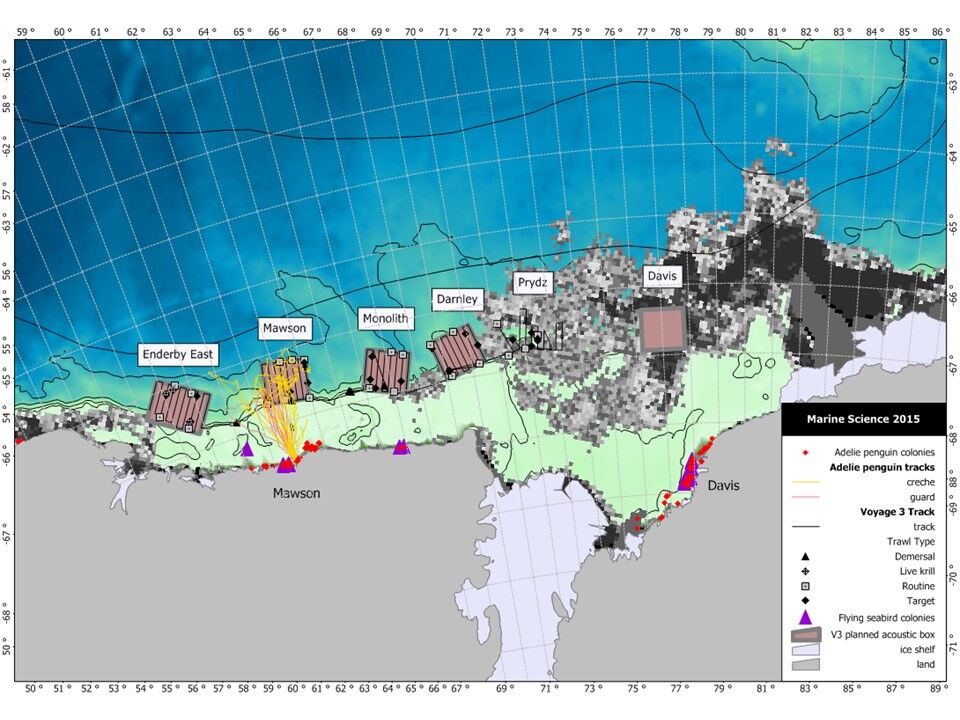
The fishery for Antarctic krill is managed by the Commission for the Conservation of Antarctic Marine Living Resources (CCAMLR) which takes an ecosystem approach. CCAMLR is developing a feedback management strategy for the krill fishery which will require the collection of information from the CCAMLR Ecosystem Monitoring Program (CEMP), from the fishery and from scientific krill surveys. Predator-performance at CEMP sites in the Atlantic sector have been linked to krill-availability but not in east Antarctica due to lack of data on krill at the right spatiotemporal scales. A cost effective long-term krill survey program is essential to monitor changes in the krill population at the scale relevant to the ongoing CEMP predator monitoring. We plan to develop and implement an integrated predator-prey monitoring program will also ensure Australia can fulfil future CCAMLR requirements. This year we successfully conducted an acoustic survey to collect prey distribution data off Mawson station .