
Project information
Project aim
The rocks comprising the Windmill Islands and Bunger Hills form part of a vast but now largely unexposed system that runs through the formerly contiguous Antarctic-Australian continent. Both regions occupy critical locations in this system, and determining the characteristics of the tectonic events they record forms essential information for understanding how the Antarctic-Australian continental system formed. This project will determine this information and use it to improve models explaining the evolution of Antarctica-Australia and the ancient supercontinents they once belonged to.
Project milestones
Summary of the project achievements 2014/15
The aim of this project is to understand tectonic and thermal development of the Australian-Antarctic supercontinental system. Of central importance is the formation of Musgrave-Albany Fraser Orogenic Belt, which transects Australia and continues into Wilkes Land (Windmill Islands and Bunger Hills).
Project aims were:
(1) Obtain U-Pb and Lu-Hf-O analysis of detrital zircons in rocks of sedimentary origin. Lu-Hf-O analysis of zircon is a powerful tool that allows deep insights into crustal-mantle interactions and the geodynamic regime.
(2) Determine zircon Lu-Hf-O isotopic character of the magmatic rocks to constrain the mode of crustal growth.
(3) Determine the thermal evolution. Current data suggests metamorphism occurred c. 1300-1150 million years ago. However the thermal evolution is poorly constrained and thermodynamic modelling combined with modern geochronology will allow us to determine the geodynamic setting of metamorphism.
During this project we have:
1) Collected an extensive detrital and magmatic zircon Lu-Hf dataset that shows that crust in Windmill-Bunger system was generated largely by reworking of late Archaean (c. 2700 Ma) crust combined with additions of new material from the mantle. This dataset now means that the tectonic development of the basement rocks in Wilkes Land can be directly equated with the in the Albany Fraser Province in Australia.
2) Undertaken extensive analysis of the thermal history of the Windmill Islands and Bunger Hills domains. The Windmill Islands underwent high temperature metamorphism and deformation at 1300 Ma and again at 1150 Ma. Both of these events involved very high geothermal gradients. In the Bunger Hills, rocks underwent high grade metamorphism at 1150 Ma, characterised by a PT evolution reminiscent of continental collision. The event timing is similar to the events recorded in the Albany Fraser Province in Australia.
Summary of the season 2013/14
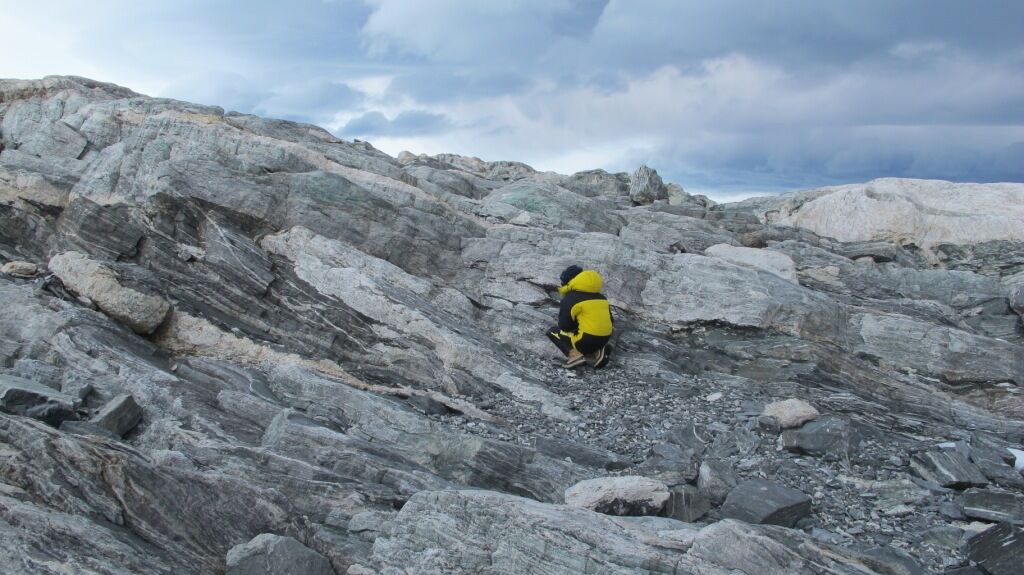
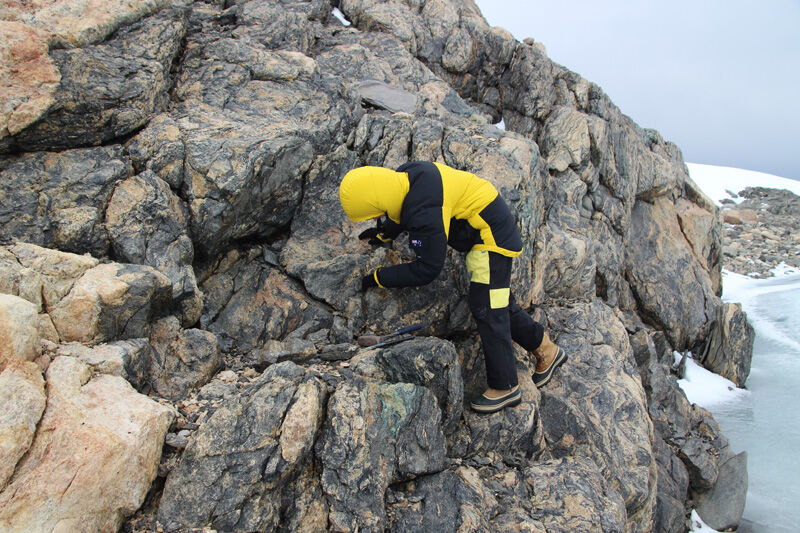
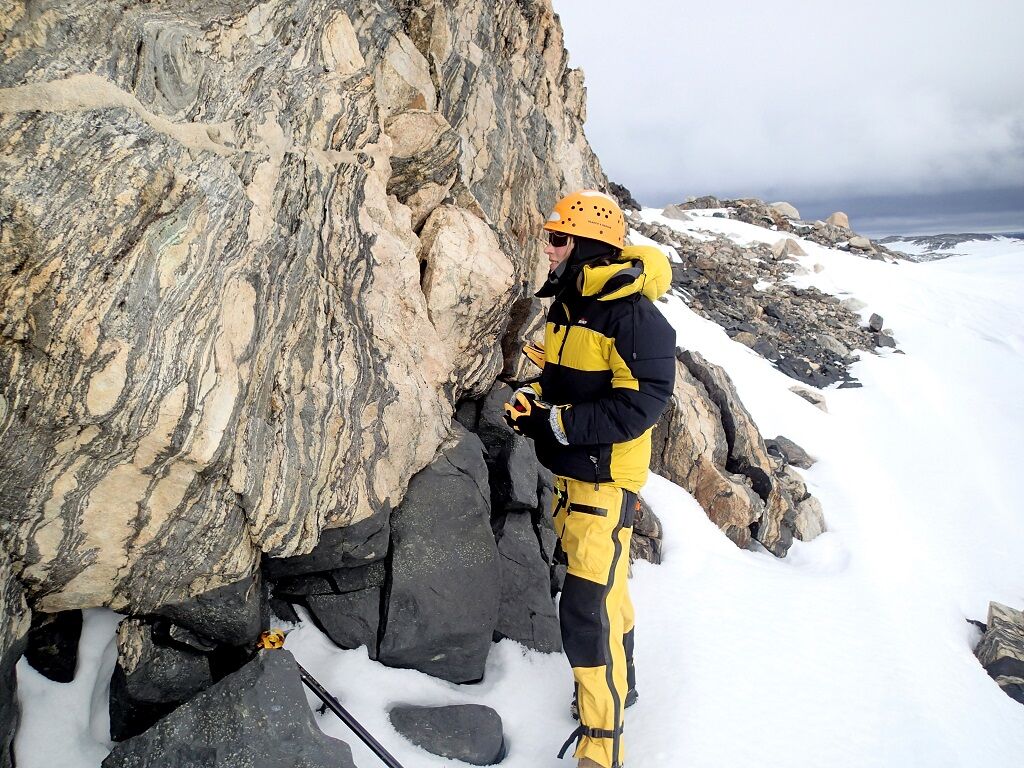
Fieldwork was undertaken in the Windmill Islands in January 2014. Samples were collected from a north-south transect of islands and peninsulas. These samples were selected to represent the change in metamorphic grade from north to south. Samples were also collected from the moraines in the northern and southern ends of the field area. The rocks in the moraines are used to give an insight into the geology of the inland, ice covered areas of Wilkes Land. The majority of samples are metamorphosed sediments, which have sensitive chemical compositions and therefore best record the pressures and temperatures of metamorphism.
So far, in situ monazite geochronology geochronology has been done on 8 metamorphosed sediments from the islands and moraines. Geochemistry has been collected from these samples and will be used to quanitfy the pressures and temperatures of metamorphism for each sample. Zircon geochronology has been done on 6 samples of metamorphosed sediment and granite from the islands.