
Project information
Project aim
The purpose is to study events that foster good team "processes" (collaboration, cohesion, interaction processes) and team effectiveness. Most research has been cross-sectional, where a set of measures is collected at a single time point along with team process and effectiveness ratings. In contrast to this "snapshot," we view team processes and effectiveness as highly dynamic with peaks and valleys. We want to understand factors that cause teams to experience effectiveness highs and lows and how team members cope with long duration missions in isolated, confined, and extreme environments.


Project milestones
Summary of the project achievements 2016/17
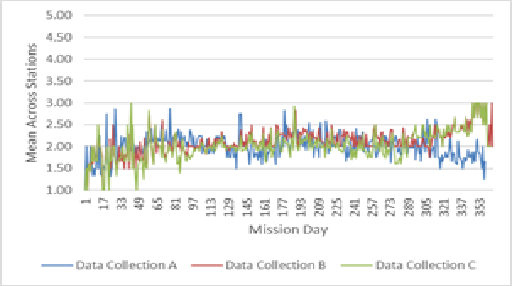
Over the course of four AAD seasons we collected data from 154 different individuals, and 7956 daily reports of various aspects of team functioning. This data will provide invaluable insights regarding several important research questions on the development of teams over time, team composition and leadership.
Important initial findings center on the relationships of individual personality traits with perceptions of team functioning. We found evidence that high levels of neuroticism and low levels of agreeableness are related to lower perceived team functioning (such as lowered cohesion and increased conflict) and performance. Furthermore, stations differ in the distribution of personality traits such that Station A appears to have had more neurotic and less agreeable individuals over the course of our data collection, which may account for the lower performance of this station relative to B and C.
Personality and individual perceptions of experiences and team functioning may be related to critical personal outcomes, such as the experience of depressive symptoms. This points to the importance of team social experiences for the support of team and individual level outcomes. Additionally, conflict negatively affects cohesion from day to do, but conflict management improves it in a way which may allow AAD leadership to influence team functioning. We also analyzed qualitative reflections from participants on their experiences. These reports generally corroborate the importance of participant social lives for their well-being. They also emphasize the effects of AAD leadership on on their experiences.
Based on our findings, we made some recommendations to the AAD: (1) use personality measures as part of the selection process for expeditioners, (2) use those measures to assist in assigning members to teams, (3) foster strong social climates within stations, (4) build trust between AAD leadership and team members, and (5) seek ways to support expeditioner personal health.
Summary of the season 2015/16
Thirty-one individuals completed daily surveys throughout their expeditions. These 31 individuals lived at four Antarctic stations. All results discussed in this report have been aggregated across stations to ensure anonymity. Our findings from the data collection effort show that there are positive, autoregressive effects between team processes from one day to the next. For instance, when a team performed well on the previous day, it was likely that they performed well the next day. We found this finding for performance, team cohesion, social conflict, task conflict, conflict management, negative affect, and positive affect. In addition, we found relationships between different team processes. For instance, social conflict and task conflict were positively related such that if social conflict existed the previous day, it was likely that task conflict would be present the next day (and vice-versa). In addition, we found that social conflict the previous day was positively related to conflict management the next day. Thus, when social conflict was high the previous day, expeditioners likely engaged in conflict management the next day to resolve the conflict. It was also found that conflict management the previous day was negatively related to social conflict the next day. Thus, it appears that engaging in conflict management played a beneficial role in reducing social (and thereby task) conflict in the team. The findings about conflict management are useful given that social conflict the previous day was also negatively related to cohesion the next day. In turn, cohesion the previous day was negatively related to task conflict the next day. Altogether, these findings show that task conflict feeds into social conflict and social conflict can, in turn, hurt team functioning by negatively impacting cohesion. Conflict management can negatively impact social conflict and break the cycle, thereby improving the likelihood of positive team functioning in extreme teams.
Summary of the season 2014/15
We collected data from 26 individuals who were stationed in the Antarctic for 9-15 months. From the 2,333 daily surveys from these individuals we present four key findings. First, we found that individuals have different dynamic patterns that fit into four categories: rock solid, uni-varier, multi-varier, or stabilizer. Individuals with a rock solid pattern do not vary in their responses to most of the questions over time. Individuals who are uni-variers primarily vary on one variable. Individuals who are multi-variers vary daily in their responses, either because they perceive more variability in the environment or because they are more impacted by external factors in the environment. Individuals who are stabilizers initially vary in many variables, but then maintain a stable equilibrium. Second, we found that most of the variance in team processes is at the individual or day level, which suggests that individuals may not be working closely as a team. We find that this is often true of the station teams ? many individuals work in isolation from each other because their occupations are diverse. Third, we found two reciprocal relationships between team process variables. Team cohesion and performance were positively related to one another suggesting that increases in team cohesion can positively impact team performance. Individual positive affect and team conflict were found to be negatively related to one another. This suggests that positive affect can buffer conflict. but that team conflict can also decrease positive affect from one day to the next. Fourth, we found direct relationships between team process variables. We found that prior conflict management was positively related to later team cohesion. This finding suggests that teams engaging in conflict management felt more cohesive the next day, but that being cohesive may not mean conflict management will occur. In addition, we found that prior positive affect was negatively related to later negative affect.
Summary of the season 2013/14
We collected data from 26 individuals who were stationed in the Antarctic for 12 months. Through the 2,365 daily surveys from these individuals we present three key findings. First, shared or collaborative work gives teams the opportunity to perform better. Throughout the AAD mission, team members tended to rate performance low when they were working alone or had no work to perform. By providing more opportunities for shared work, team members may be able to build social ties and friendships and feel like their work is more rewarding. Furthermore, such work may provide a buffer against the isolation they experience in the Antarctic. Second, the data also revealed that training team members about how to better improve their team processes can not only increase performance, but also their satisfaction with the AAD experience. Given that conflict in particular fluctuated over time in two of the three teams, a program that facilitates conversation with regard to how to handle conflict that are both personal and task oriented in nature may assist in lowering the amount of conflict experienced during the missions. Third, with respect to personality factors, the data showed that teams with higher average Conscientiousness and higher average Emotional Stability had more stable cohesion and performance ratings. This suggests that selecting individuals who are more Conscientious (i.e., detail oriented, organized and dependable) and less neurotic (i.e., worried, more prone to be stress) may improve team processes and outcomes in future AAD missions. We are continuing to collect data from both long duration and short duration teams to provide additional insight on team processes and outcomes in isolated, confined and extreme environments.
Summary of the season 2012/13
Our research is focused on developing a better understanding of individual and team functioning in isolated, confined, and extreme (ICE) settings like the Antarctic. Although there is much research on team effectiveness, "intensive" longitudinal research that examines human functioning with frequent assessments over long durations is quite limited. Our research is funded by NASA and this portion is conducted in collaboration with AAD medical officers. During the past several months we have surveyed 22 individuals from three of the AAD stations in the Antarctic - Mawson, Casey and Davis. Over 1,000 daily surveys have been completed, providing rich data on the states of cohesion and team effectiveness, among other factors, that will be analyzed to better understand how people adapt to challenging working and living conditions. Data collection is currently in progress and is expected to continue for several more months.