
Project information
Project aim
The Gravity Recovery and Climate Experiment (GRACE) mission is used to "weigh" Antarctica to derive estimates of mass balance changes. Changes in Enderby Land, between Mawson and Syowa, show either significant snow accumulation 2002-2006 that then stopped, then restarted in 2009 or ongoing uplift of the bedrock that stopped, then restarted, or a combination of both. GPS heights from 2007 to 2008 showed no significant crustal uplift, but were taken when GRACE shows no change. This project will extend the GPS record to answer definitively whether the GRACE signal is snowfall or long-term uplift.
Project milestones
Summary of the project achievements 2015/16
This project has developed tools to enable the study of mass balance change and ice dynamics of the ice sheet in the region of Enderby Land and further south. The original aim was to assimilate data from a space gravity mission, GRACE, with uplift rates from long-term installations of remote, solar-powered GPS equipment, and ice height changes from satellite altimetry. Unfortunately, for logistical reasons the GPS fieldwork was not undertaken, leaving a major component of the project incomplete.
To overcome this setback, we modified the project to focus on developing a new method for estimating ice dynamics (the change in amount of glacial ice through ice flows from the continent versus the increase in ice through compaction of snow) from two different satellite mission data. We found good agreement between the two approaches, providing confidence that a) the approach for estimating ice dynamics is valid and reproduceable, and b) that there is a loss of glacial ice of ~0.1-0.2 m/yr around the coastline of Enderby Land, whereas the inland region is essentially in equilibrium.
Summary of the season 2014/15
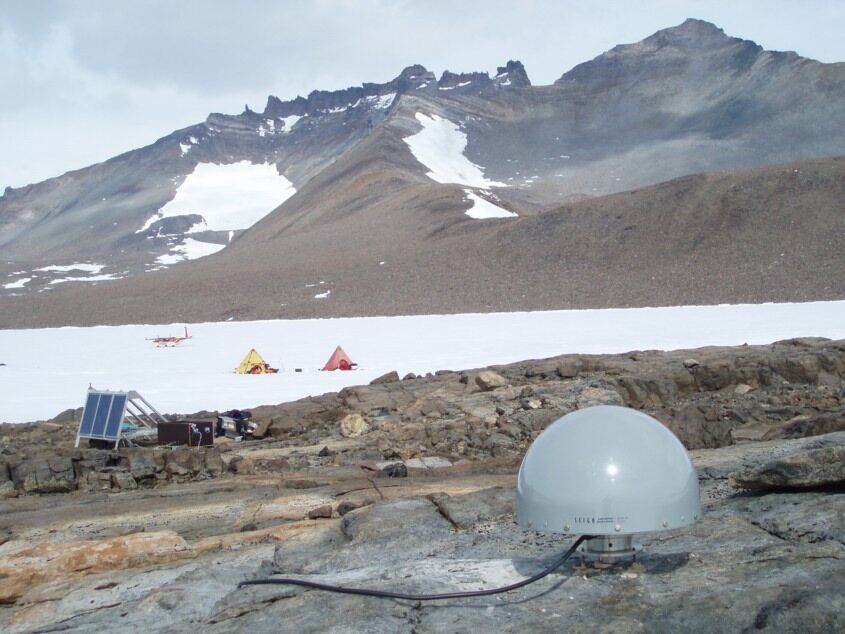
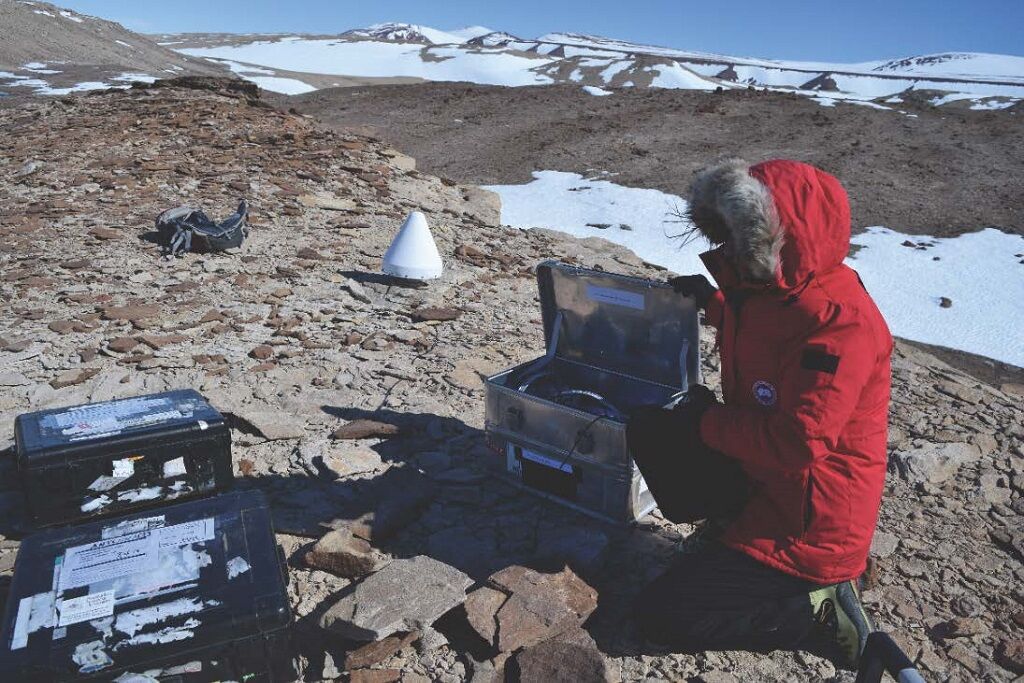
The field programme did not progress as planned. The AAD fixed-wing aircraft were unable to find suitable landing sites at either Richardson Lake or at our proposed new site inland and south of this location. Therefore, our field party were unable to go into the remote field regions to install the autonomous systems. Instead, they revisited Beaver Lake and Landing Bluff (but were unable to get to Dalton Corner), and GPS observations were made at these two sites using the existing antenna mounts from our previous project. The equipment was subsequently retrieved and 1-2 weeks of data were recorded.
After our field party left Antarctica, AAD staff managed to access Richardson Lake (Enderby Land) using helicopters from Mawson. Our GPS equipment was installed and operated there for 10 days and was then removed.
Summary of the season 2013/14
The Gravity Recovery and Climate Experiment (GRACE) mission is used to "weigh" Antarctica to derive estimates of mass balance changes. Changes in Enderby Land, between Mawson and Syowa, show either significant snow accumulation in 2002-2006 that then stopped, then restarted in 2009 or ongoing uplift of the bedrock that stopped,, then restarted, or a combination of both. GPS heights from 2007-2008 showed no significant crustal uplift, but were taken when GRACE observations show no change. This project will extend the GPS record to aswer definitively whether the GRACE signal is snowfall, indicating increased accumulation in this region, or long-term uplift, indicating that a correction needs to be made to the change in "weight" derived from the GRACE observations.