
Project information
Project aim
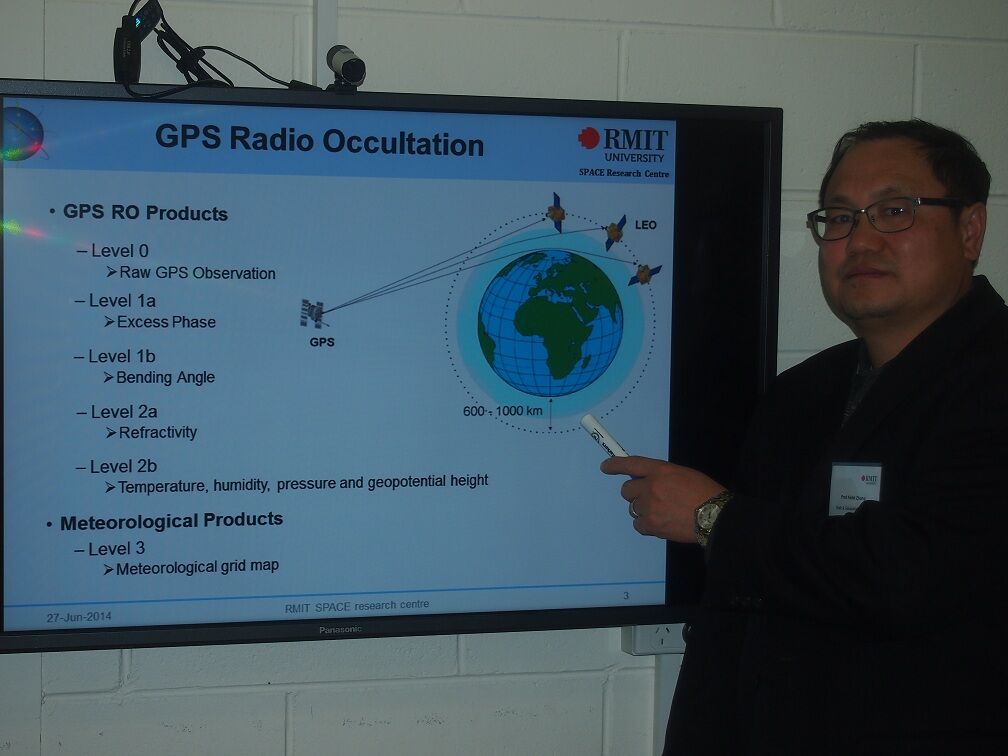
This study will utilise the technique of Radio Occultation (RO), where electromagnetic signals are refracted as they pass through the Earth’s atmosphere, to study the physical properties of the Antarctic atmosphere. Signals from GPS to Low Earth Orbit (LEO) satellites will be monitored as they pass through the atmosphere to reveal important atmospheric properties such as temperature, pressure, refractivity and relative humidity. This information will be used in a feasibility study into the use of RO for meteorological and climate analyses over the Antarctic region.

Project milestones
Summary of the project achievements 2014/15
Global Positioning System (GPS) radio occultation (RO) is a new space-based Earth observation technique, with the potential for atmospheric profiling. New radio occultation algorithms and innovative methodologies for meteorology and climate trend analysis have been developed. Accurate weather and climate information over Antarctica and surrounding oceans is currently restricted by measurement bias and the sparse and heterogeneous distribution of conventional weather forecasting and climate analysis instruments. The outcome of this research is a robust atmospheric sounding platform for meteorological data assimilation that can significantly enhance both weather and climate research.
The necessary algorithms and software for atmospheric profiling using FORMOSAT-3/COSMIC (Constellation Observing System for Meteorology, Ionosphere and Climate) RO data were developed. The software is capable of determining atmospheric profiles of temperature, pressure, water vapour content and refractivity. Software inputs include: Year, day of year, time of day, latitudinal and longitudinal ranges and size of the spatial and temporal buffer when comparing to radiosonde (RS) measurements. Software outputs include: comparisons of RO-RS co-located atmospheric parameters and area weighted grid model average temperature, pressure and water vapour content profiles. Algorithms have been developed to determine tropopause temperature and height from the GPS RO measurements. Climatic trends and the temperature variations over Antarctica and the surrounding oceans have revealed some interesting results and have verified the importance of using the GPS RO monitoring technique in this region.
Summary of the season 2013/14
The first two years of this project have been very productive with the successful completion of milestones 1 to 5 ahead of schedule. The necessary algorithms and software for atmospheric profiling using FORMOSAT-3/COSMIC (Constellation Observing System for Meteorology, Ionosphere and Climate) Radio Occultation (RO) data were developed. The software is capable of determining atmospheric profiles of temperature, pressure, water vapour content and refractivity. Software inputs include: Year, day of year, time of day, latitudinal and longitudinal ranges and size of the spatial and temporal buffer when comparing to radiosonde (RS) measurements. Software outputs include: comparisons of RO-RS co-located atmospheric parameters and area weighted grid model average temperature, pressure, and water vapour content profiles. Algorithms have been developed to determine tropopause temperature and height from the GPS RO measurements. Climatic trends and the temperature variations over Antarctica and the surrounding oceans have revealed some interesting results and have verified the importance of using the GPS RO monitoring technique in this region.