
Project information
Project aim
The project’s goals are to investigate climate change in the Australian region and fire emissions of black carbon over the 20th Century from Antarctic ice core records. This significant new study will exploit Australia’s existing ice core archive and a new analytical facility for black carbon analysis. The ice core data will be used to calibrate ice core black carbon records with respect to Southern Hemisphere fire emissions and atmospheric circulation providing critical data for interpreting past variability and fast-tracking future climate forecasts.
Project milestones
Summary of the project achievements 2015/16
Every year Southern Hemisphere fires and fossil fuel combustion emit large quantities of black carbon nanoparticles (BC) into the atmosphere. The particles absorb sunlight and become hot, heating surrounding air, impacting rainfall and atmospheric circulation. Some of the BC is transported by atmospheric circulation to Antarctica and becomes incorporated into the ice sheet. A primary objective of this project was to investigate the nature of individual BC particles deposited on the ice sheet and their spatial and temporal variability over the past century. The project successfully developed new methods for concentrating BC from Antarctic ice to study single particles at a near - atomic level. The detailed analysis revealed that contrary to assumptions BC particles exist in the atmosphere as individual nanoscopic spheres as well as complex aggregates with metal impurities and insoluble nitrogen rich coatings. These particle characteristics are important for understanding the origin of BC and its climate impact. In addition to BC, the study found microscopic tar balls, which are emitted by biomass burning. Tar balls are a type of brown carbon, which also absorbs sunlight and impacts climate. As far as we are aware this is the first discovery of tar balls in Antarctic ice. Using ice core samples from different ages, the study investigated changes in particle characteristics over the industrial revolution and differences between the East Antarctic and West Antarctic BC deposition. Differences between the two regions revealed new information regarding BC transport into the Antarctic atmosphere and changes in atmospheric circulation.
Summary of the season 2014/15
In the past year, the project made significant advances with regards to the analysis of individual black carbon particles (BC) in Antarctic ice and the development of high-resolution BC time series. These particles are emitted by fires and fossil fuel combustion and impact global climate. They represent a major gap with respect to our understanding of past climate change. As part of the project, Ph.D candidate Aja Ellis conducted the"first" detailed analysis of BC particles preserved in Antarctic ice. This cutting edge research concentrated minute quantities of BC from large volumes Antarctic ice and analysed them at nearly atomic resolution. This study revealed that the particles contain metal impurities and are coated with a nitrogen-rich organic material. The new results have implications for our understanding of how the particles age in the atmosphere, their impact on climate and the fertility of the global ocean. The project is now developing high-resolution BC time series from East Antarctica. Two records have been reconstructed, with a further two ice cores records still to be analysed. Data from the study will be used to determine spatial variability, between East Antarctica and West Antarctica.
Summary of the season 2013/14
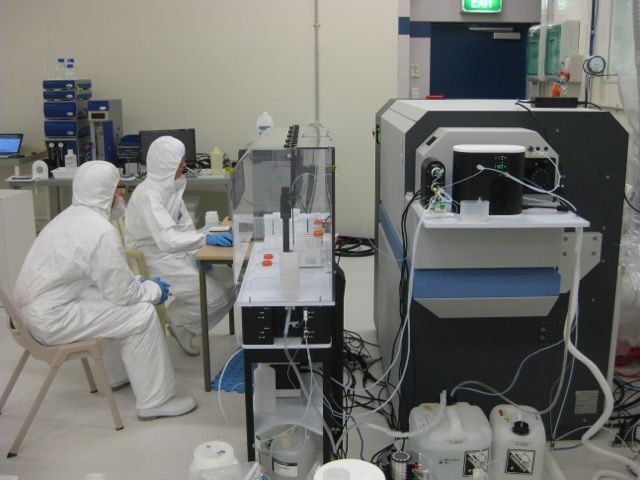
The project made significant progress over the past year with respect to the analysis of insoluble nanopaticles in Antarctic snow and ice. These particles originate from variety of sources including fire emissions, mineral dust and the vaporisation of meteorites and cosmic dust. Senior Research Fellow Ross Edwards and PhD student Aja Ellis developed new analytical methods for extracting nanoparticles from ice samples and determining their composition and origin using advanced instrumentation. These records provide new information with respect to the transport and ageing of ultra-fine particles in the atmosphere. At high concentrations these particles alter climate and impact human health. The Antarctic ice cap serves as a sentinel, preserving a history of the particles in the atmosphere. Previously, the polar ice caps alerted researchers to the global contamination of the Earth by toxic heavy metals such as lead, from leaded gasoline and coal combustion. However, little is known with respect to the form in which these toxic metals are transported through out the global atmosphere. The project is revealing the interaction of these metals with ubiquitous black carbon particles from fire combustion.
Summary of the season 2012/13
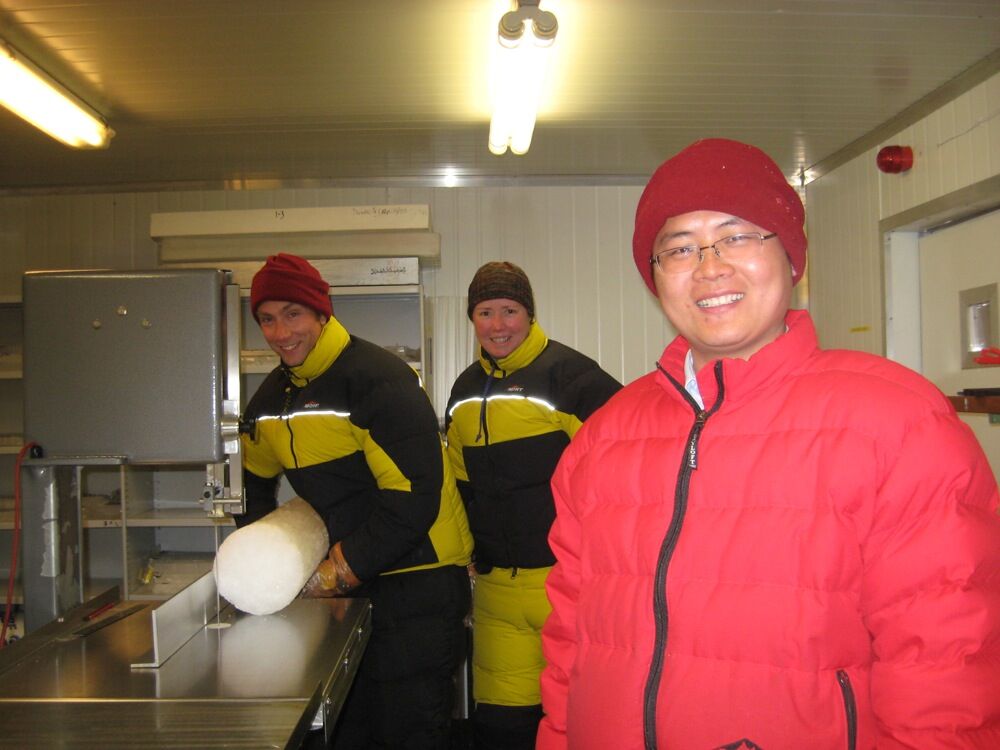
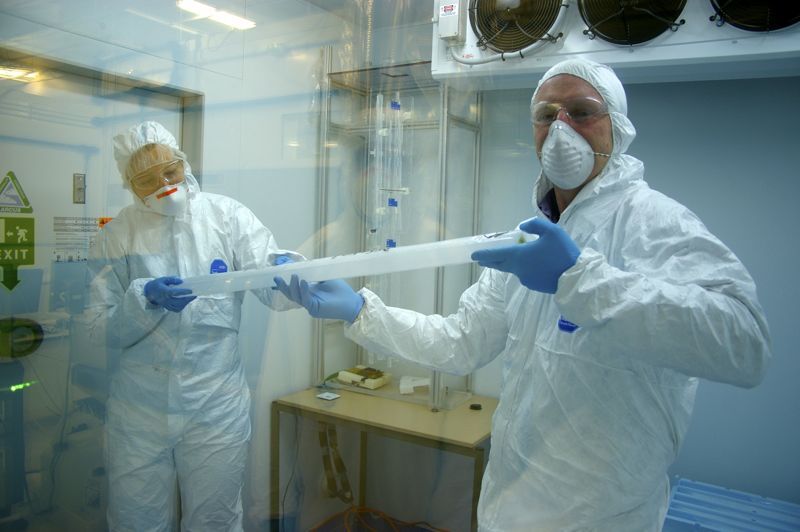
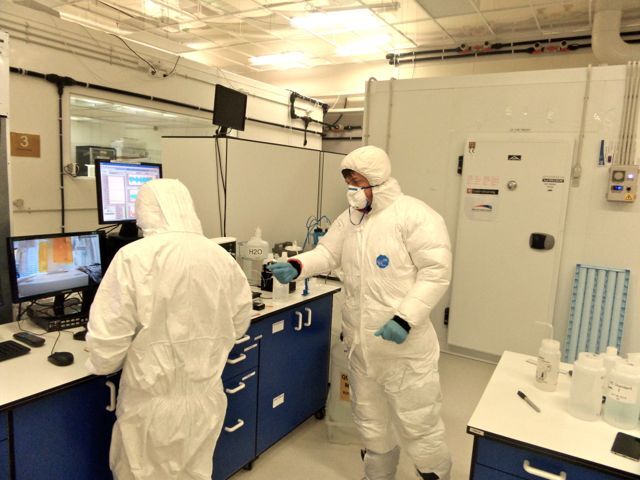
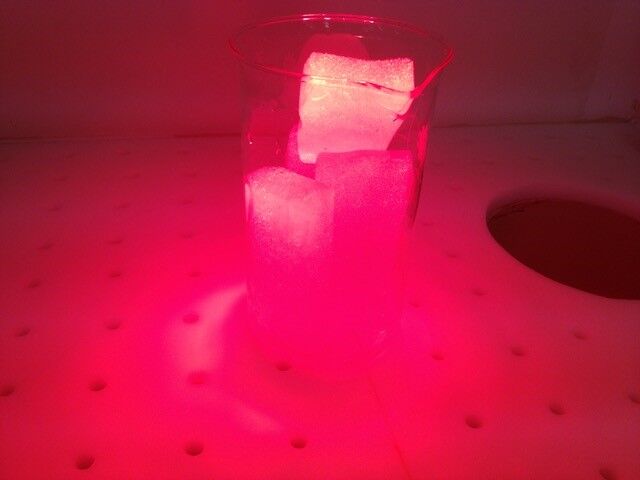
The first stage of the project comprised of sub-sampling archived ice cores in Hobart during March and April 2013. Ice cores to be analyzed were sectioned using a band saw in the Antarctic Climate and Environment CRC freezer at the University of Tasmania. For our project the sub-samples were 3.5 x 3.5 cm square sticks of ice, which were typically 1 m in length. These dimensions are required for our continuous ice core melter system, which slowly melts the ice sticks from to bottom to top and feeds the meltwater into our analytical instrumentation.