
Project information
Project aim
This project will deliver improved capacity to understand, manage and conserve Australia's unique Antarctic biodiversity and ecosystems through cutting edge research that will be delivered to Australian environmental decision makers and other key stakeholders. It will focus on quantifying and predicting offshore marine biodiversity to provide a consistent and comprehensive view using methods recently developed in Australia. It will deliver information that stakeholders need to better inform biodiversity management and policy and decision making in the short-term and into the future.
Project milestones
Summary of the project achievements 2015/16
The project quantified and predicted aspects of marine biodiversity for a range of key taxa at several scales. We identified relationships between benthic biodiversity and environmental surrogates to enable robust prediction of biodiversity, and made available data and methods to inform the management and assessment of MPAs. The products include:
• compilations of key biological and environmental data;
• development and assessment of statistical methods for quantifying and mapping biodiversity;
• development of new tools and models for quantifying key environmental variables for benthic biota;
• production of maps of the spatial distribution of biodiversity for key assemblages.
Highlights include:
1) Development of new statistical tools for simultaneously classifying and mapping biodiversity. These tools allow:
(i) straightforward and quantitative interpretation of the composition of assemblages and their environment;
(ii) direct prediction of assemblages in unsampled locations (a significant improvement on current approaches used for ecoregionalisation).
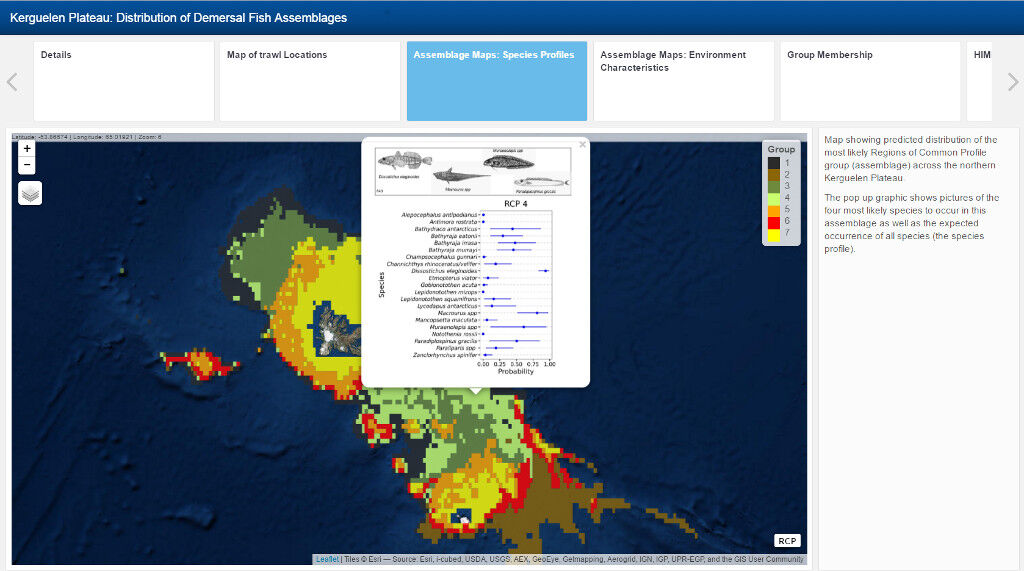
2) Application of the new tool to characterise demersal fish assemblages and map their spatial distribution on the Kerguelen Plateau provided new ecological insights and an evaluation of the representativeness of the HIMI marine reserve.
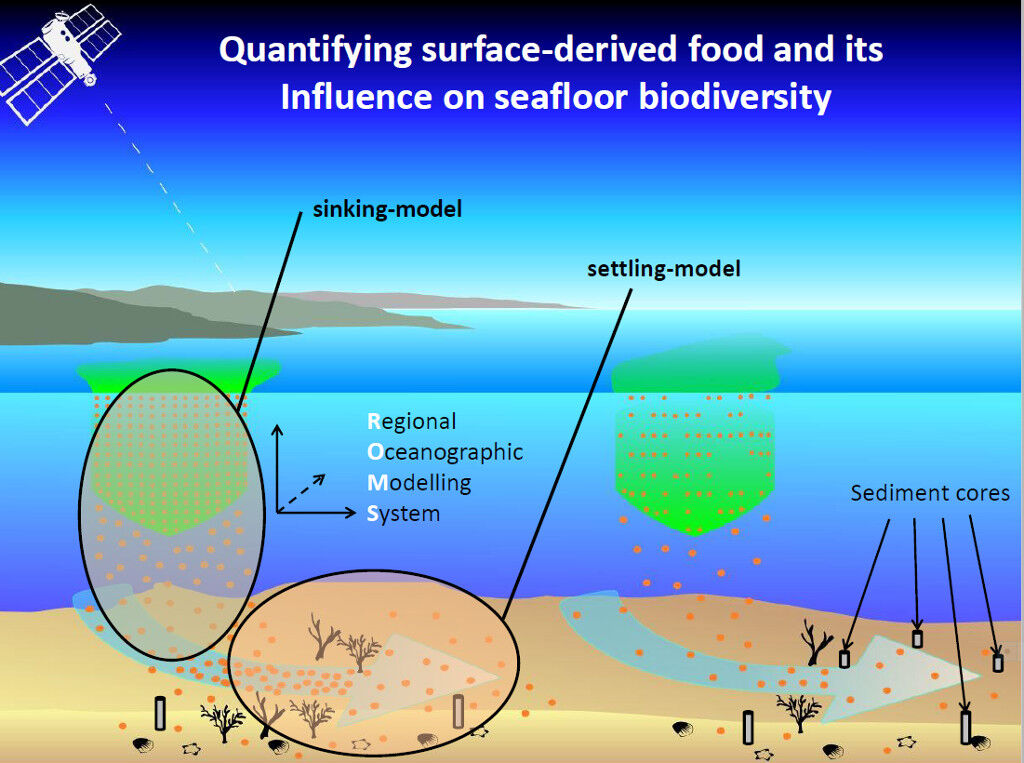
3) A novel modelling approach that combines satellite-derived chla, a regional oceanographic model, and particle tracking to quantify the availability of surface-derived food to the benthos. Using these linked models, the importance and nature of the connection between surface production and predicting benthic biodiversity was quantified.
The tools developed are suitable for characterising biodiversity across Antarctic ecosystems more widely. Our case studies provide biodiversity information for key taxa in areas where MPAs exist or are proposed, enhancing understanding of Antarctic marine systems and providing improved information to guide decisions on biodiversity management.
Summary of the season 2014/15
Productive collaborative relationships have been established and consolidated with French, UK and NZ researchers in identifying, collating and sharing data for the project. This was facilitated by an Academy of Science International Fellowship awarded to Dr Hill and undertaken in November/December 2014. The fellowship facilitated discovery and understanding of available datasets, the sharing of data and ideas, and undertaking preliminary analyses.
Key biological and environmental datasets for the project have been identified and sourced. Biological datasets include comprehensive data on zooplankton; benthic fish (from French and Australian sources); other benthic taxa (from French, UK, Australian and New Zealand sources); and circumpolar datasets including benthic invertebrates from the SCAR biodiversity Atlas. Additional environmental layers are being generated as required.
Analysis is underway with these datasets to quantify and predict biodiversity patterns at a range of scales and identify consistently important environmental variables.
Two PhD students have been recruited to the project to tackle questions concerned with (i) quantifying and predicting regional patterns in the distribution of benthic diversity, and (ii) improving statistical methods for quantifying and predicting Southern Ocean biodiversity.
Collaborations with international researchers are strong and ongoing with several French collaborators visiting IMAS in 2015 to work on the project.
Summary of the season 2013/14
This project has been greatly delayed by the death of the key postdoc in the project (refer previous report). Dr Nicole Hill was recruited as the replacement post doc and commenced on the project on 17 June 2014. Since that time she has worked on identifying and obtaining data, and developing relationships with national and international partners able to provide significant data to the project. Visits to colleagues in France, the UK and NZ for the purposes of data collection and analysis are arranged for later in the year (and funded by external funds leveraged through the project).
Related publications
-
Abundance and richness of key Antarctic seafloor fauna correlates with modelled food availability Nature Ecology and Evolution, 2018
(Ref: 15956)
Authors:Category 1: Peer-reviewed literature
-
Comparison of independently derived benthic invertebrate and demersal fish ecoregionalisations for the Kerguelen Plateau The Kerguelen Plateau: Marine Ecosystems and Fisheries: Proceedings of the Second Symposium, 2019
(Ref: 16162)
Category 3: Conference paper
-
Reliable species distributions are obtainable with sparse, patchy and biased data by leveraging over species and data types Methods in Ecology and Evolution, 2019
(Ref: 16163)
Category 1: Peer-reviewed literature
-
Mapping Antarctic Suspension Feeder Abundances and Seafloor Food-Availability, and Modeling Their Change After a Major Glacier Calving Frontiers in Ecology and Evolution, 2018
(Ref: 16011)
Category 1: Peer-reviewed literature
-
Taxonomic Resolution, Functional Traits, and the Influence of Species Groupings on Mapping Antarctic Seafloor Biodiversity Frontiers in Ecology and Evolution, 2018
(Ref: 16012)
Category 1: Peer-reviewed literature