
Project information
Project aim
This project aims to use satellite & other data to enhance our knowledge of i) change & variability in the seasonality of East Antarctic sea ice coverage & the circumpolar distribution of fast ice, & factors responsible; & ii) possible linkages between pack & fast ice change/variability & ice sheet margin characteristics & stability (including ice shelf disintegration events). It addresses gaps highlighted in IPCC Assessment Report 4 (2007), but will also provide new information on potentially crucial yet previously overlooked linkages e.g. between sea ice change & floating ice sheet margins.
Project milestones
Summary of the project achievements 2017/18
Better understanding the current state & likely future trajectory of the Antarctic cryosphere is a high priority in climate science. This project has made ground-breaking & highly-original contributions by not only shedding new light on the nature of recent large-scale change/variability in sea ice (both pack and fast ice) & its drivers (combining observations & modelling). It has also uniquely linked the marine ice & ice sheet themes by highlighting key sea ice-ice sheet interactions that have been unconsidered to date e.g., in IPCC Assessment Reports. These advances have resulted in 32 gap-filling & highly-cited refereed papers (incl. major reviews), 4 major reports, & uptake of project data/findings by 5 others. Specific key achievements include:
- New gap-filling datasets & analyses on recent change & variability in: 1) E Antarctic sea ice seasonality & 2) circumpolar fast ice extent; & 3) the exposure of the vulnerable Antarctic coastal environment to open ocean (Through sea ice loss) – each of wide-ranging significance.
- Substantial advance in knowledge & understanding of the drivers of observed Antarctic sea ice change & recent records (highlighting the importance of thermodynamic processes).
- a Nature Article implicating sea-ice loss in Antarctic ice-shelf disintegration (& thus sea level rise) since 1995, creating a new direction in cross-cryosphere ice-sheet research.
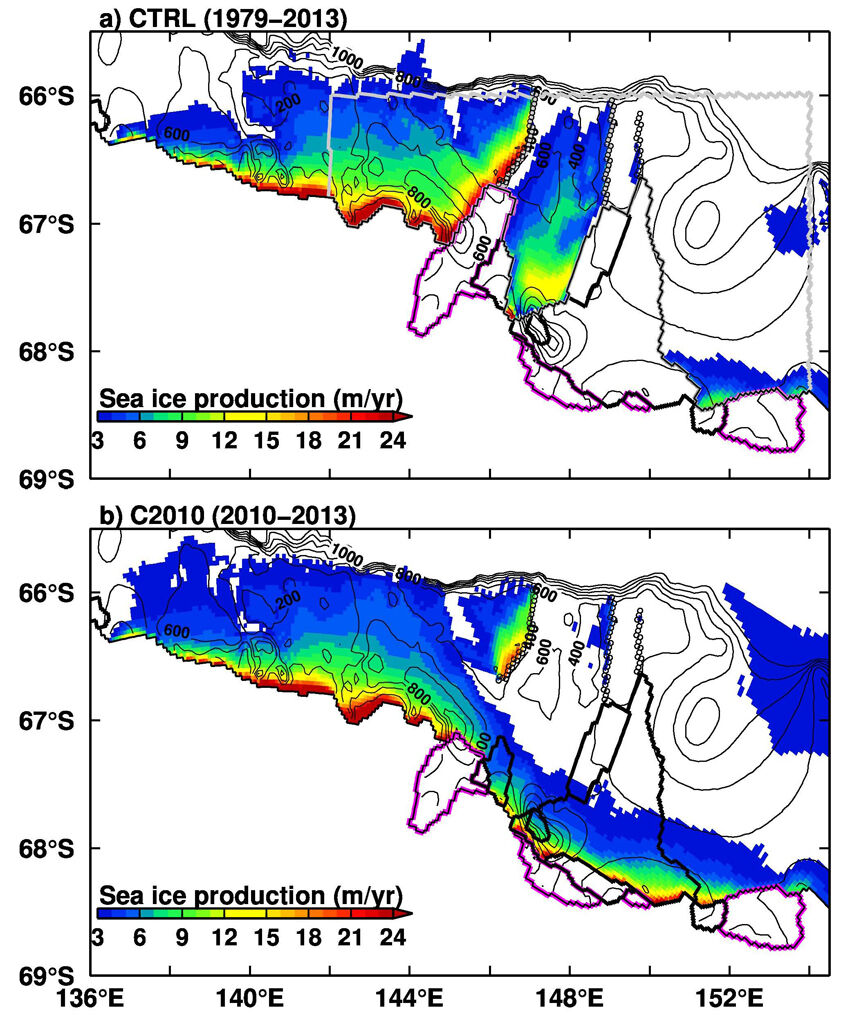
- Improved understanding & high-resolution modeling of Antarctic coastal processes (sea ice & water mass formation, polynyas, iceberg & ice tongue calving).
- Exciting new capability (tools) for spaceborne mapping & monitoring of coastal 1) fast ice at broad & fine scale); 2) exposure; & 3) complexity.
- Key new information on the coupled sea ice-ice sheet-ocean-atmosphere system to enhance climate & Earth system model performance & predictive capability.
As a measure of the project significance, there has been strong uptake both by other projects (spawning new cross-disciplinary collaboration & publications) & by major high-level policy-relevant reports e.g., State of the Environment, IPCC Assessment & NOAA/BAMS State of the Climate reports. Considerable effort put into outreach, result dissemination & engagement generated very positive feedback & substantial media & public interest. In summary, we are very proud of the project achievements of this project, which has benefitted greatly from international & national partnerships & collaborations, across the disciplines.
Summary of the season 2016/17
Good progress has again been made against all project milestones, resulting from novel synthesis of remote sensing, numerical modelling and in situ observations. Highlights include the publication of a review paper (already widely cited) on Antarctic sea ice change and its drivers and forcings, expanded/improved mapping of coastal fast ice, and development of enhanced numerical modelling capability. In particular, significant progress has been made in modelling recent trends and variability in Antarctic sea ice coverage since 1979 (including recent record maxima and minima), leading to enhanced understanding of processes responsible. Enhancement is underway through development of improved sea ice-ocean-atmosphere modelling with ice shelf interactions via coupling with the Australian ACCESS model. New work is also successfully underway regarding i) coastline and bathymetric contour complexity as they affect circumpolar/regional variability in fast ice distribution; and ii) development of a satellite data-based "coastal exposure index" to analyse spatio-temporal variability in the presence of sea ice off the Antarctic coastline and possible trends since 1979. International/national influence and recognition has been strong, with i) significant uptake of project results in a major new international report on "Antarctic Sea Ice Variability and the Southern Climate-Ocean System" (2016, USA) and the Australian State of the Environment Report 2016, and ii) continued lead contribution on Antarctic sea ice change and variability to the annual international NOAA/BAMS State of the Climate report. The success of this project is built on productive research partnerships and links with internal and external researchers that further cross-disciplinary collaborative science in the Antarctic sea ice zone.
Summary of the season 2015/16
Progress has been good against all project milestones. Highlights include the publication of in-depth analyses of recent change & variability in Antarctic sea ice coverage (including record extents in 2012-14), and papers in press/submitted on long-term changes in Antarctic sea ice and their drivers (including a new modelling analysis). Significant progress has been made towards the first-ever (satellite) high resolution mapping & monitoring (at 1 km) of Antarctic coastal fast ice distribution (2000-ongoing). A further highlight has been acquisition of new fast ice & snow cover data at Davis Station (Nov-Dec 2015). International influence and recognition has been strong, in the shape of invited lead participation in the first international workshop on "Antarctic Sea Ice Variability & the Southern Climate-Ocean System" (2016, USA), and continued lead contribution on Antarctic sea ice change and variability to the annual international State of the Climate report. Key outreach/stakeholder engagement activities include: a presentation on Antarctic sea ice change & its drivers to a wide range of stakeholders in Canberra (July, 2015); & invited participation in a World Science Festival public colloquium (Brisbane, March 2016) on recent global sea-ice change/variability (a current "hot topic"). Both were well attended, & very positive feedback was received. There has also been strong uptake of project results in the new Australian State of the Climate report (in prep.).
Summary of the season 2014/15
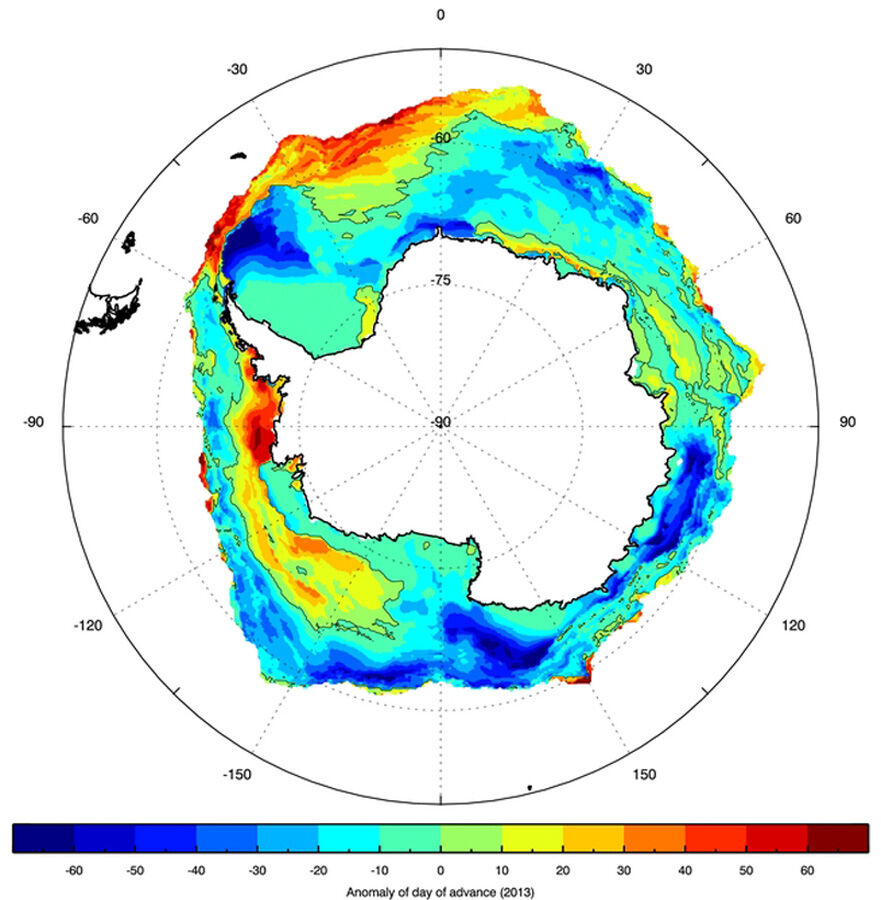
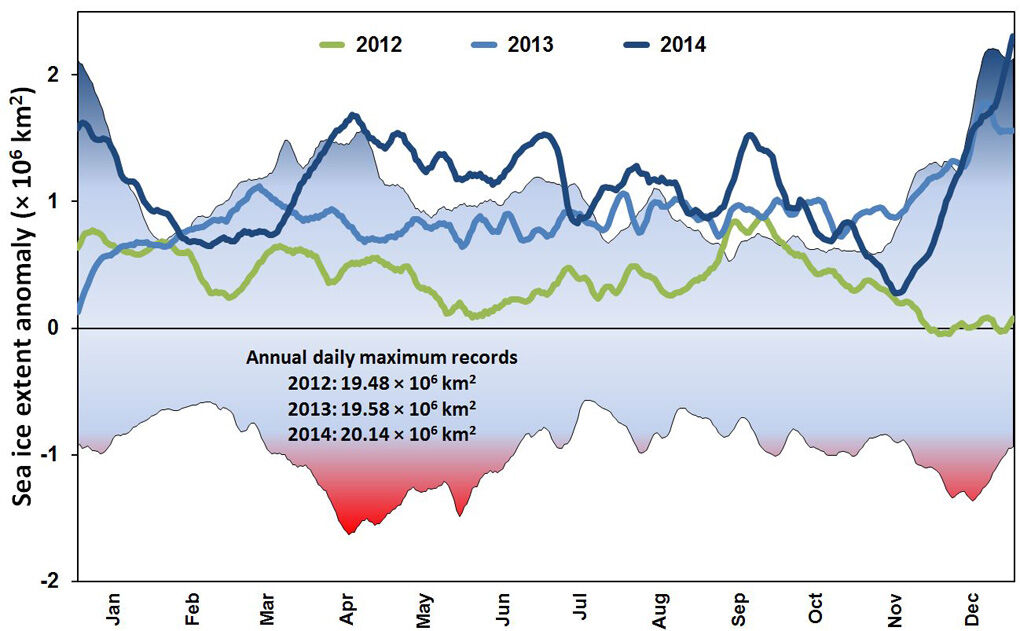
Good progress has been made. Major outcomes include: i) publication of a paper highlighting the effect of external factors on the Mertz Glacier calving in 2010; ii) a paper analysing the record 2013 Antarctic ice extent; iii) a paper (accepted) on seasonal sea ice changes in the Amundsen Sea; iv) establishment & leadership of a new project-related international "targeted research activity" within the World Climate Research Programme (WCRP) Climate & Cryosphere (CliC) project, a talk at a CliC Science Steering Group meeting (Feb 2015) & a poster at the WAIS meeting (Sept 2014); v) Organization of a special session (& poster) on Cross-Cryosphere Interactions at the IUGG General Assembly (June, 2015); vi) Continued lead contribution to annual BAMS/NOAA State of the Climate reports re Antarctic sea ice change & variability; vii) major contribution to the SCAR Antarctic and Southern Ocean Science Horizon Scan (2 papers). Also, significant improvements were made to our medium-resolution satellite-based fast ice mapping tool, & coverage was extended from 2009 to 2014. Key new fast ice information has been provided to the Japanese Cape Darnley Polynya project, & to various national/international studies on the effects of sea ice on penguins. Major progress has been made on a new cross-disciplinary synthesis paper implicating sea ice change in ice shelf disintegration. Invited presentations on Antarctic sea ice change/variability & related challenges for logistical operations/shipping were given at meetings of the International Ice Chart Working Group (Chile, October 2014) & COMNAP (May, 2015). Key outreach activities include various media interviews on recent Antarctic sea-ice change/variability, & its apparent paradoxical contrast to Arctic sea ice change; this is a "hot topic". Collaborative work has continued with Prof. Raphael (USA) & Dr Hobbs (IMAS, Univ. of Tasmania) regarding attribution of recent patterns of observed change in E Antarctic sea-ice distribution.
Summary of the season 2013/14
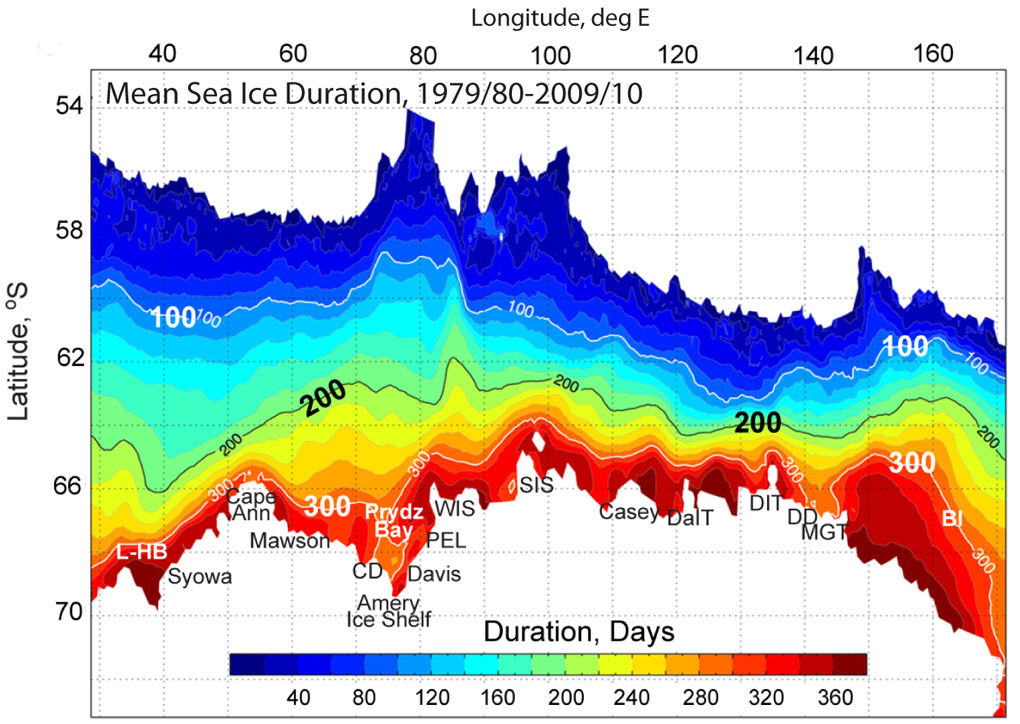
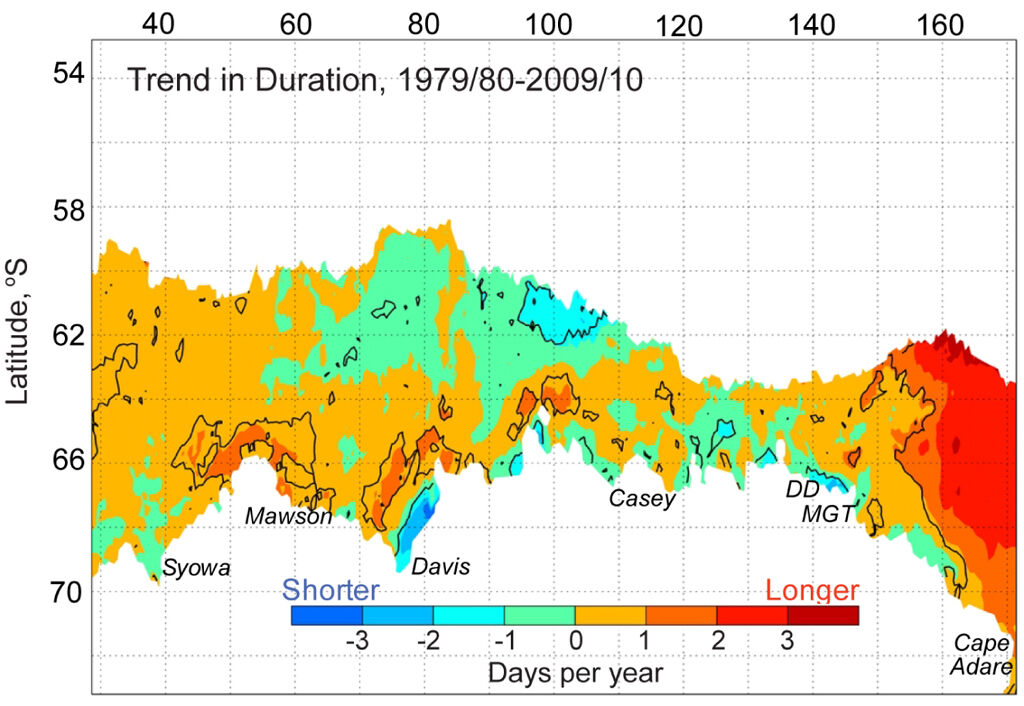
Good progress has been made over the year. Major outcomes are: i) publication of a ground-breaking paper providing the first detailed analysis of change & variability in E Antarctic sea ice seasonality (1979/80-2009/10); ii) uptake of our new sea-ice seasonality and fast ice results in the IPCC 5th Assessment Report (2013), & citation of 3 project papers there; iii) organising/chairing (Drs Massom & Heil) a major international sea ice conference (Hobart, March 2014), & presenting project results there; iv) Publication of a new ACE CRC Position Statement on Antarctic Sea Ice and Climate Change, highlighting core project findings for communication to the general public, policy makers and Government; v) Continued lead contribution to annual BAMS/NOAA State of the Climate reports; vi) Successfully proposing a new project-related international "targeted research activity" to World Climate Research Organisation Climate & Cryosphere Project. Also, key improvements were made to our satellite-based fast ice mapping tools (high & medium resolution), & work is progressing on automating the process & extending the time series/coverage. Results have been applied to mapping the Cape Darnley Polynya (CDP) region, in collaboration with Japanese colleagues (Hokkaido Univ.) as our contribution to their CDP Project, & to various penguin studies. A new cross-disciplinary synthesis paper implicating sea ice change in ice shelf disintegration is well underway. Key outreach activities included 8 presentations in Japan/Australia, & various media interviews on recent Antarctic sea-ice change/variability, & its apparent paradoxical contrast to Arctic sea ice change; this is a "hot topic". Collaborative work has been initiated with Prof. Raphael (USA) & Dr Hobbs (IMAS, Univ. of Tasmania) regarding attribution of recent patterns of observed change in E Antarctic sea-ice distribution; this next-level stage of the project also involves Dr Klekociuk (AAD) & Prof. Simmonds (Univ. of Melbourne).
Summary of the season 2012/13
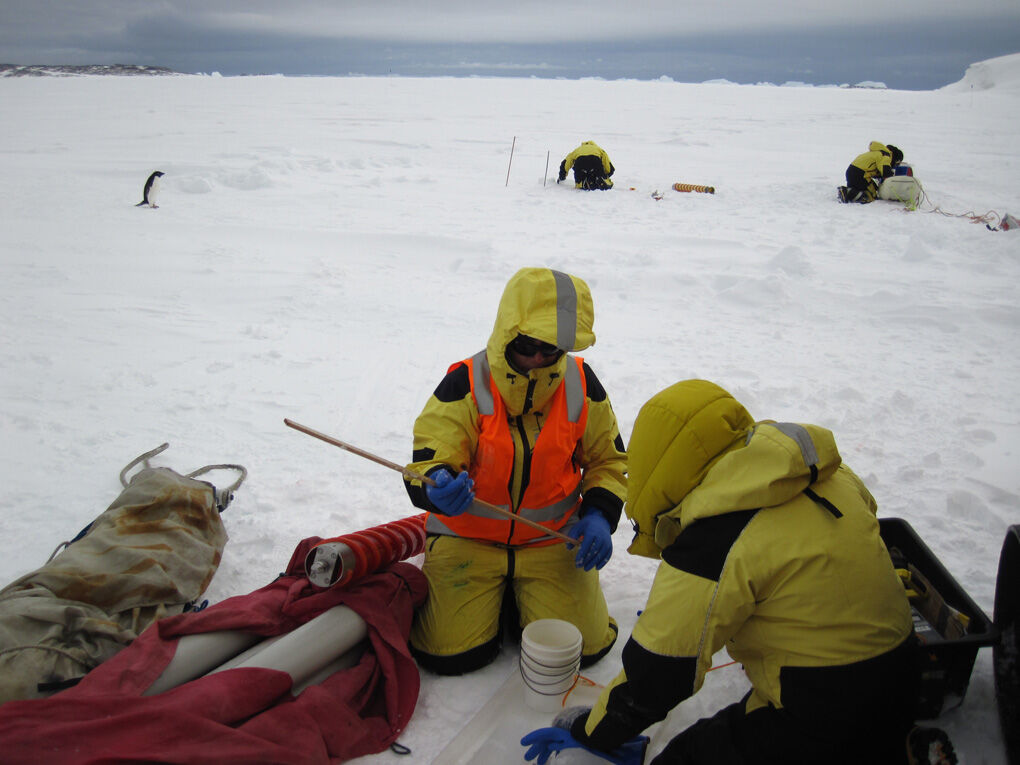
Good progress has been made, although much of 2012 was taken up with the SIPEX 2 project. Major outcomes are: i) acceptance of a paper that provides the first detailed analysis of change & variability in East Antarctic sea ice seasonality (1979/80-2009/10); & ii) 2 papers (published) highlighting & comparing patterns of sea ice change in the both the Antarctic & Arctic. The new results are to be included in the new IPCC Assessment Report (AR5). Also published during the year was a paper on E Antarctic fast ice distribution (again important new results). Also, key improvements have been made to our high-resolution fast ice mapping tool to enable more accurate retrievals from satellite SAR data. Application is successfully underway to map the Cape Darnley Polynya region, as planned. A synthesis paper implicating sea ice change in ice shelf disintegration is well underway. Key outreach activities include an invited talk at Canberra Science Week, & various media interviews.
Related publications
-
Dynamics and influence of environmental processes on the coastal marine system of the Vestfold Hills, East Antarctica Antarctic Science, 2025
(Ref: 17470)
Authors:Category 1: Peer-reviewed literature
Antarctic ice-free coastal environments, like the Vestfold Hills (East Antarctica), are shaped by a complex interplay of physical processes. This study synthesizes new data and existing research from the Vestfold Hills across marine, terrestrial and cryosphere science, meteorology, geomorphology…
-
Sea-ice extent, concentration, and seasonality in 'State of the Climate in 2023' Bulletin of the American Meteorological Society, 2024
(Ref: 17388)
Category 1: Peer-reviewed literature
Net sea-ice extent (SIE; the area enclosed by greater than 15% sea-ice concentration) and sea-ice area (SIA; the product of sea-ice extent and concentration) were well below average or at record-low levels throughout 2023 (Fig. 6.11a).
-
Sea ice extent, concentration, and seasonality in 'State of the Climate in 2024' Bulletin of the American Meteorological Society, 2025
(Ref: 17385)
Category 1: Peer-reviewed literature
Surface melt on the Antarctic Ice Sheet (AIS) occurs primarily on the low-elevation coastal margins, especially on the Antarctic Peninsula and on the ice shelves surrounding the continent.
-
Snow on sea ice and how it varies through the seasons Sea Ice: Its Physics, Chemistry, Biology, Geology and Societal Importance, 2025
(Ref: 17366)
Category 1: Peer-reviewed literature
Snow on sea ice plays a critical role in the global climate system, affecting the growth and decay of the ice, polar ecosystems, human activities, and the retrieval of sea ice characteristics from remote sensing data.
-
Large-scale ice-shelf calving events follow prolonged amplifications in flexure Nature Geoscience, 2025
(Ref: 17386)
Category 1: Peer-reviewed literature
The retreat of Antarctic ice shelves due to calving and the subsequent reduction in buttressing of the Antarctic Ice Sheet are of major concern for future sea-level rise. Sudden…