
Project information
Project aim
Mesoscale cyclones over the Southern Ocean are not well known. A better knowledge is important for a range of human pursuits such as aviation and field safety. Additionally, low pressure systems are a vital component of the climate system by transporting heat and momentum towards high latitudes. We aim to use high resolution model outputs to study the physical properties of small destructive cyclones on the fringe of the Antarctic continent. This knowledge is essential for improving the Antarctic weather and climate prediction and the interactions between high latitudes and the global climate.
Project milestones
Summary of the project achievements 2014/15
This project has looked into a fundamental research puzzle for Australia, by addressing how the very small cyclones that form close to Antarctica can intensify and evolve. We have shown that the heat fluxes associated with the contrast between the water and the air temperature exert a very definite effect upon how these cyclones form and evolve. One of our key findings is that some of the winter mesoscale cyclones that form near the Australian coast have virtually the same properties as the Antarctic lows, helping understand why and how they contribute towards snowstorms that occur in the southern Australian Alps. These winter snowstorms, as we know, have been decreasing due to global warming. Importantly, cyclones that undergo very rapid intensification (also called 'bombs', or 'explosive') tend to become longer lived. This suggests that as the world continues to warm and experience an increase in the intensity of severe weather events, longer-lived cyclones are expected to develop, with greater potential to influence the southern Australian coast during winter episodes of polar outbreaks.
Summary of the season 2013/14
The main objective of this project is to produce a high resolution climatology of Southern Hemisphere mesoscale cyclones using a state-of-the-art tracking scheme, determining specific 'hot spots' around the Antarctic where ship routes and Antarctic bases may be at risk. This project will improve weather forecasting in the region by determining the physical mechanisms associated with the formation of these vigorous small cyclones, which are also commonly referred to as polar lows when formed at very high latitudes.
Over the last year a great deal of progress has been achieved towards the delivery of the principal aims of the project. The climatology has been determined for the high resolution datasets available, and we now know the areas that have the greatest risk of occurrence associated with these systems. remarkably, these areas of high cyclone activity are primarily located in the Australian sector of the Antarctic.
The analysis have also indicated that, although very rarely, some Polar Lows can present explosive development (pressure drop greater than 24 hPa in 24 hours, normalised by the mean latitudinal changes in pressure). This means that a fraction of our targeted systems are among the most dangerous (high latitude) severe weather phenomena on Earth, being sometimes referred to as polar hurricanes.
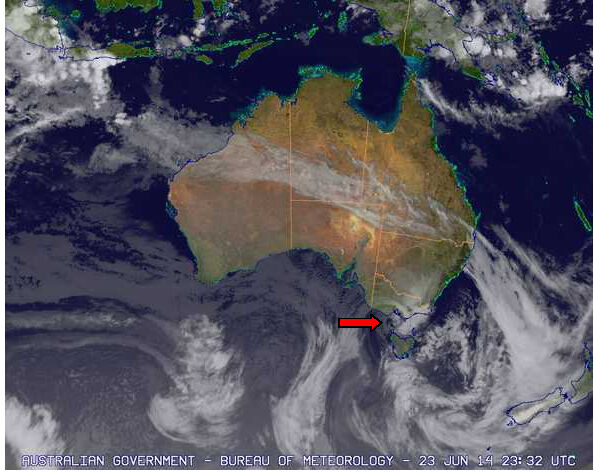
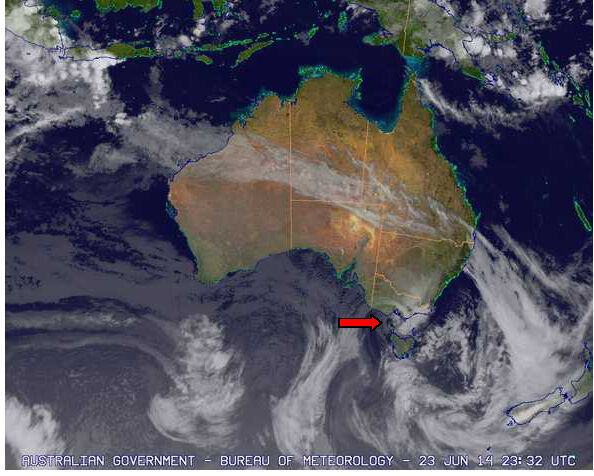
Another important advancement was the identification of a strong mesoscale system forming over anomalous warm water very close to the Australian coast in June 2014. We have used this system to illustrate our "project in action", showing that these systems can also form at significantly lower latitudes than usual. If global warming continues to warm up the waters of the Southern Ocean occurrences like this may become more common, posing a future threat to the Australian coast.
Apart from the influence of warm water, we are currently investigating the dynamics leading to the formation of these systems and how well they are depicted in the forecasts.
Related publications
-
Southern Hemisphere strong polar mesoscale cyclones in high-resolution datasets Climate Dynamics, 2016
(Ref: 15929)
Category 1: Peer-reviewed literature
-
A new perspective on Australian snow Atmospheric Science Letters, 2015
(Ref: 15612)
Authors:Category 1: Peer-reviewed literature
-
Current and future climate variability associated with wintertime precipitation in Alpine Australia Climate Dynamics, 2015
(Ref: 15480)
Authors:Category 1: Peer-reviewed literature
-
Synoptic climatology of extreme precipitation in Alpine Australia International Journal of Climatology, 2015
(Ref: 15481)
Authors:Category 1: Peer-reviewed literature