


Project information
Project aim
The project will use all available upper air and surface temperature data from the IGY (1957) to present to determine the vertical and seasonal characteristics of Antarctic temperature change. Sophisticated meteorological analyses will then be exploited to diagnose the changes in the southward atmospheric transport of energy to ascertain to what extent Antarctic trends can be seen as a response to large-scale atmospheric transport changes. These analyses will be complemented by climate model simulations designed to identify the key causes of the temperature changes.



Project milestones
Summary of the project achievements 2016/17
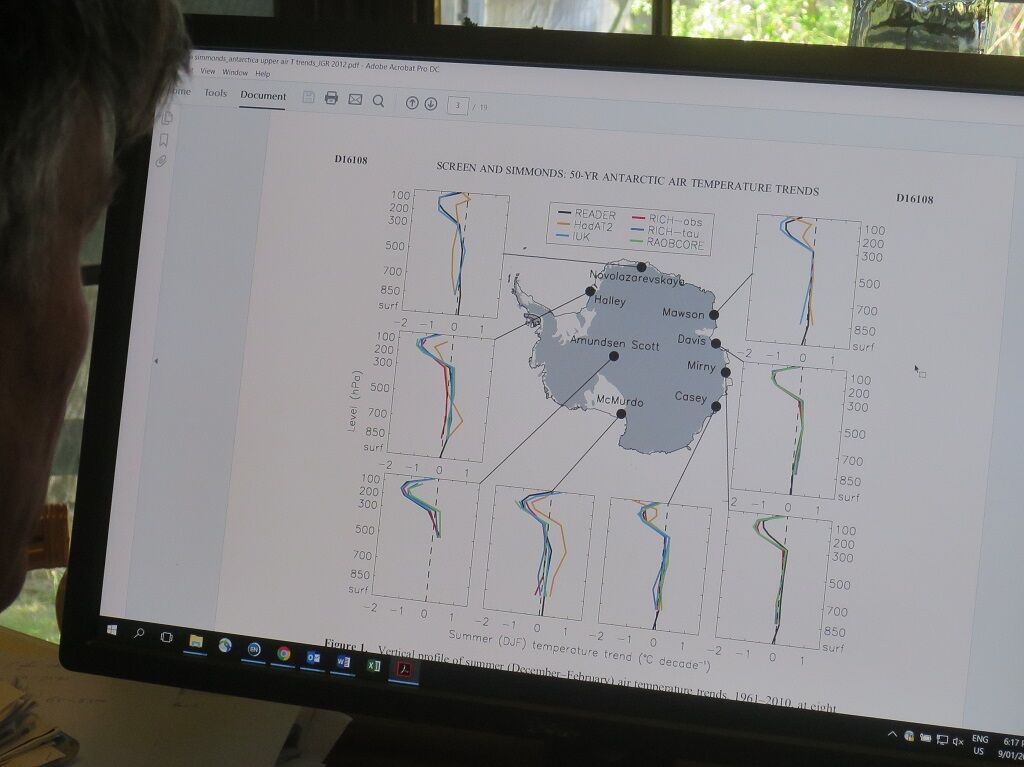
By making optimum use of all available data from regular balloon ascents over the Antarctic continent the project has documented the temperature structure of the atmosphere up to 20 km above sea level. It has also revealed the nature of the variability and change over the last 50 years, and enabled us to provide an updated estimate of how temperature has been changing across the continent.
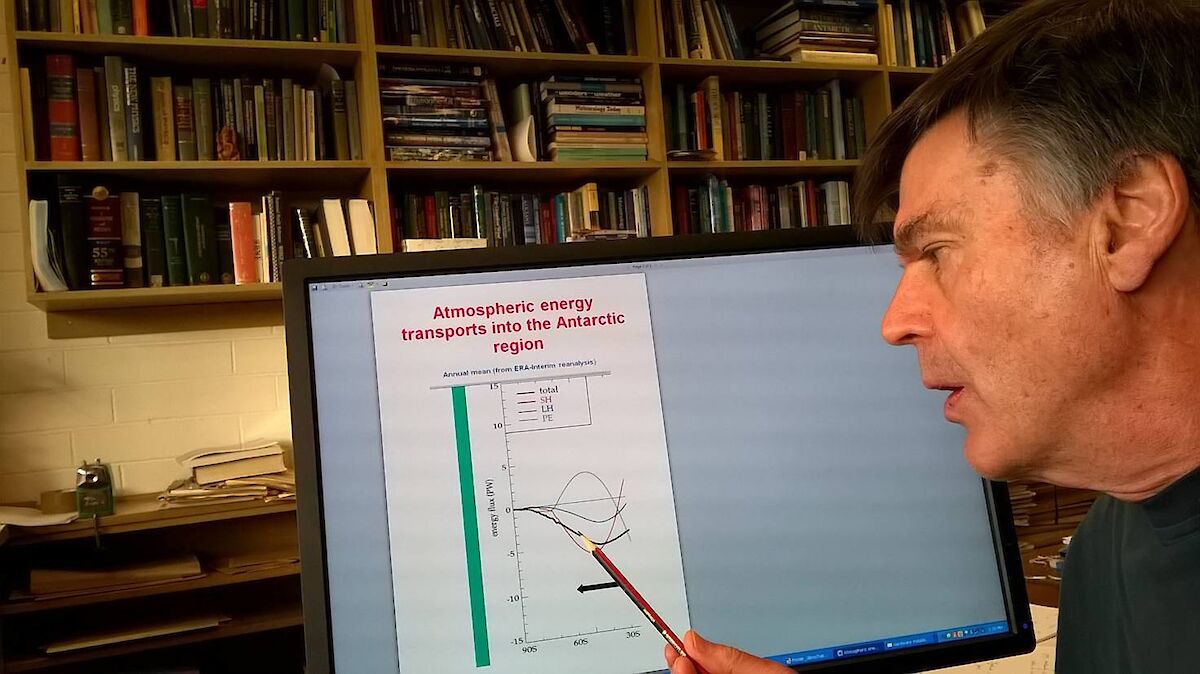
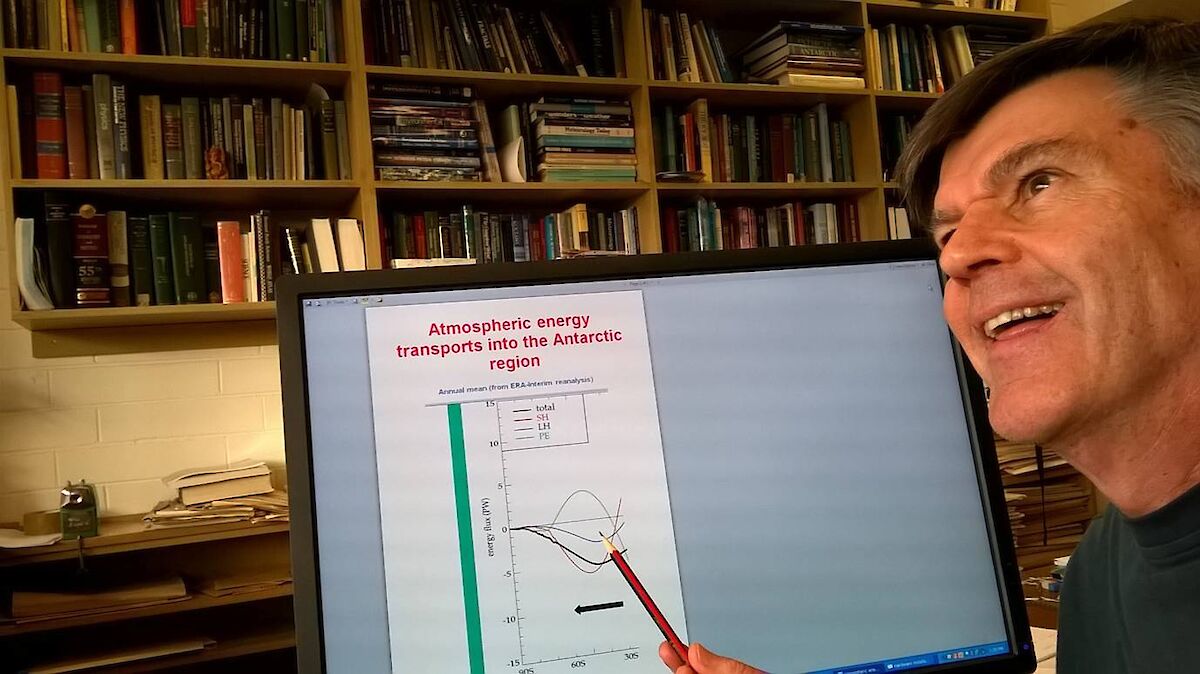
Careful analysis of a number of atmospheric data sets across the entire Southern Hemisphere has allowed us to quantify how atmospheric energy is transferred to the Antarctic region, and to provide reliable estimates of how much of this transport is being done by the ubiquitous Southern Ocean storms. This has led to a greater understanding of the workings of the Antarctic weather and climate systems.
These achievements, both in terms of scientific understanding and the development of sophisticated computer software, are of direct relevance to end users such as at Monash University, the Bureau of Meteorology, and CSIRO MAR in terms of ongoing collaborative research into the Antarctic environment.
Summary of the season 2015/16
As indicated in last year's Milestone Report the start of the project was been held up by the fact that the initial funding agreement between AAD and The University of Melbourne for FY12/13 was finalised only in April 2013. This late start has had a carry-over effect and a 'legacy' impact on progress in FY15/16. Notwithstanding this, it has been a very productive 12 months, with a number of publications and presentations:
Boschat, G., and I. Simmonds, 2015: A new 'energetic' approach into the variability and trends of the Hadley Circulation and energy transports to the high southern latitudes. Australian Meteorological and Oceanographic Society 21st Annual Conference, Brisbane, 15 - 17 July 2015. Australian Meteorological and Oceanographic Society, 273.
Boschat, G., and I. Simmonds, 2015: A new 'energetic' approach into the variability and trends of the Hadley circulation. 18th Centre for Australian Weather & Climate Research Model evaluation workshop Melbourne, 19-22 October 2015.
Boschat, G., and I. Simmonds, 2015: A new 'energetic' approach into the variability and trends of the Hadley Circulation and energy transports to the high southern latitudes. 4th Forum of the French Researchers in Australia Network (FRAN),
Irving, D., and I. Simmonds, 2015: Southern Hemisphere planetary wave activity and its influence on weather and climate extremes. Australian Meteorological and Oceanographic Society 21st Annual Conference, Brisbane, 15 - 17 July 2015. Australian Meteorological and Oceanographic Society, 30.
Irving, D., and I. Simmonds, 2015: A novel approach to diagnosing Southern Hemisphere planetary wave activity and its influence on regional climate variability. Journal of Climate, 28, 9041-9057, doi: 10.1175/jcli-d-15-0287.1.
Simmonds, I., 2016: Antarctic sea ice: Has the retreat finally started? Australian Meteorological and Oceanographic Society 22nd Annual Conference, Melbourne, 8-11 February 2016. Australian Meteorological and Oceanographic Society.
Summary of the season 2014/15
As indicated in last year's Milestone Report the start of the project was been held up by the fact that the initial funding agreement between AAD and The University of Melbourne for FY12/13 was finalised only in April 2013. This late start has had a carry-over effect and a 'legacy' impact on progress in FY14/15. Notwithstanding this, it has been a very productive 12 months, with a number of publications and presentations:
Papritz, L., S. Pfahl, I. Rudeva, I. Simmonds, H. Sodemann and H. Wernli, 2014: The role of extratropical cyclones and fronts for Southern Ocean freshwater fluxes. Journal of Climate, 27, 6205-6224, doi: 10.1175/JCLI-D-13-00409.1.
Rudeva, I., and I. Simmonds, 2015: Variability and trends of global atmospheric frontal activity and links with large-scale modes of variability. Journal of Climate, 28, 3311-3330, doi: 10.1175/jcli-d-14-00458.1.
Simmonds, I., 2015: Comparing and contrasting the behaviour of Arctic and Antarctic sea ice over the 35-year period 1979-2013. Annals of Glaciology, 56(69), 18-28, doi: 10.3189/2015AoG69A909.
Boschat, G., and I. Simmonds, 2015: A new 'energetic' approach into the variability and trends of the Hadley circulation and energy transports to the high southern latitudes. Australian Meteorological and Oceanographic Society 21st Annual Conference, Brisbane, 15 - 17 July 2015 (presentation accepted).
Simmonds, I., and P. Govekar, 2014: Changes in the Southern Hemisphere atmospheric circulation in recent decades. Research Activities in Atmospheric and Oceanic Modelling, WCRP Report No. 11/2014. A. Zadra, Ed., World Meteorological Organization, 2.13-2.14.
Summary of the season 2013/14
It has been a very productive 12 months, after a delayed start to the project, with a number of publications and presentations:
Cataldo, M., H. Evangelista, J. C. Simões, R. H. M. Godoi, I. Simmonds, M. H. Hollanda, I. Wainer, F. Aquino and R. Van Grieken, 2013: Mineral dust variability in central West Antarctica associated with ozone depletion. Atmos. Chem. Phys., 13, 2165-2175, doi: 10.5194/acp-13-2165-2013.
Simmonds, I., P. Govekar and J. A. Screen, 2014: Discrepancies between the Reanalysis products in their Antarctic tropospheric and stratospheric temperature trends, and the message from the radiosonde records. Australian Meteorological and Oceanographic Society 20th Annual Conference, Hobart, Tasmania, 12-14 February 2014.
Simmonds, I., and J. Screen, 2013: What the READER and the homogenized radiosonde data sets reveal about the seasonality of multi-decadal temperature trends in the Antarctic troposphere and stratosphere. Strategic Science in Antarctica, Hobart, Tasmania, 24-28 June 2013.
Simmonds, I., and J. A. Screen, 2013: Antarctic tropospheric temperature trends in reanalyses and radiosonde data. Research Activities in Atmospheric and Oceanic Modelling, Report No. 43, WCRP Report No. 10/2013. A. Zadra, Ed., World Meteorological Organization, 2.15-2.16, (http://collaboration.cmc.ec.gc.ca/science/wgne/).
Summary of the season 2012/13
The initiation of the project has been held up by the fact that the funding agreement between AAD and The University of Melbourne for FY12/13 was finalised only in April 2013. However, some progress has been made, as some of our other resources were able to be transferred temporarily to this project. Some publications have resulted from this activity undertaken over FY12/13 including
Screen, J. A., and I. Simmonds, 2012: Half-century air temperature change above Antarctica: Observed trends and spatial reconstructions. J. Geophys. Res., 117, D16108, doi: 10.1029/2012JD017885.
Simmonds, I., and J. A. Screen, 2013: The vertical and seasonal profile of temperature changes over the Antarctic in the ‘new’ generation reanalyses, and their radiosonde ground-truthing. AMOS 19th Annual Conference, Melbourne Convention and Exhibition Centre, Melbourne, 11 - 13 February 2013, 107.
An Abstract has been submitted to the 'Strategic Science in Antarctica' June 2013 Hobart meeting.
Related publications
-
Mineral dust variability in central West Antarctica associated with ozone depletion Atmospheric Chemistry and Physics, 2013
(Ref: 15913)
Authors:Category 1: Peer-reviewed literature
We present here data of mineral dust variability retrieved from an ice core of the central West Antarctic, spanning the last five decades. Main evidence provided by the geochemical analysis is that northerly air mass incursions to the coring site, tracked by insoluble dust microparticles…
-
A new method for identifying the Pacific-South American pattern and its influence on regional climate variability Journal of Climate, 2016
(Ref: 15914)
Authors:Category 1: Peer-reviewed literature
The Pacific-South American (PSA) pattern is an important mode of climate variability in the mid-to-high southern latitudes. It is widely recognized as the primary mechanism by … which the El Nino-Southern Oscillation (ENSO) influences the south-east Pacific and … south-west Atlantic…
-
What can we learn from energy transports in the atmosphere? European Meteorological Society Annual Meeting, Dublin, Ireland, 4-8 September 2017, 2017
(Ref: 15916)
Authors:Category 3: Verbal presentation
-
A new 'energetic' approach into the variability and trends of the Hadley Circulation and energy transports to the high southern latitudes Australian Meteorological and Oceanographic Society 21st Annual Conference, Brisbane, 15-17 July 2015, 2015
(Ref: 15917)
Authors:Category 3: Conference paper
-
On the relative role of eddies and mean meridional circulations in the global energy balance of the atmosphere Australian Meteorological and Oceanographic Society 22nd Annual Conference, Melbourne, Australia, 8-11 February 2016, 2016
(Ref: 15918)
Authors:Category 3: Conference paper