
Project information
Project aim
In-situ and remotely sensed observations of sea-ice drift from the East Antarctic [EA] together with auxiliary data will provide a baseline of sea-ice motion and deformation, including any high-frequency processes that may be resolved from the available time-series. The focii will be to (a) derive the dominant modes of variability in sea-ice dynamics, (b) attribute these to change in the climate system, (c) gauge the effect of the dynamical variability on sea-ice thickness and volume, and (d) to provide information on how to incorporate these processes into numerical models.
Project milestones
Summary of the season 2014/15
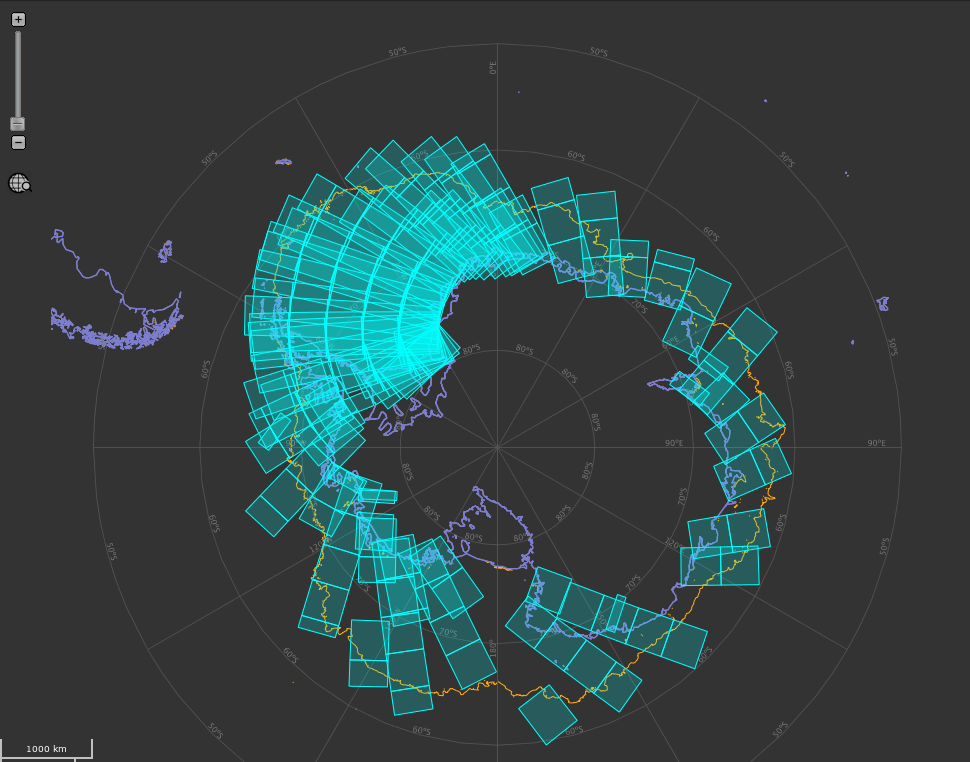
In 2014/15 we benefited from the persistent survival of some of the buoys deployed in the Weddell Sea during austral summer 2013/14 (supported by the Alfred-Wegener-Institute, Germany). Many of those survived well in 2014 and provided additional data for our analysis. Incoming data were processed to update our ice-motion information database. Furthermore, high-resolution ASAR data from Sentinel-1 has been trickling in, providing data to setup the IPADS software for this new very high resolution product. Launched in April 2014 and required to undergo three orbit maneuvers, Sentinel-1 currently remains in the ramp-up phase with limited scientific image acquisitions. It is anticipated that the background mission of Sentinel-1 will deliver on high repeat coverage of the full Antarctic sea-ice zone. This will support our current investigation into Antarctic sea-ice dynamics, were we focus on: (a) deriving the dominant modes of variability in sea-ice dynamics, (b) assess if any of these may be attributed to change in the climate system, (c) gauge the effect of the dynamical variability on sea-ice thickness and volume, and (d) to provide information on how to incorporate these processes into numerical models.
Summary of the season 2013/14
In-situ observations of Antarctic sea-ice drift together with auxiliary data have been collected during two expeditions in the Weddell Sea, supported by the Alfred-Wegener-Institute (Germany) from the RV Polarstern. Additionally remotely sensed data, acquired by the Deutsche Luftraum Behoerde have been obtained through an external grant. Together they are used to derive a baseline of sea-ice motion and deformation, including synoptic-scale as well as high-frequency processes that are contained in the available time-series. Here, the focii will be to (a) derive the dominant modes of variability in sea-ice dynamics, (b) assess if any of these may be attributed to change in the climate system, (c) gauge the effect of the dynamical variability on sea-ice thickness and volume, and (d) to provide information on how to incorporate these processes into numerical models.
Summary of the season 2012/13
In-situ and remotely sensed observations of sea-ice drift from the East Antarctic [EA] together with auxiliary data will provide a baseline of sea-ice motion and deformation, including synoptic-scale as well as high-frequency processes that are contained in the available time-series. The focii will be to (a) derive the dominant modes of variability in sea-ice dynamics, (b) assess if any of these may be attributed to change in the climate system, (c) gauge the effect of the dynamical variability on sea-ice thickness and volume, and (d) to provide information on how to incorporate these processes into numerical models.
Related publications
-
SIPEX 2012: Extreme sea-ice and atmospheric conditions off East Antarctica Deep Sea Research Part II: Topical Studies in Oceanography, 2016
(Ref: 17053)
Category 1: Peer-reviewed literature
In 2012, Antarctic sea-ice coverage was marked by weak annual-mean climate anomalies that consisted of opposing anomalies early and late in the year (some setting new records) which were interspersed by near-average conditions for most of the austral autumn and winter. Here…
-
Introduction: SIPEX-2: A study of sea-ice physical, biogeochemical and ecosystem processes off East Antarctica during spring 2012 Deep Sea Research Part II: Topical Studies in Oceanography, 2016
(Ref: 17054)
Category 1: Peer-reviewed literature
This editorial introduces a suite of articles resulting from the second Sea Ice Physics and Ecosystems eXperiment (SIPEX-2) voyage by presenting some background information on the study area and Antarctic sea-ice conditions, and summarising the key findings from the project.
-
On the extraordinary snow on the sea ice off East Antarctica in late winter, 2012 Deep Sea Research Part II: Topical Studies in Oceanography, 2016
(Ref: 17055)
Category 1: Peer-reviewed literature
In late winter-early spring 2012, the second Sea Ice Physics and Ecosystems Experiment (SIPEX II) was conducted off Wilkes Land, East Antarctica, onboard R/V Aurora Australis. The sea-ice conditions were characterized by significantly thick first-year ice and snow…
-
Seasonal and Interannual Variations of Sea Ice Mass Balance From the Central Arctic to the Greenland Sea Journal of Geophysical Research Oceans, 2018
(Ref: 16057)
Category 1: Peer-reviewed literature
-
Comparing methods of measuring sea ice density in the East Antarctic Annals of Glaciology, 2015
(Ref: 15610)
Category 1: Peer-reviewed literature