
Project information
Project aim
Ice cores provide valuable records of past climatic and environmental change, preserved in the chemical and isotopic composition of the ice and entrapped air bubbles. These records provide measures of snowfall, temperature, atmospheric composition and circulation. Some of the most detailed records come from high resolution Law Dome ice cores. This project will use existing ice cores and data from Law Dome and other sites in E. Antarctica to develop new records and climate reconstructions, explore climate processes and improve the calibrations and interpretations used in ice core studies

Project milestones
Summary of the project achievements 2017/18
This project has used existing ice cores and data from Dome Summit South (DSS) Law Dome and other sites in East Antarctica to further develop new records and climate reconstructions that explores climate processes and improves the calibration and interpretations used in ice core studies. The project has delivered high resolution East Antarctic climate records using archived ice cores from the Australian Antarctic program; has used high resolution ice core records in conjunction with meteorological records to further calibrate ice core data and validate reanalysis data; has used these ice core records and other East Antarctic ice core records to reconstruct regional, continental and hemispheric climate (e.g. temperature, snow accumulation); and has used the high resolution ice core records to explore, quantify and determine the natural variability of climate processes and climate modes (e.g. rainfall and streamflow reconstructions for Eastern Australia, El Nino-Southern Oscillation (ENSO) and Interdecadal Pacific Oscillation (IPO)).
Summary of the season 2016/17
Progress for this project for the last year includes:
Calibration studies of ice core proxies against meteorological records and climate indices demonstrate newly developed sea-ice extent proxy records are supported by previous studies of sea-ice variability (Vallelonga et al., 2017).
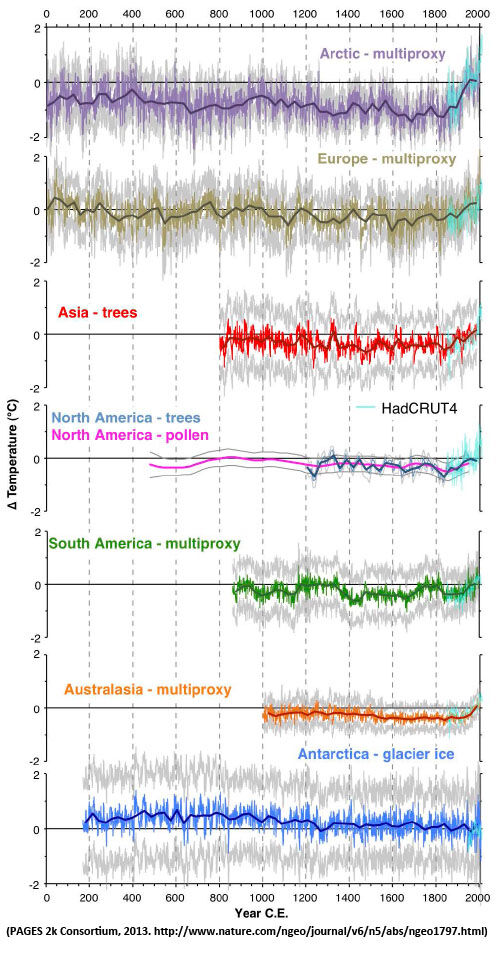
Our work through PAGES 2k working groups contributes towards syntheses of regional, continental and hemispheric climate studies. This includes the use of climate data to identify human-induced global warming began about 180 years ago (Abram et al., 2016); a community-sourced database of temperature-sensitive proxy records; Antarctic climate variability at regional and continental scales over the last 2,000 years; a review of regional Antarctic snow accumulation over the past 1000 year; and development of a global database of palaeo-water isotopes covering the past two millennia.
East Antarctic climate records continue to be utilised to explore, quantify and determine natural variability of key climate processes. This includes; trapped atmospheric gases from Law Dome to verify and quantify the relationship and show how it impacts the cycles of carbon between land, ocean and the atmosphere (Rubino et al., 2016); development of ice core and climate reanalysis analogs to predict Antarctic and Southern Hemisphere climate change (Mayewski et al., 2016); and meteorological observations in the high-latitude Southern Hemisphere are assessed in terms of their trends in the context of palaeoclimate records and climate model simulations (Jones et al. 2016).
The ice core archive continues to play an important role in the development of new analytical capability. Capillary ion chromatography systems have been developed for analysis using small volume Antarctic ice core samples (Rodriguez et al., 2016). And organochlorine pesticides (OCPs) were quantified in Antarctica (Bigot et al., 2016).
Summary of the season 2015/16
The project has seen considerable progress against the scientific objectives over the past 12 months.
The project has utilised the extension of the ice core record from Law Dome to further complete calibration studies of ice core proxies against meteorological records and climate indices. The teleconnection relationships between the Law Dome summer sea salt deposition record and rainfall variability in eastern Australia was applied to existing Law Dome ice core data to reconstruct 1013 years of rainfall (1000-2012 CE) in eastern Australia (Tozer et al., 2016).
A site selection paper for a new ice core to add to the IPICS 2k array was completed. The Vance et al., (2016) paper utilises existing observation and ice core data, together with meteorological reanalysis to determine optimal ice core sites in East Antarctica to best capture climate processes and teleconnections. Three sites in coastal East Antarctica likely offer ice core records from a region of the Indian Ocean not previously sampled at high resolution over the past two millennia.
Our work through PAGES 2k working group continues to contribute towards the Antarctica 2k Antarctic temperature reconstruction. Preliminary results identified 5 distinct regions across Antarctica with different temperature regimes, and a better understanding of processes acting on different spatial and temporal scales that influence the calibration between water stable isotopes and temperature in ongoing.
Lastly, the valuable ice core storage archive continues to play an important role in the development of new analytical capability in the determination and validation of ice core chemical records. A new capillary ion chromatography method has been developed for quantitative analysis using small volume Antarctic ice core samples (Rodriguez et al., 2015). The characterizing of black carbon in rain and ice cores using coupled tangential flow filtration and transmission electron microscopy was also completed (Ellis et al., 2015).
Summary of the season 2014/15
Four major outputs have been achieved for the project during the past 12 months.
Firstly, the project team have contributed to the most comprehensive Southern Hemisphere reconstruction of past climate that reveals a clear temperature history over the past 1000 years. The paper (by Neukom et al., 2014] showed temperature variations over the past 1000 years have differed greatly between the Southern and Northern hemispheres, although the two hemispheres show consistent warming over the last 40 years.
Secondly, a 1000 year ice core record from Law Dome sheds light on eastern Australia's long-term drought patterns, with important benefits for water infrastructure planning. The study (by Vance et al., 2015) finds that the instrumental Interdecadal Pacific Oscillation (IPO) index could be reconstructed using the annual snowfall and sea-salt concentrations from the Law Dome ice core record. The reconstruction of the IPO index combined with an eastern rainfall proxy from the Law Dome ice cores provides a pattern of the rise and fall in Australia's rainfall over the past 1000 years.
Thirdly, a record of annually dated snow accumulation for Dome Summit South, Law Dome has been derived. This record (Roberts et al., 2015) extends the snow accumulation record from van Ommen & Morgan (2010) to greater than 2000 years.
Lastly, the well dated Law Dome volcanic record has been used in conjunction with other ice cores from 19 different sites in Antarctica to provide the most accurate account to date of the number, timing and strength of major volcanic eruptions over the past 2000 years.
Summary of the season 2012/13
Three major outputs of the project this season represent significant advances in the field. Firstly, a chronology of significant volcanic eruptoins over the past 2000 years has been published from the very well dated Law Dome ice core. The paper (by Plummer et al., 2012) presents a record of 45 events from 23BC to 1995 AD with lowest error in dating of any presently published Antarctic ice core record.
Secondly, a record of ENSO variability (Vance et al., 2013) has been derived from summer-time sea-salts the Law Dome ice core. This proxy series shows a clear connection to rainfall in Eastern Australia in the past century and gives an insight into ENSO variability back to 1000AD.
Thirdly, a reconstruction of Antarctic temperatures over the last 2000 years has been constructed from the Law Dome record and 8 other ice cores. This has been published as part of the international PAGES2k reconstruction for major continental regions.
Related publications
-
Extending and understanding the South West Western Australian rainfall record using a snowfall reconstruction from Law Dome, East Antarctica Clim Past, 2021
(Ref: 16450)
Category 1: Peer-reviewed literature
-
Evaluating the 20th Century Reanalysis Version 3 with synoptic typing and an East Antarctic ice core accumulation record Climate of the Past, 2025
(Ref: 17306)
Authors:Category 1: Peer-reviewed literature
Weather systems in the southern Indian Ocean influence East Antarctic precipitation variability and surface mass balance. However…
-
Segmented linear integral correlation Kernel ensemble reconstruction: A new method for climate reconstructions with applications to Holocene era proxies from an East Antarctic ice core PLoS One, 2025
(Ref: 17258)
Authors:Category 1: Peer-reviewed literature
Understanding past climate is essential to our knowledge of how our current climate system operates, and how it might respond to future change. Techniques to reconstruct climate history are challenging, and both accuracy and certainty are hampered by the quality of the datasets used.
-
Meshless weighting coefficients for arbitrary nodes: The efficient computation to machine precision using hyper-dual numbers Advances in Engineering Software, 2024
(Ref: 17164)
Authors:Category 1: Peer-reviewed literature
A computationally efficient algorithm to calculate the weighting coefficients required to evaluate derivatives for arbitrary multi-dimensional distributions of points is presented. The iterative algorithm guarantees IEEE 754 64-bit precision (at least 15 significant decimal digits)…
-
An East Antarctic, sub-annual resolution water isotope record from the Mount Brown South Ice core Scientific Data, 2024
(Ref: 17157)
Authors:Category 1: Peer-reviewed literature
We report high resolution measurements of the stable water isotope ratios (?18O, ?D) from the Mount Brown South ice core (MBS, 69.11° S 86.31° E). The record covers the period 873 - 2009 CE with sub-annual temporal resolution.