
Project information
Project aim
Antarctic sea ice is known to store key micronutrients, such as iron, as well as a suite of less studied trace metals in winter and which are rapidly released in spring. This stimulates ice edge phytoplankton blooms which drive the biological removal of climatically-important gases like carbon dioxide. By linking the distribution of iron and other trace elements to the cycles of carbon, nitrogen and silicon in the sea ice zone in spring, this project will identify their biogeochemical roles in the seasonal ice zone and how this may change with predicted climate-driven perturbations.
Project milestones
Summary of the project achievements 2014/15
The availability of both light and/or iron has been shown to limit biological production in large areas of the Southern Ocean (Boyd et al., 2012; Martin, 1990). Changes in the supply of iron to the surface ocean are evoked in explaining glacial-interglacial changes in atmospheric carbon dioxide concentrations (Petit et al., 1999). Sea ice zones are ideal natural laboratories to test the long-standing paradigm of light versus iron control in the high-nutrient-low-chlorophyll waters of the Southern Ocean. There is considerable evidence that sea ice provides considerable amounts of iron into surface waters and triggers ice-edge blooms when it melts in spring (Lannuzel et al., 2007). Given that sea-ice formation and retreat affects yearly 40 per cent of the Southern Ocean surface area, the importance of sea ice as a source of iron to Antarctic surface waters is beyond question. However, compared to open ocean research at islands and plateaus, these annually occurring natural iron fertilizations in the marginal ice zone remain largely understudied.
We first demonstrated that light, not iron, was the limiting the sea ice productivity during the SIPEX2 voyage (Lannuzel et al., 2014; Roukaerts et al., 2015). Our study suggests that most primary production in the sea-ice interior is regenerated and supported by a microbial food web, recycling detritus (Roukaerts et al., 2015). Secondly, we are the first to not only measure but also show that dissolved organic ligands, most probably produced by sea ice microbes, control the distribution of iron sea ice (Lannuzel et al., 2015). We also reported the only currently available Fe2+ data in the field for the sea-ice environment from under-ice seawater, with values below 10 pmol/L. The results do not suggest that sea ice supplies detectable amounts of Fe2+ to Antarctic surface waters (Schallenberg et al. 2015).
Summary of the season 2013/14
Unlike previous studies in the area, the Chlorophyll a, Particulate Organic Carbon and Nitrogen (POC and PON) maxima did not occur at the ice/water interface, because of the dynamic processes under which the sea ice formed. Our results show high concentrations of iron (Fe) in sea ice relative to under-ice seawater. The ranges were 0.9 – 17.4 nmol/L for the dissolved (< 0.2 µm) and 0.04-990 nmol/L for the particulate (>0.2um) fractions. Our results highlight that the concentration of particulate iron in sea ice was the highest when approaching the continental shelf (up to 990 nmol/L at station 7). The high POC and low particulate aluminium concentrations in these samples surprisingly demonstrated that this particulate iron mostly comes from biogenic sources (70% of biogenic contribution at station 7, as opposed to 54% at the other stations). Our iron fluxes estimates suggest that a reduction in sea ice extent would have a negative impact on phytoplankton production in the marginal ice zone.
Summary of the season 2012/13
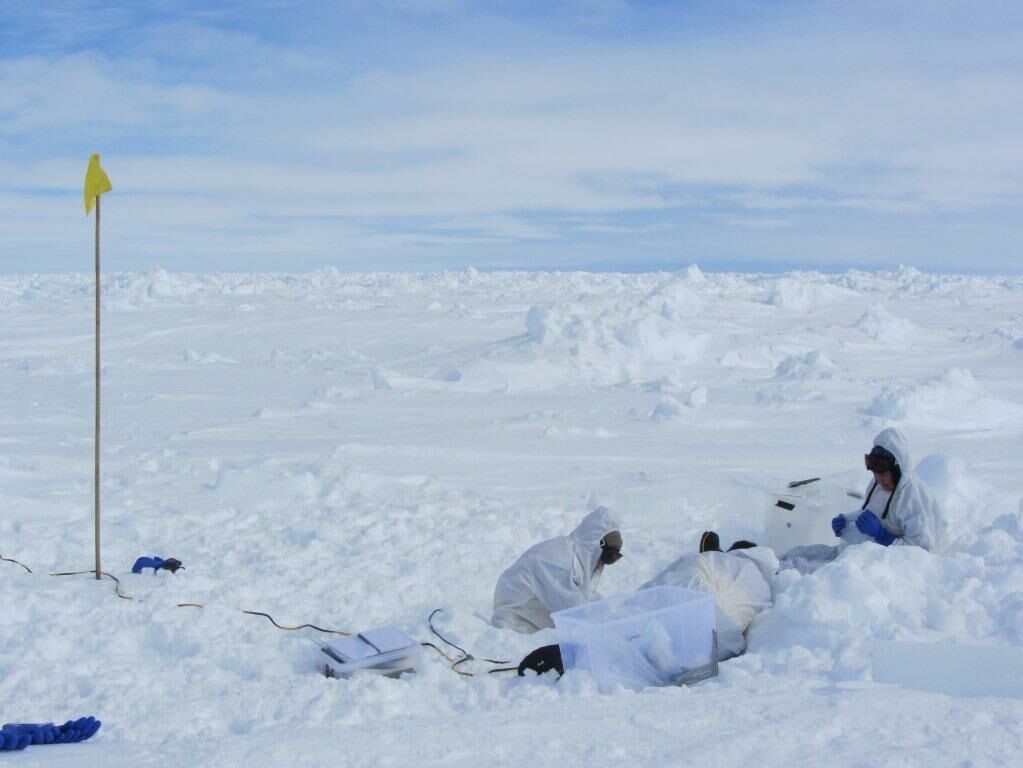
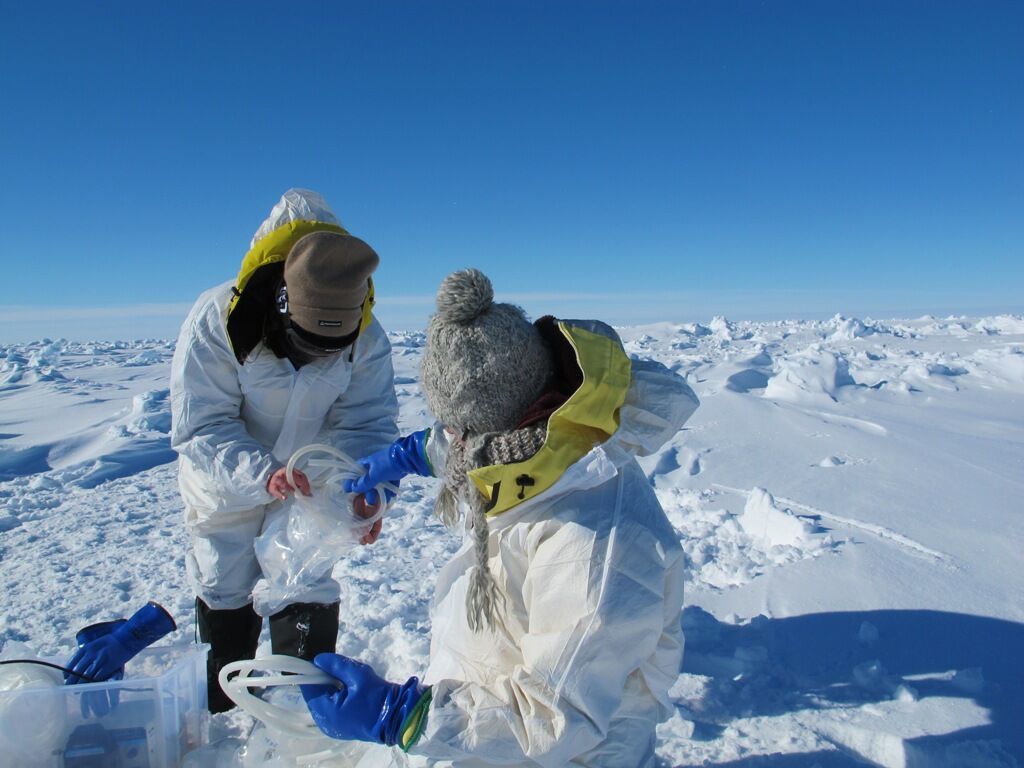
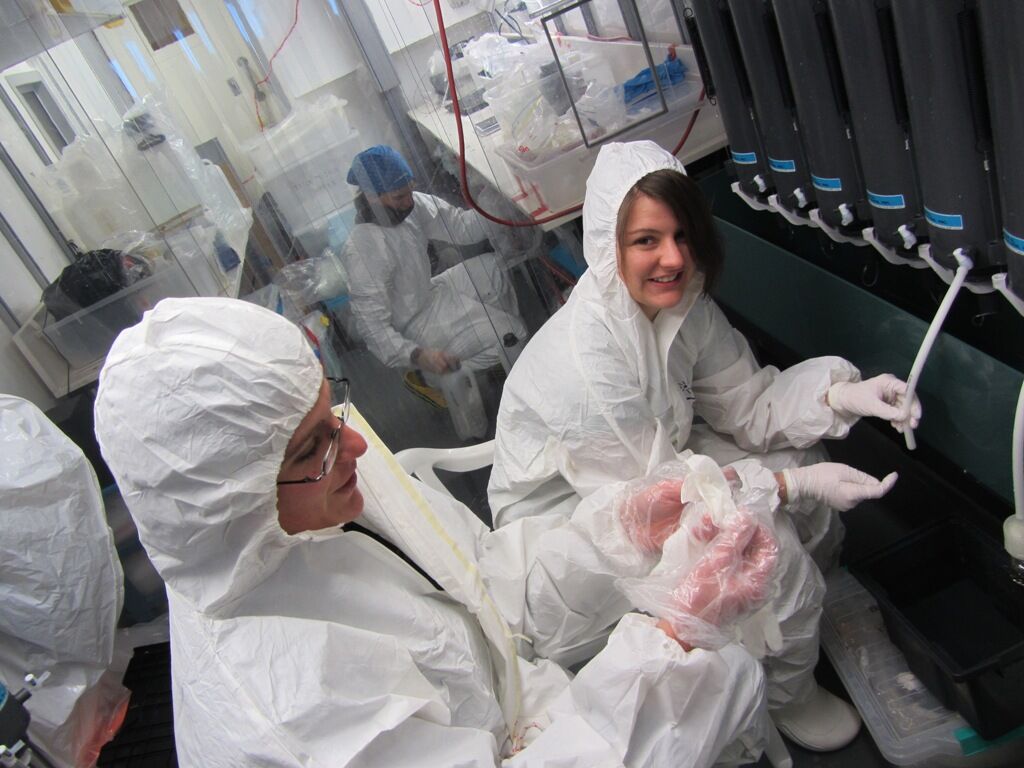
Our study quantified the spatial and temporal distribution of iron in sea ice cores, surface snow, brine and underlying seawater collected during an interdisciplinary Australian Antarctic fieldwork in East Antarctic pack ice in 2012 (SIPEX-2). Additional processing in the home laboratory was achieved on ice cores to obtain for the first time the size fractionation of iron in the soluble (< 0.02 µm), dissolved (< 0.2 µm) and particulate (> 0.2 µm) fractions. Complementary samples were collected for the determination of sea ice salinity and temperature, sea ice texture, macro-nutrients, dissolved and particulate organic carbon, chlorophyll a as well as other key trace elements in first-year (seasonal) sea ice. Preliminary results are presented and discussed in this session
Related publications
-
Genetics of Antarctic Krill Biology and Ecology of Antarctic Krill, Volker, Siegel, 2016
(Ref: 16087)
Authors:Category 1: Peer-reviewed literature
-
Iron in sea ice: review and new insights Elementa: Science of the Anthropocene, 2016
(Ref: 15943)
Authors:Category 1: Peer-reviewed literature
-
Macro-nutrient concentrations in Antarctic pack ice: Overall patterns and overlooked processes Elementa: Science of the Anthropocene, 2017
(Ref: 15944)
Authors:Category 1: Peer-reviewed literature
-
Sea-ice algal primary production and nitrogen uptake rates off East Antarctica Deep-Sea Research II, 2015
(Ref: 15620)
Category 1: Peer-reviewed literature
-
Dissolved iron and iron(II) distributions beneath the pack ice in the East Antarctic (120°E) during the winter/spring transition Deep-Sea Research II, 2015
(Ref: 15471)
Category 1: Peer-reviewed literature