
Project information
Project aim
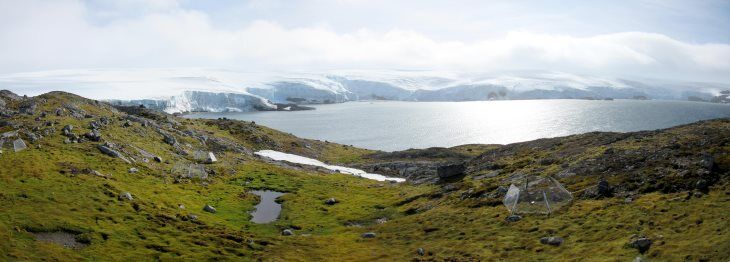
Climate change is affecting East Antarctica more dramatically than first predicted. We will use existing and new data to model spatial and temporal variation of mosses and lichens (key components of Antarctic terrestrial vegetation), identify the environmental drivers that determine their current locations and predict the species that are most at threat from station activities and future climate scenarios. The project will also update the only Antarctic State of the Environment Indicator for terrestrial biodiversity and inform managers tasked with protecting Antarctic biodiversity.
Project milestones
Summary of the project achievements 2016/17
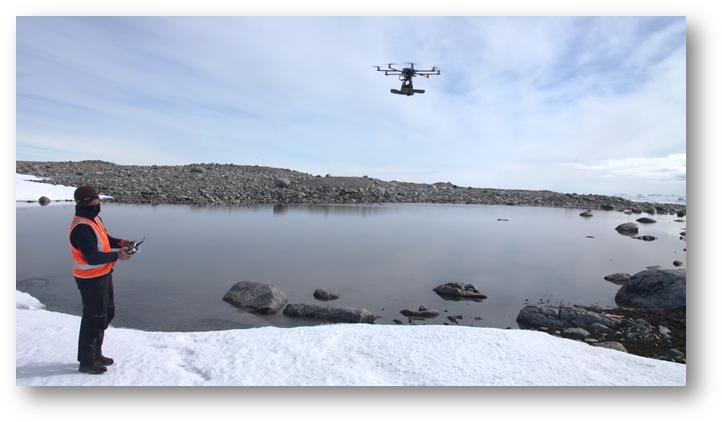
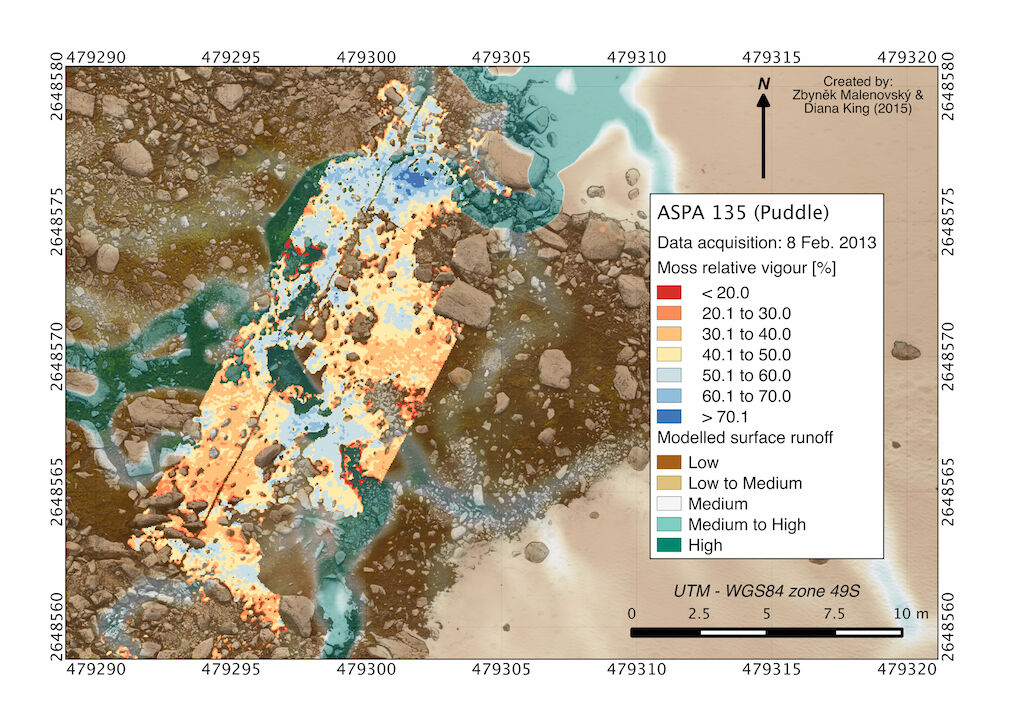
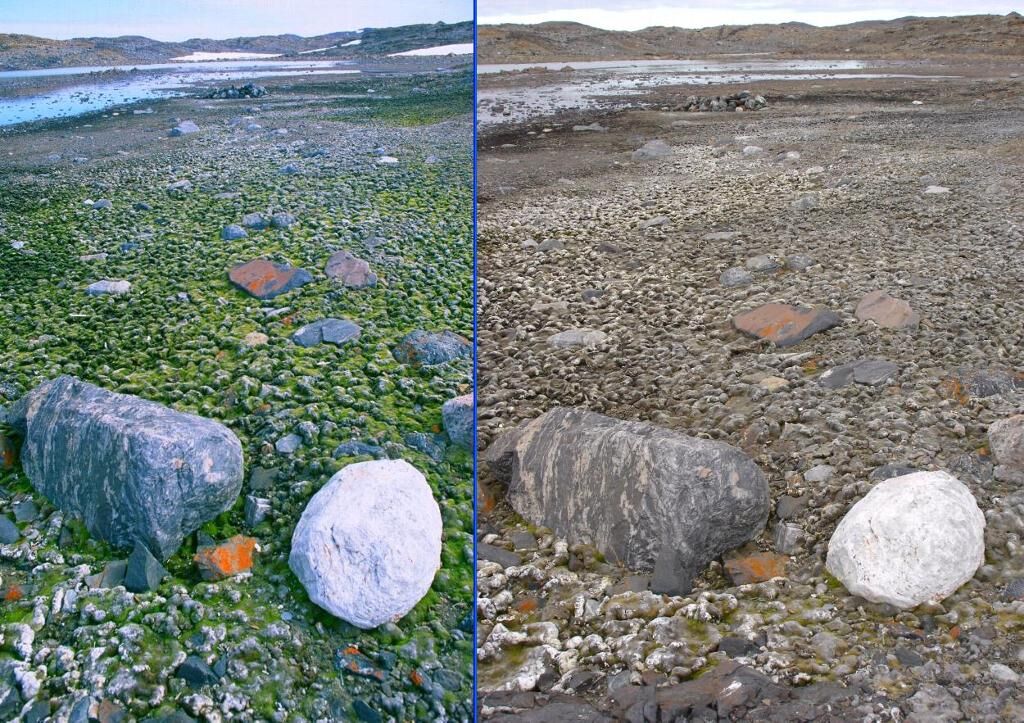
We have shown that vegetation near Casey Station in East Antarctica is changing rapidly due to a drying climate over recent decades. We have developed new remote sensing methods to map moss health in a single visit using hyperspectral images captured by an unmanned aircraft system (UAS, aka drones). This is complemented by a time-series of photographs taken between 2000 and 2013, which show changes in moss health in a number of permanent quadrats, with changes to species over this time monitored from micro-samples collected at the same time. We have developed new models to describe physiological and ecological response curves of species to environmental gradients, and to how climate variability affects health and composition of East Antarctic moss communities. We developed a new method to date moss shoots to determine historical (up to ~600 years) growth conditions. We demonstrated for the first time that rapid vegetation change is occurring in East Antarctica and that Antarctic mosses provide potentially important proxies for monitoring environmental changes.
The project provided training for 3 post-doctoral researchers, 4 honours students, and 6 PhD candidates. This project provided data on the health of Antarctic biodiversity to Environmental Managers through a State of the Environment Indicator and contributed outputs to Australia's State of the Environment and United Nations Environment Programme (UNEP) Environmental Effects Assessment Panel (EEAP) reports (2014-2018). Since the methods developed as a result of this project are increasingly in demand from colleagues in New Zealand, USA, Chile and Brazil, we are continuing to develop advanced versions applicable across Antarctic and also Arctic regions.
Summary of the season 2015/16
We have collated evidence of changes in Antarctic vegetation that are likely linked to a regional drying trend over recent decades. We have developed new remote sensing methods to map moss health in a single visit using hyperspectral images captured by an unmanned aircraft system. This method is complemented by a time-series of photographs taken between 2003 and 2013 which show changes in moss health in a number of permanent quadrats we have established. We have published a new method for comparing the physiological and ecological response curves of species to environmental gradients and are now comparing the environmental niches of Antarctic mosses with congeners in maritime Antarctica and temperate Australia. The project has provided training for three post-doctoral researchers, four honours students, and six PhD candidates. Nine of the ten students have now graduated. The project has and is continuing to contribute outputs to Australia's State of the Environment and United Nations Environment Programme (UNEP), Environmental Effects Assessment Panel (EEAP) reports.
Summary of the season 2014/15
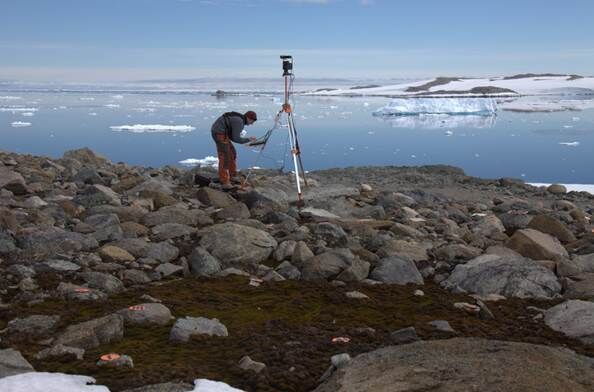
We have developed a near remote sensing methodology, based on plant pigments and leaf density, which allows us to map moss health from tripods or unmanned aerial systems (UASs). Over the last decade we have observed species changes in the moss communities in the Windmill Islands, likely associated with regional drying linked to ozone depletion/climate change. We have developed new methodologies to analyse response curves for species abundance or physiological parameters. We have identified two novel sunscreen compounds in the Antarctic moss Ceratodon purpureus. To date we have provided training for two postdoctoral researchers, six PhD and four Honours students, with three PhDs already submitted. So far, we have published 16 peer reviewed papers and our work was featured in the 2014 United Nations Environment Panel UNEP report. We have extended our collaborative efforts to include colleagues from the USA and Chile as well as UK and Austria. One of the PhD students working on the project was awarded an Endeavour fellowship to work with these colleagues in Chile and the US in 2015.
Summary of the season 2013/14
We have completed analysis for the 10th year of State of the Environment 72 (2013), and developed a new template for SOE reporting of Windmill Island terrestrial ecosystem health. Dating of Antarctic moss and analysis of stable isotopes and UV absorbing compounds is complete with the oldest shoot several hundered years old. The functional link between moss spectral signatures and specific quantitative indicators of Antarctic moss health have been established and tested on ground-based hyperspectral image data collected in the field. The relationships were also applied on the imaging spectroscopy data acquired from a low flying multi-rotor unmanned aircraft system (UAS) to spatially assess the actual health state of moss beds in the vicinity of the Casey Australian Antarctic station. We have published eight journal articles, two book chapters and an article for the public related to this project so far. Four papers have been submitted to journals and two are in an advanced stage of preparation. Training of two Postdocs and six PhD students has been facilitated through this project. Data are now available for modeling by the modeling postdoc, whom we are currently recruiting. Our results will contribute to the development of the Antarctic near-shore and terrestrial observing system (ANTOS) proposed by the Scientific Committee for Antarctic Research (SCAR). In addition our work has informed IPCC5 and the latest UNEP-EEAP assessment of the impacts of the ozone hole.
Summary of the season 2012/13
Our multidisciplinary research network provides a unique and comprehensive range of expertise to assess the impact of Climate change on East Antarctic plant communities. Building on past experience with the only Antarctic State of the Environment Indicator for terrestrial biodiversity we are developing methodologies that could be applied to an Antarctic Terrestrial Observing Network. In 2013 at Casey Station, we deployed the first multi-rotor UAV carrying a hyperspectral scanner in Antarctica, obtaining a range of plant health, temperature, and spectral measurements in addition to high accuracy GPS observations. We also collected RGB imagery and thermal imagery with a second UAV for 3D terrain modelling and thermal mapping. The data collected will be used to model spatial and temporal variation in vegetation identify the environmental drivers that determine their current locations and predict the species that are most at threat from station activities and future climate scenarios.
Related publications
-
Islands in the ice: Potential impacts of habitat transformation on Antarctic biodiversity Global Change Biology, 2022
(Ref: 16644)
Category 1: Peer-reviewed literature
Antarctic biodiversity faces an unknown future with a changing climate. Most terrestrial biota is restricted to limited patches of ice-free land in a sea of ice, where they are adapted to the continent's extreme cold and wind and exploit microhabitats of suitable conditions. As temperatures rise…
-
Basking in the sun: how mosses photosynthesise and survive in Antarctica Photosynthesis Research, 2023
(Ref: 16924)
Category 1: Peer-reviewed literature
The Antarctic environment is extremely cold, windy and dry. Ozone depletion has resulted in increasing ultraviolet-B radiation, and increasing greenhouse gases and decreasing stratospheric ozone have altered Antarctica's climate. How do mosses thrive photosynthetically in this harsh environment?
-
Characteristics of Gravity Wave Horizontal Phase Velocity Spectra in the Mesosphere Over the Antarctic Stations, Syowa and Davis Journal of Geophysical Research, 2023
(Ref: 16750)
Category 1: Peer-reviewed literature
-
It Is Hot in the Sun: Antarctic Mosses Have High Temperature Optima for Photosynthesis Despite Cold Climate Frontiers in Plant Science, 2020
(Ref: 16646)
Category 1: Peer-reviewed literature
-
Stable isotope approaches and opportunities for improving plant conservation Conservation Physiology, 2022
(Ref: 16645)
Category 1: Peer-reviewed literature