

Project information
Project aim
This project will develop materials and methods for the stabilization and removal of metal contaminants from cold regions contaminated sites. It involves laboratory studies, mathematical modelling and field implementation.
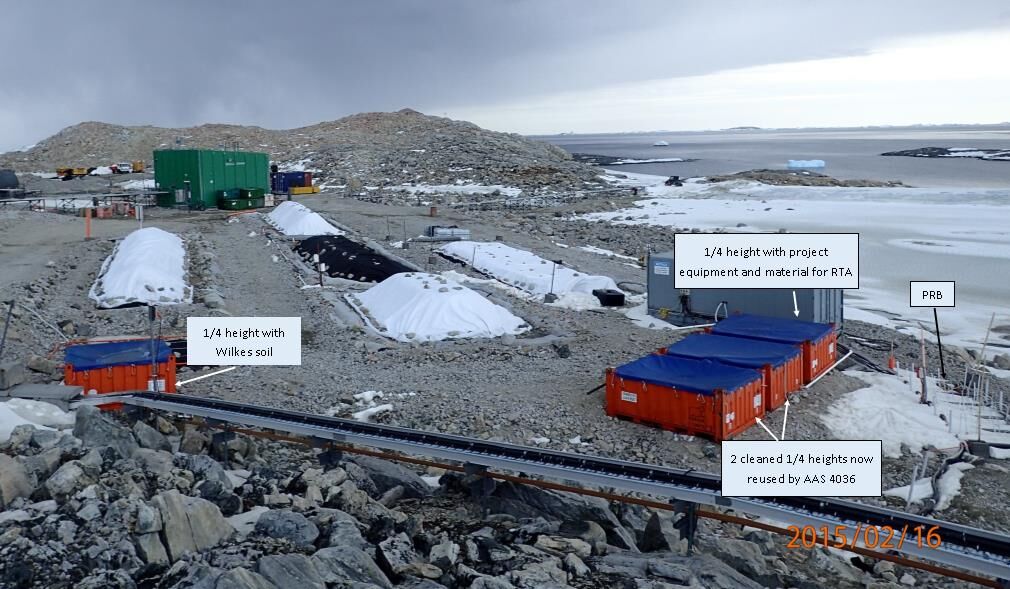
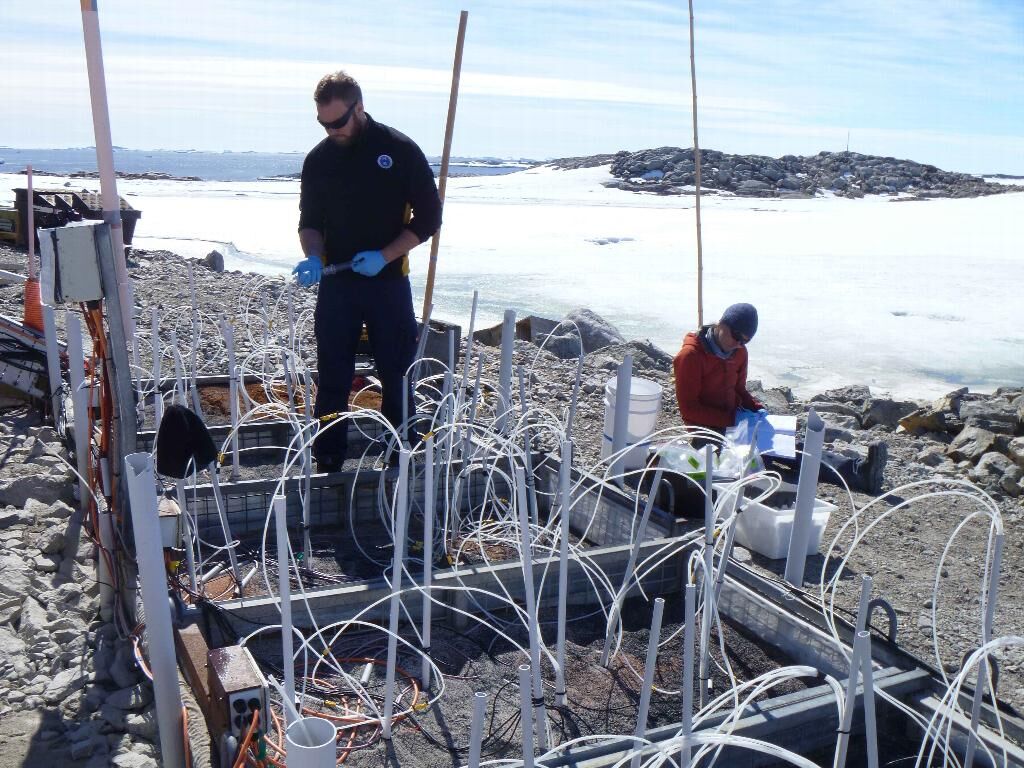
Project milestones
Summary of the project achievements 2016/17
This program successfully developed effective and efficient methods for the remediation of metal and hydrocarbon contaminated sites in cold regions. The technologies developed were based on Permeable Reactive Barriers and in-situ stablization techniques using state of the art knowledge possessed by the University of Melbourne, Macquarie University and AAD. It has positioned the AAD well for the remediation of its contaminated sites legacy and cemented its position as a leader of the Antarctic Treaty Nations in this area.
Summary of the season 2015/16
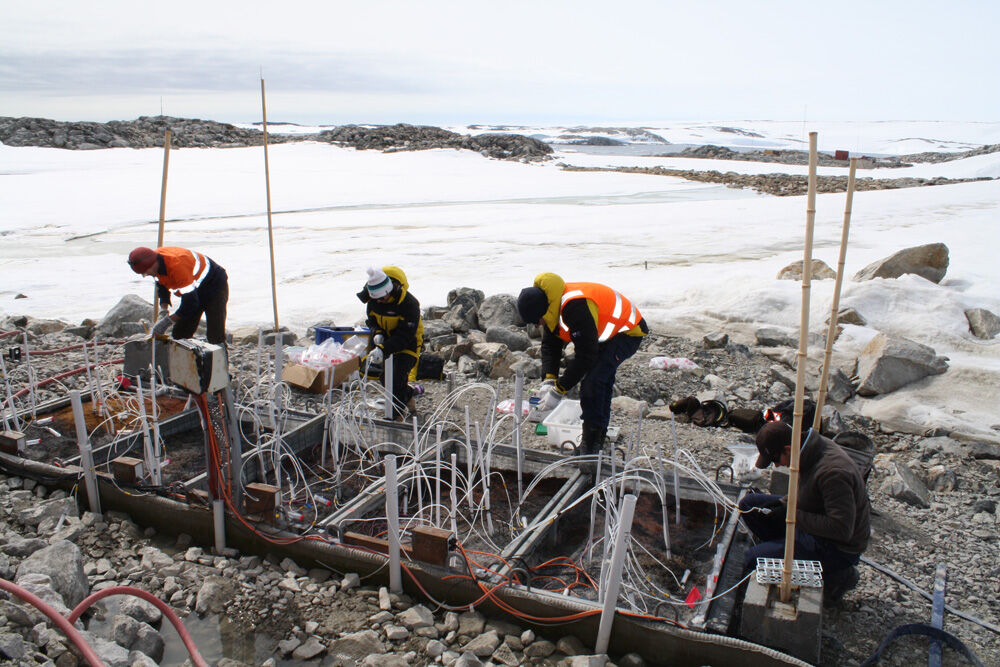
Field testing of a sequenced Permeable Reactive Barrier for containment of heavy metals and hydrocarbons showed the feasibility of this technology for containment of legacy contaminated sites in Antarctica. Also, during 2015/16 two PhD students involved in the Project, Tom Statham and Danielle Camenzuli, submitted and passed their respective PhD's. Additionally, journal articles regarding the work have been prepared, submitted and accepted by publishers.
Summary of the season 2014/15
During 2014, Tom Statham (PhD Student from the University of Melbourne) submitted and passed his PhD thesis titled 'Zero-valent iron for the in-situ remediation of Antarctic Contaminated Sites", whilst PhD student Danielle Camenzuli finalised preparations for submission of her thesis. Ms Camenzuli also traveled extensively to present the results of her work to the Scientific Community (Amsterdam, Prague amongst others). A PhD student from the University of Melbourne, Ben Freidman also traveled to Macquarie Island to install a Permeable Reactive Barrier at a fuel contaminated site. Additionally, Junchao Ma commenced a PhD at the University of Melbourne, developing new materials for heavy metal and hydrocarbon remediation. Whilst no AAS 4029 project members traveled to Casey Station this year, team members from AAS 4029 helped to consolidate the site and send samples back to Melbourne and Sydney for analysis.
Summary of the season 2013/14
Project 4029 successfully completed all objectives of the 2013/14 Casey field seasons. This incorporated a survey of the Wilkes tip site, on-going evaluation of a Permeable Reactive Barrier (PRB) for the remediation of heavy metal and hydrocarbon contaminated sites and investigation of various in-situ stabilisation technologies.
Summary of the season 2012/13
The main achievements of the Casey 2012/13 field season were: i) The completion of a successful Geophysical survey of the Wilkes Landfill site ii) Excavation of two full quarter-heights of landfill material from Wilkes and safely returning it to Casey Station for Orthophosphate Fixation trials and column experiments iii) Completion of a salt-tracer test on the lower MPH PRB iv) Core sampling of both the upper and lower MPH PRB v) The establishment and sampling of the Orthophosphate Fixation trials and column experiments vi) Replacement of the exchange materials in Cell 5 of the lower PRB with material which facilitates the removal of hydrocarbons, metals and excess phosphate and vii) the first collection of post-disturbance assessment sampling after the Wilkes excavation.
Related publications
-
The effect of temperature on hydrocarbon adsorption by diphenyldichlorosilane coated zeolite and its application in permeable reactive barriers in cold regions Cold Regions Science and Technology, 2018
(Ref: 16039)
Authors:Category 1: Peer-reviewed literature
-
A permeable reactive barrier (PRB) media sequence for the remediation of heavy metal and hydrocarbon contaminated water: A field assessment at Casey Station, Antarctica Chemosphere, 2016
(Ref: 15828)
Category 1: Peer-reviewed literature
-
Permeable bio-reactive barriers to address petroleum hydrocarbon contamination at subantarctic Macquarie Island Chemosphere, 2017
(Ref: 15822)
Category 1: Peer-reviewed literature
-
Effects of freeze-thaw phenomena on controlled nutrient release: Application to bioremediation CLEAN-Soil, Air, Water, 2016
(Ref: 15826)
Category 1: Peer-reviewed literature
-
The performance of ammonium exchanged zeolite for the biodegradation of petroleum hydrocarbons migrating in soil water Journal of hazardous materials, 2016
(Ref: 15825)
Category 1: Peer-reviewed literature