

Project information
Project aim
This collaborative postdoctoral research project between the AAD and University of Queensland aims to undertake innovative analyses in conservation and ecology, with a focus on alien species distributions and associated ecosystem restructuring in the Antarctic and sub-Antarctic. This work will address the gaps in conservation and biodiversity management in terrestrial Antarctic ecosystems. We will apply evidence-based decision making principles to issues associated with the presence of alien species and their impacts on Antarctic ecology and conservation thereof.
Project milestones
Summary of the project achievements 2015/16
We successfully achieved the primary objective of Project 4024 to undertake innovative analyses in conservation ecology, with a focus on alien species and associated ecosystem restructuring in the Antarctic and sub-Antarctic regions. Our team successfully completed fieldwork components of the project and have processed the majority of the data collected.
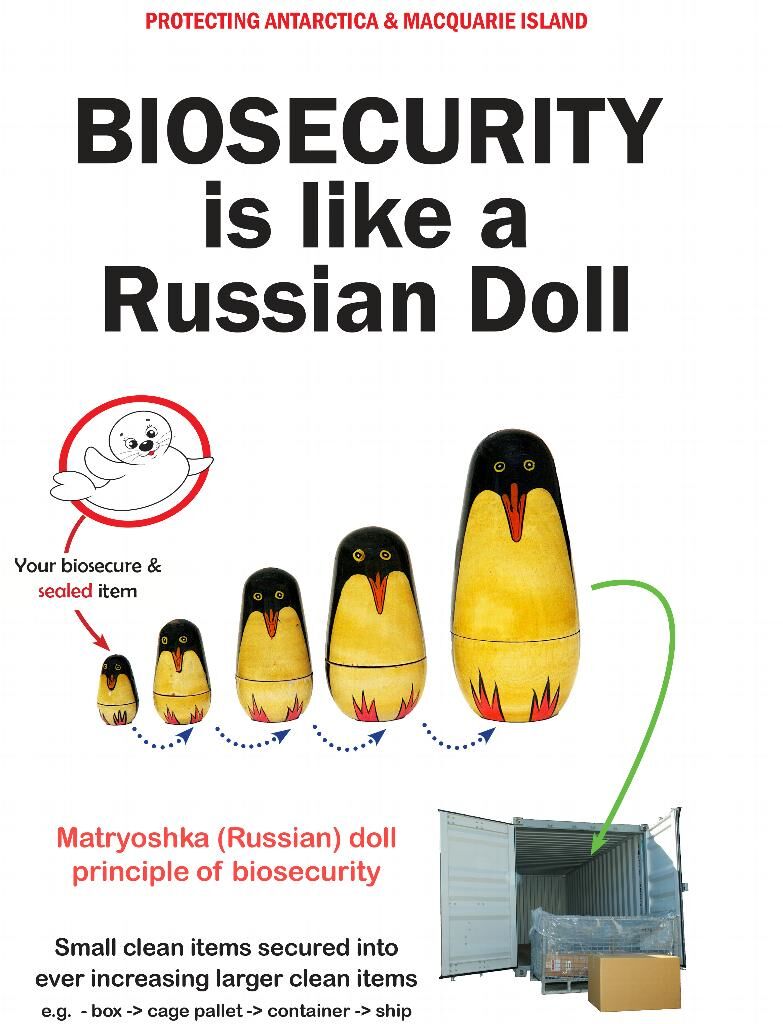
Based on our findings, we have provided advice throughout the project that has informed and improved biosecurity practices and associated understanding of invasions and invasion risk at the Australian Antarctic Division and in the Australian Antarctic territory and on sub-Antarctic Islands. We have published our results in international peer-reviewed journals and presented at international conferences, often leading discussion on issues that change the course of Antarctic policy and management and both national and international levels.
We have hosted early career researchers and supervised a number of post-graduate students, providing guidance and mentoring as required, increasing capacity in this field of research. We have developed strong international and national collaborations, that have not only facilitated achieving the objectives of this project, but will also continue to inform on the mitigation of the impacts of alien and invasive species in Antarctica and the sub-Antarctic.
Summary of the season 2014/15
The overall aim of the project is to undertake innovative analyses in conservation ecology, focusing on alien species and associated ecosystem restructuring in the Antarctic and sub-Antarctic region. This year our team has continued to provide advice that directly informs and improves biosecurity practices at the Australian Antarctic Division and in the Australian Antarctic territory. We have published our results in international peer-reviewed journals and presented at international conferences, often leading discussion on issues that change the course of Antarctic policy and management. We have hosted early career researchers and supervise a number of post-graduate students, providing guidance and mentoring as required. Our research has been used to inform policy and management decisions at national and international levels.
Summary of the season 2013/14
This project is examining the pathways of non-native species into the Antarctic rand sub-Antarctic regions and the status of such species that have already arrived in Antarctica. This year we focused on Australia-based work, looking at past collections of non-native species incursions, current effectiveness of biosecurity measures at Hobart facilities and the status of high conservation areas in Antarctica in the context of invasive species risks. We have also translated the work of this project into action, leading the development of a new AAD Biosecurity Improvement Plan. In the past 12 months, our team has lead-authored two publications and one book chapter, and co-authored several others publications that deliver into the objectives of the project. Two post-graduate students (one Honours, one Masters) working on this project graduated successfully this year and our work has been highlighted internationally in a diverse range of media.
Summary of the season 2012/13
Conservation Decision-making in Antarctic Terrestrial Ecosystems: 1. Alien Species has made good progress towards the objectives outlined in the proposal. We have successfully completed research that has significantly increased our understanding of the nature and pathways of alien invertebrate introduction to Antarctica and the sub-Antarctic. The risk of non-native species introductions has also been analysed in the context of Antarctic Specially Protected Areas, and a manuscript detailing these risks has been completed. Good progress has been made towards understanding the interactions of non-native species within the food web of sub-Antarctic islands and a database of these interactions across the entire sub-Antarctic has been completed through successful collaborations with international colleagues. We have used insights gained from this project to provide a range of advice to the Strategies and Operations branches, particularly in regard to the development of biosecurity protocols.
Related publications
-
Invasive species impacts on sub-Antarctic Collembola support the Antarctic climate-diversity-invasion hypothesis Soil Biology and Biochemistry, 2022
(Ref: 16534)
Category 1: Peer-reviewed literature
The Antarctic climate-diversity-invasion hypothesis (ACDI) predicts that in Antarctic soil systems, climate change should lead to increases in the abundance and diversity of indigenous assemblages. Where biological invasions have occurred, however…
-
Range expansion of two invasive springtails on sub-Antarctic Macquarie Island Polar Biology, 2017
(Ref: 15996)
Category 1: Peer-reviewed literature
-
Detection and eradication of a non-native Collembola incursion in a hydroponics facility in East Antarctica Biological invasions, 2017
(Ref: 15881)
Category 1: Peer-reviewed literature
-
Polar lessons learned: long-term management based on shared threats in Arctic and Antarctic environments Frontiers in Ecology and the Environment, 2015
(Ref: 15577)
Authors:Category 1: Peer-reviewed literature
-
Pathways of alien introduction to Antarctica Strategic Science in Antarctica Conference, Hobart, Australia, 24-26 June 2013, 2013
(Ref: 15551)
Category 3: Poster