
Project information
Project aim
During the past 3 decades, man-made ozone depleting chemicals have caused dramatic reductions in stratospheric ozone over Antarctica each spring. These ozone changes have influenced climate in the Southern Hemisphere, particularly during summer, but the nature of the effects is not well understood. This project uses atmospheric data and world-class climate models to gain new insights into how variations in the regional distribution of ozone couples to the Earth system in the Antarctic and Southern Ocean region, and how the coupling will respond to the expected future recovery in ozone levels.

Project milestones
Summary of the project achievements 2016/17
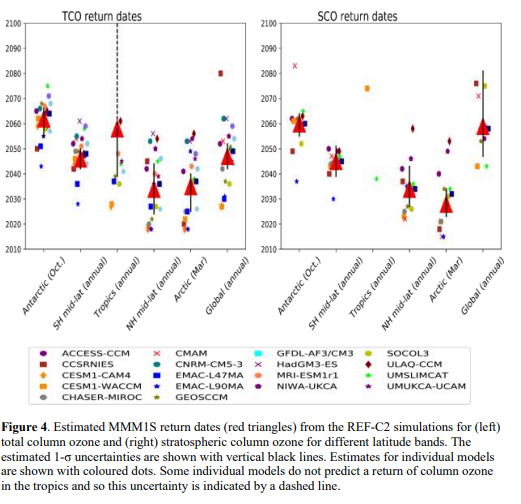
During the past 3 decades, human-produced ozone depleting chemicals have caused dramatic reductions in stratospheric ozone over Antarctica each spring. These ozone changes have influenced climate in the Southern Hemisphere, particularly during summer, but the nature of the effects is not well understood. This project created a new Australian capability in chemistry-climate modelling which enabled new insights to be gained into how variations in the regional distribution of ozone couples to the Earth system in the Antarctic and Southern Ocean region, and how the coupling will respond to the expected future recovery in ozone levels. The key findings include (a) a new assessment of the strength and variability of the Antarctic polar vortex, demonstrating that long-term changes in its shape and position are controlled by greenhouse gases and ozone depleting substances; (b) that recovery of the Antarctic ozone hole to 1980 levels is likely in the range 2055-2062; and (c) there remains uncertainty in how ozone depletion is influenced by interactions with key climate gases including methane, carbon dioxide and nitrous oxide, and how these effects couple with Antarctic surface climate.
Summary of the season 2015/16
During the last year we successfully completed further chemistry-climate model simulations using the Australian Community Climate and Earth System Simulator (ACCESS). These simulations add to Australia's contribution to the Chemistry-Climate Model Initiative (CCMI) which is a comparison of state-of-the-art climate models that will inform future assessments of global climate. The new simulations provide additional ensemble members to evaluate internal variability in the model. Our model output is currently being made available publicly through the CCMI archive at the British Atmospheric Data Centre. We have progressed the implementation of further simulations which will test the sensitivity of the Antarctic surface climate to the distribution of stratospheric ozone. The new simulations includes the use of an advanced configuration of the chemistry-climate version of ACCESS model, which for the first time involves a coupled ocean. We have also prepared for peer review a manuscript which describes future changes in the distribution of Antarctic ozone based on our model simulations.
Summary of the season 2014/15
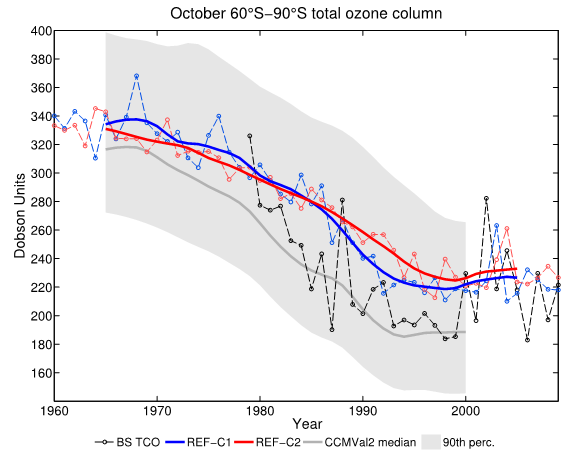
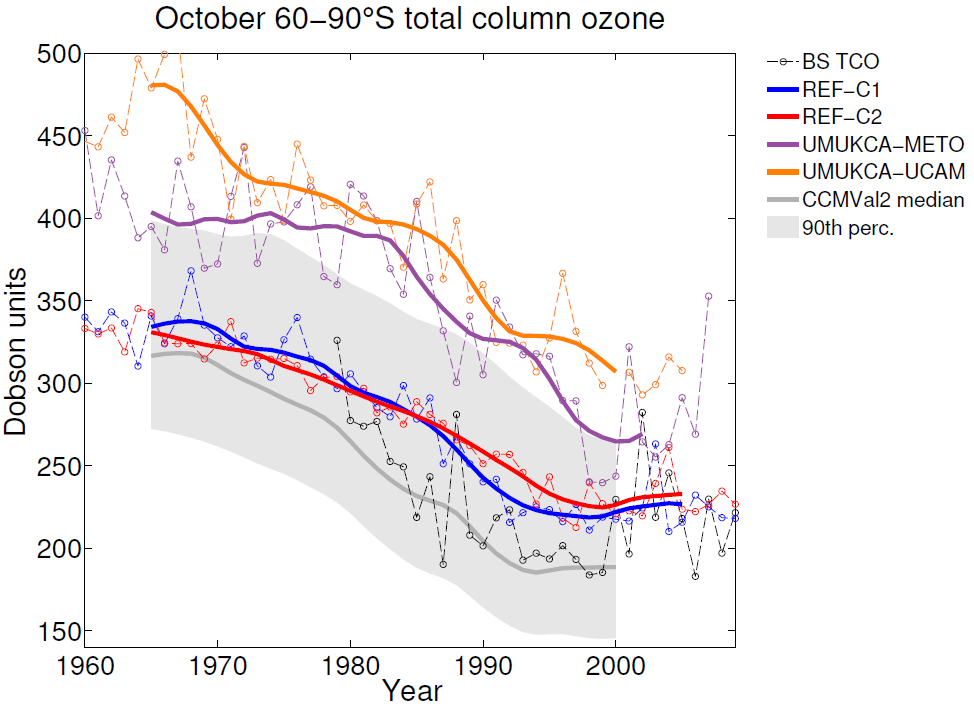
During the last year we successfully completed two further chemistry-climate model simulations using the Australian Community Climate and Earth System Simulator (ACCESS). These simulations add to Australia's contribution to the Chemistry-Climate Model Initiative (CCMI) which is a comparison of state-of-the-art climate models that will inform future assessments of global climate. The new simulations separately evolve ozone depleting substances and greenhouse gases over the period 1960 to 2100, and are being used with our earlier model output to evaluate the sensitivity of Antarctic surface climate to anthropogenic influences. We have submitted a manuscript for peer review which evaluates the performance of our initial simulations against historical observations. Aspects of the performance of our simulations can be gauged from Figs. 1 and 2 in the attached project image. Our model output is currently being made available publicly through the CCMI archive at the British Atmospheric Data Centre. We have progressed the design of further simulations which will test the sensitivity of the Antarctic surface climate to the distribution of stratospheric ozone. We have also progressed investigations of trends and variability of polar ozone, publishing details on the link with of Pacific sea surface temperature anomalies, and completed an analysis which shows that changes in the large scale pattern of spring ozone over Antarctica over the past decade are concomitant the warming hiatus that has taken been observed in the eastern Pacific since 2001.
Summary of the season 2013/14
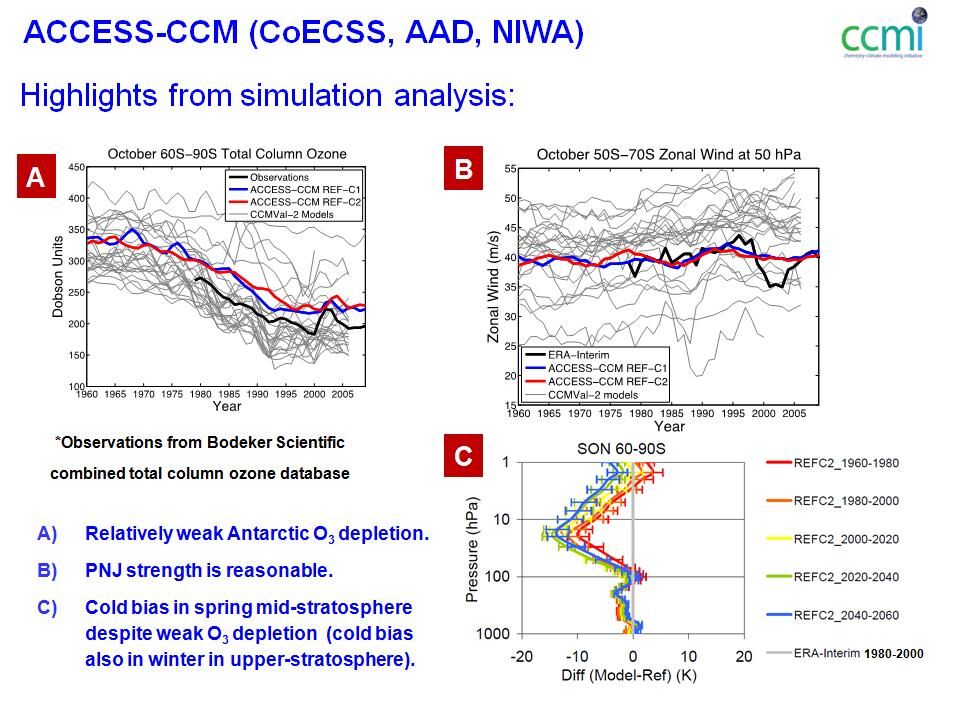
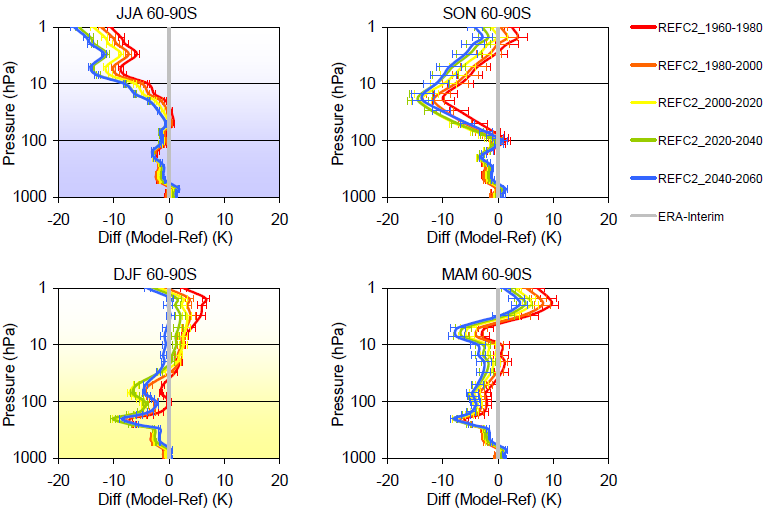
During the last year we successfully completed three chemistry-climate model simulations using the Australian Community Climate and Earth System Simulator (ACCESS). These simulations provide Australia's initial contribution to the Chemistry-Climate Model Initiative (CCMI) which is a comparison of state-of-the-art climate models that will inform future assessments of global climate. We have started to evaluate the performance of our simulations in comparison with observations, other simulations with ACCESS that have used a simplified description of ozone concentrations and other climate models to evaluate the sensitivity of climate in the Antarctic region to changes in ozone. While we find some biases in the ability of our model to represent the Antarctic atmosphere during the observational period from 1960-2010 (primarily in terms of an underestimation of the depth of the Antarctic ozone hole and a cold bias in spring stratospheric temperatures), our simulations generally have improved performance compared with models that participated in the previous chemistry-climate model assessment (the 2nd Chemistry-Climate Model Validation) - aspects of the performance of our simulations can be gauged from panels A and B in the attached project image. We are currently accumulating further simulations so that we can adequately characterise the internal variability of our model and assess the sensitivity of surface climate in the Antarctic region to the distribution of ozone.
Summary of the season 2012/13
The project began using the Australian Community Climate and Earth System Simulator (ACCESS) to provide the Australian contribution to the international Chemistry-Climate Model Initiative (CCMI) project. This is the first time that Australia has participated in an assessment program of this type. In performing this work, we have extended and improved the capability of ACCESS to more accurately simulate climate in the Antarctic region. We have also undertaken evaluation of Australian climate model simulations for the 5th Climate Model Intercomparison Project (CMIP5) to provide a benchmark to evaluate our CCMI runs. In addition, we have analysed historical atmospheric measurements for the Antarctic region to help understand the mechanism behind circulation changes related to greenhouse gas and ozone changes, and to evaluate how chemistry-climate models represent these changes.
Related publications
-
Polar Stratospheric Clouds: Satellite Observations, Processes, and Role in Ozone Depletion Reviews of Geophysics, 2021
(Ref: 16819)
Category 1: Peer-reviewed literature
-
The 2019/2020 summer of Antarctic heatwaves Global Change Biology, 2020
(Ref: 16323)
Category 1: Peer-reviewed literature
-
Assessment of the zonal asymmetry trend in Antarctic total ozone column using TOMS measurements and CCMVal-2 models Ukrainian Antarctic Journal, 2020
(Ref: 16376)
Authors:Category 1: Peer-reviewed literature
-
Comparison of Major Sudden Stratospheric Warming Impacts on the Mid-Latitude Mesosphere Based on Local Microwave Radiometer CO Observations in 2018 and 2019. Remote Sensing, 2020
(Ref: 16343)
Authors:Category 1: Peer-reviewed literature
-
Analysis of 24 years of mesopause region OH rotational temperature observations at Davis, Antarctica – Part 2: Evidence of a quasi-quadrennial oscillation (QQO) in the polar mesosphere Atmospheric Chemistry and Physics, 2020
(Ref: 16324)
Category 1: Peer-reviewed literature