
5 January, 2026
Location: Dome C North (DCN) – MYIC Inland Station, 75.0422°S, 123.6312°E, 3239 m ASL
Personnel at DCN: Damien Beloin (traverse leader), Derryn Harvie (deputy traverse leader & drill engineer), David Holley (carpenter), Ed Maguire (diesel mechanic), Kris Keen (diesel mechanic), Andy Lewis (electrician), Meg O’Connell (medical doctor), Dane Eden (diesel mechanic), Thom Whyte (electrician), Lenneke Jong (MYIC glaciologist), Julius Rix (MYIC driller), Joel Pedro (MYIC science lead), Chris Richards (MYIC drill technician), Chris Young (MYIC drill technician), Dave Burdon (diesel mechanic), Josh Kassulke (communications technician), Mingxia Lai (ice core processor, PhD student), Chris Plummer (ice core processor).
Weather at DCN: • Air temp: max −23˚C. • Winds: variable 5–10 knots. • Forecast for next 24 hours: Mostly clear. Winds 5−10 kn. Min/Max: −34/−22 ˚C.
Inland Station Operations, Science, Drilling
- Start depth (loggers): 213.45 m
- End depth (loggers): 227.7 m
- Meters drilled: 14.25 m
- Drill runs: 6
- Run lengths: 2.50, 1.85, 2.43, 2.50, 2.45, 2.52 m
With the four new team members arriving yesterday we are 18 on site now at Dome C North. There’s a bit louder buzz around the mess, with bigger pots of curry for dinner and even more of Meg’s awesome home-made Naan bread.
The new kids take it easy today on doctor’s order to help their altitude acclimation. Ice core processors Chris and Mingxia joined in the core logging and processing for a few runs to get familiar ahead of stepping in full time in the next days. Great to have the extra experienced hands.
More good full capacity drill runs today as we prepare to move to running the drill in shifts tomorrow (Tuesday). But also a few learnings and surprises.
1. Sharp core dogs make all the difference: For the first four runs we had issues again with ‘hangers’ of up to 30 cm protruding vulnerably from the drill head and clear evidence the dogs are dragging up the core and often only one was engaging. Taking out one of the three core dogs to try to provide some more uneven shear to break the core did not help the situation. For the last two runs the drillers changed the drill head for one with freshly hand-honed dogs and cutters (we continue to use step cutters). The next two breaks were perfect with all dogs engaged and no hanging core. Fastidious sharpening seems to make the difference.
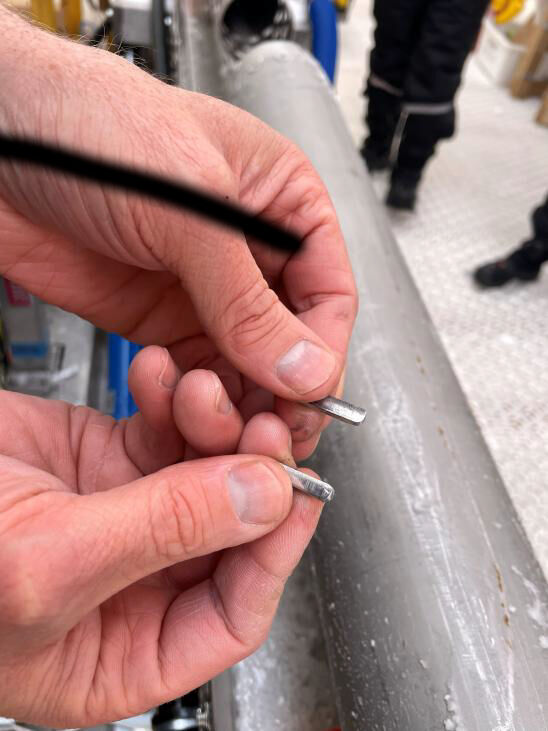
2. It's good to have shear keys: From the consistency of the material coming up in the chip chamber, which is like coconut cream, we expect there is a build-up of cuttings in the base of the borehole. This thick material also binds up in the core flutes that are designed to move the chips up the outside of the drill barrel and into the chip chamber. This afternoon this thick stuff had sufficiently bound up the barrel that an aluminium shear key was neatly sheared in half when we attempted to routinely spin the drill while horizontal on the tower. A good outcome! The shear key was replaced with a new one in 20 minutes, and the barrel cleaned out. Much better than breaking something in the gear box.
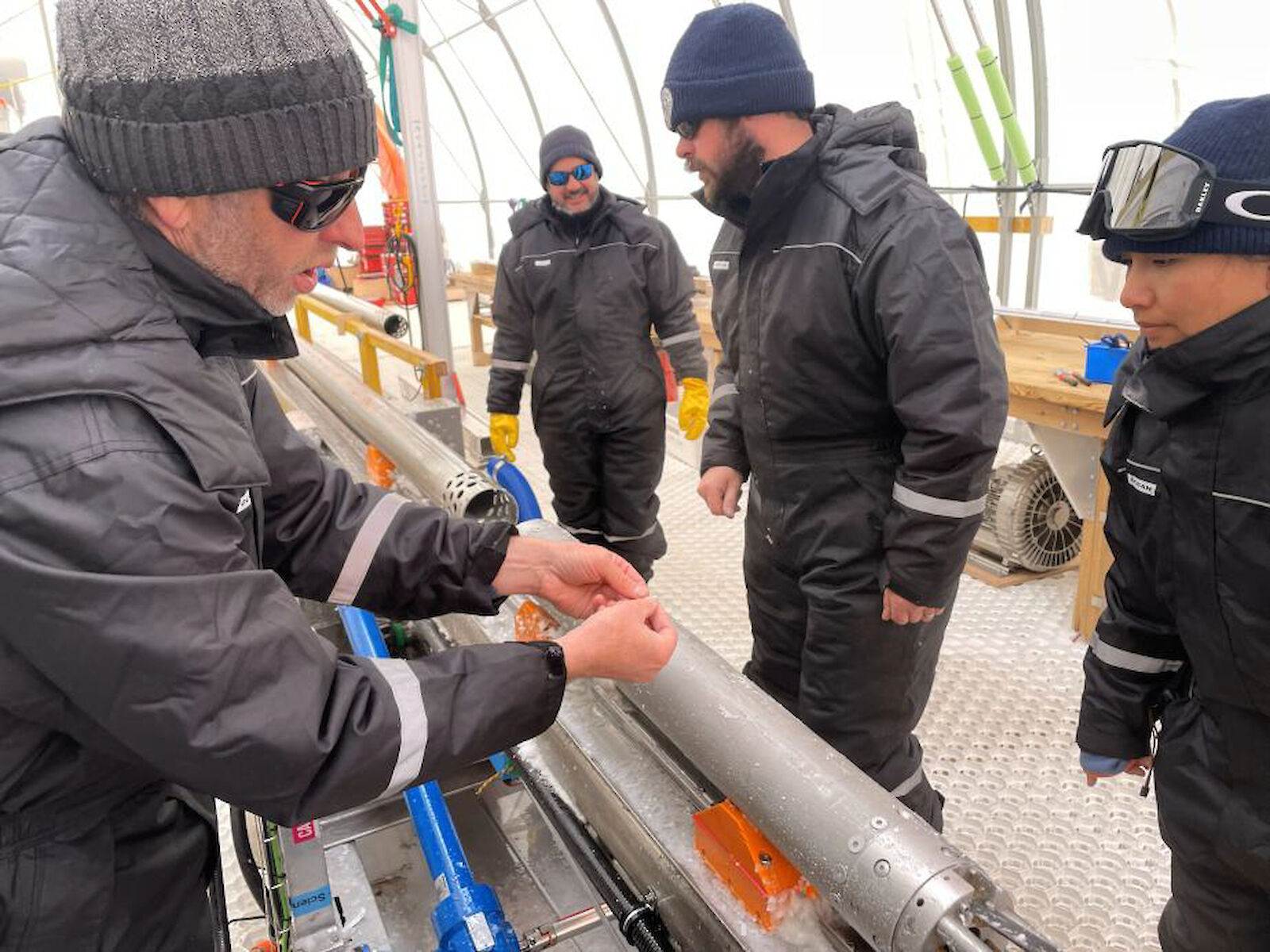
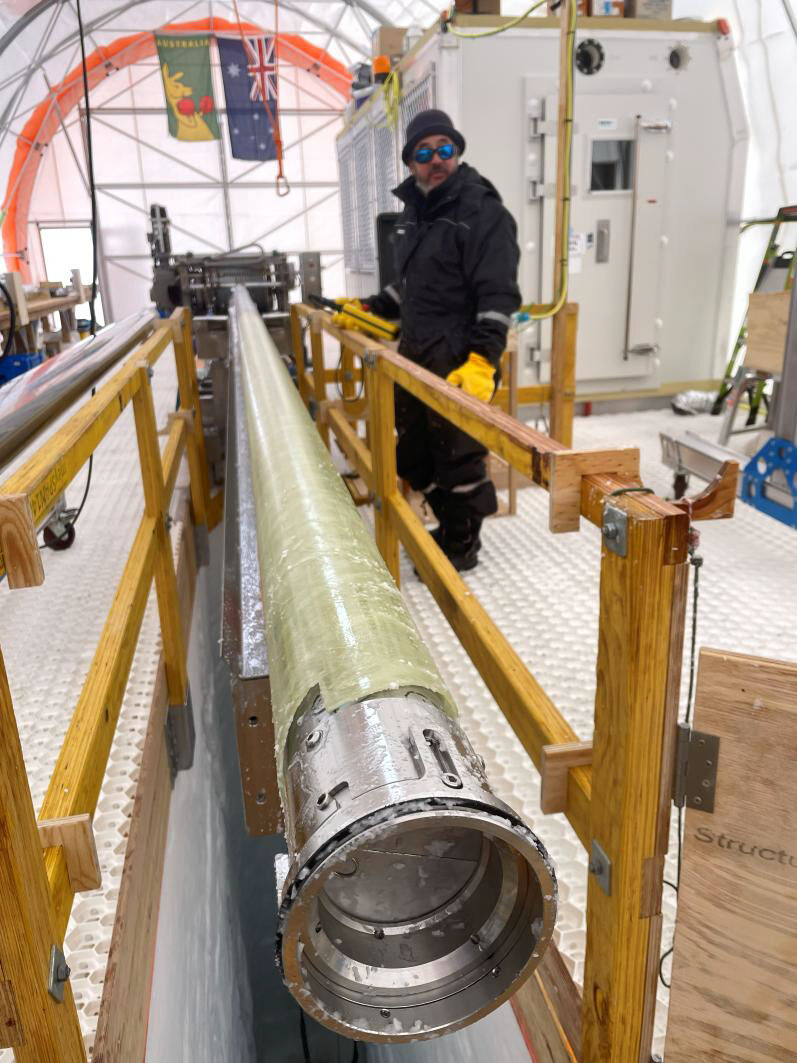
3. Stopped drill motors and more snagging on the casing: To try to capture some of the chips in the borehole we did a filtering run in which a special drill barrel with a valve in place of a cutting head (see image) is lowered slowly down the borehole while the chip pump draws fluid through a filter in the chip chamber. It was the first filtering run for us with the deep drill. On the way back up our old problem with snagging the bottom of the casing struck again. Derryn tried to creep through the casing but on attempt after attempt it was clearly catching as the load would increase steeply. To add to the challenge, the drill motor refused to run, so the drill could not be spun to help its way past. All we could think of was to get out of the cabin and manually yank the cable back and forth as the drill was lowered and raised to the catch point. Mercifully this worked and there were high fives, with drill fluid soaked gloves. We’ll do some more thinking about the approach for filtering runs. The motor not spinning turned out to be a cold limit. The slow filtering run and absence of heat normally generated by the motor during drilling had cooled the electronics to −54.5˚C. Derryn warmed it up and we were back in action.
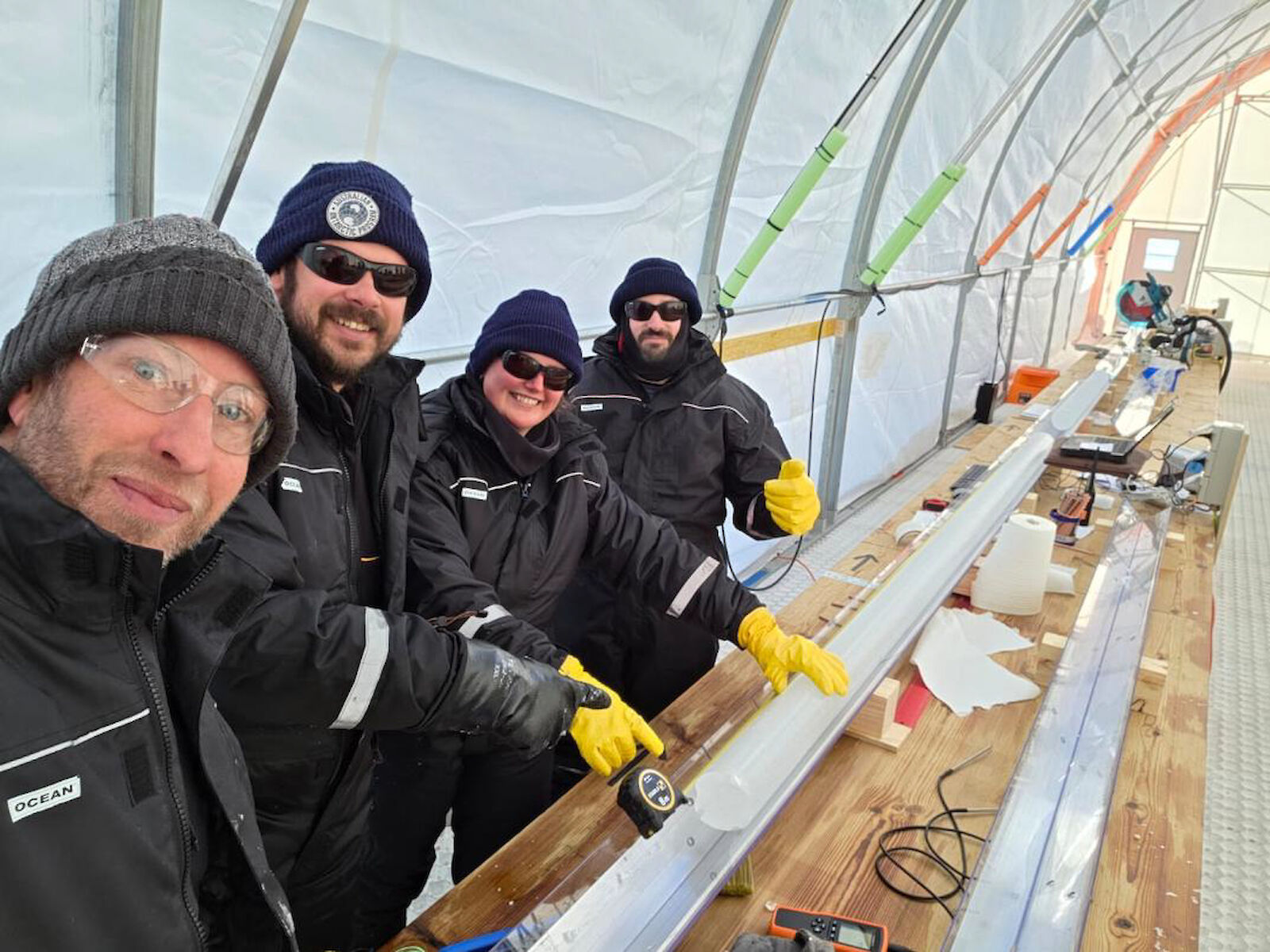
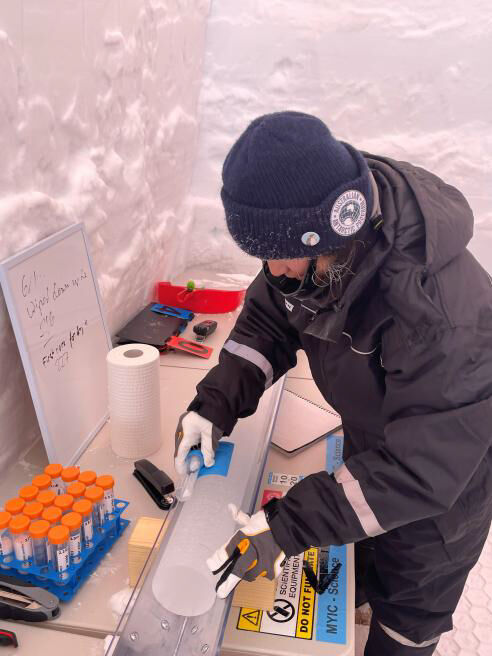
The core logging goes well with the good quality long cores. It's cold work down in the core processing tent, but satisfying to see full racks of cores and boxes filling up for transfer to our buried ice core storage container.
Tomorrow we start operating in two x eight-hour drill shifts, with an early shift from 7am to 3pm and a second from 3pm to 11pm. Each has 2–3 core processors and 2-3 drillers. Some of the traverse team are stepping in to add an extra person to the shifts, especially while Chris and Mingxia are still acclimatising.
The traverse team has loaded two containers and cargo onto traverse sleds ready for the return journey. A fuel cache of excess Jet-A1 drums is being set up in anticipation for next summer.
6 January, 2026
Location: Dome C North (DCN – MYIC Inland Station, 75.0422°S, 123.6312°E, 3239 m ASL
Personnel at DCN: Damien Beloin (traverse leader), Derryn Harvie (deputy traverse leader & drill engineer), David Holley (carpenter), Ed Maguire (diesel mechanic), Kris Keen (diesel mechanic), Andy Lewis (electrician), Meg O’Connell (medical doctor), Dane Eden (diesel mechanic), Thom Whyte (electrician), Lenneke Jong (MYIC glaciologist), Julius Rix (MYIC driller), Joel Pedro (MYIC science lead), Chris Richards (MYIC drill technician), Chris Young (MYIC drill technician), Dave Burdon (diesel mechanic), Josh Kassulke (communications technician), Mingxia Lai (ice core processor, PhD student), Chris Plummer (ice core processor).
Weather at DCN: •Air temp: max −22˚C. • Winds: W/SW 5–10 knots. • Forecast for next 24 hours: Mostly cloudy. Winds 5–10 kn. Min/Max: −30/−20 ˚C.
Inland Station Operations, Science, Drilling
- Start depth (loggers): 227.7 m
- End depth (loggers): 241.5 m (at 7 pm, evening shift continues)
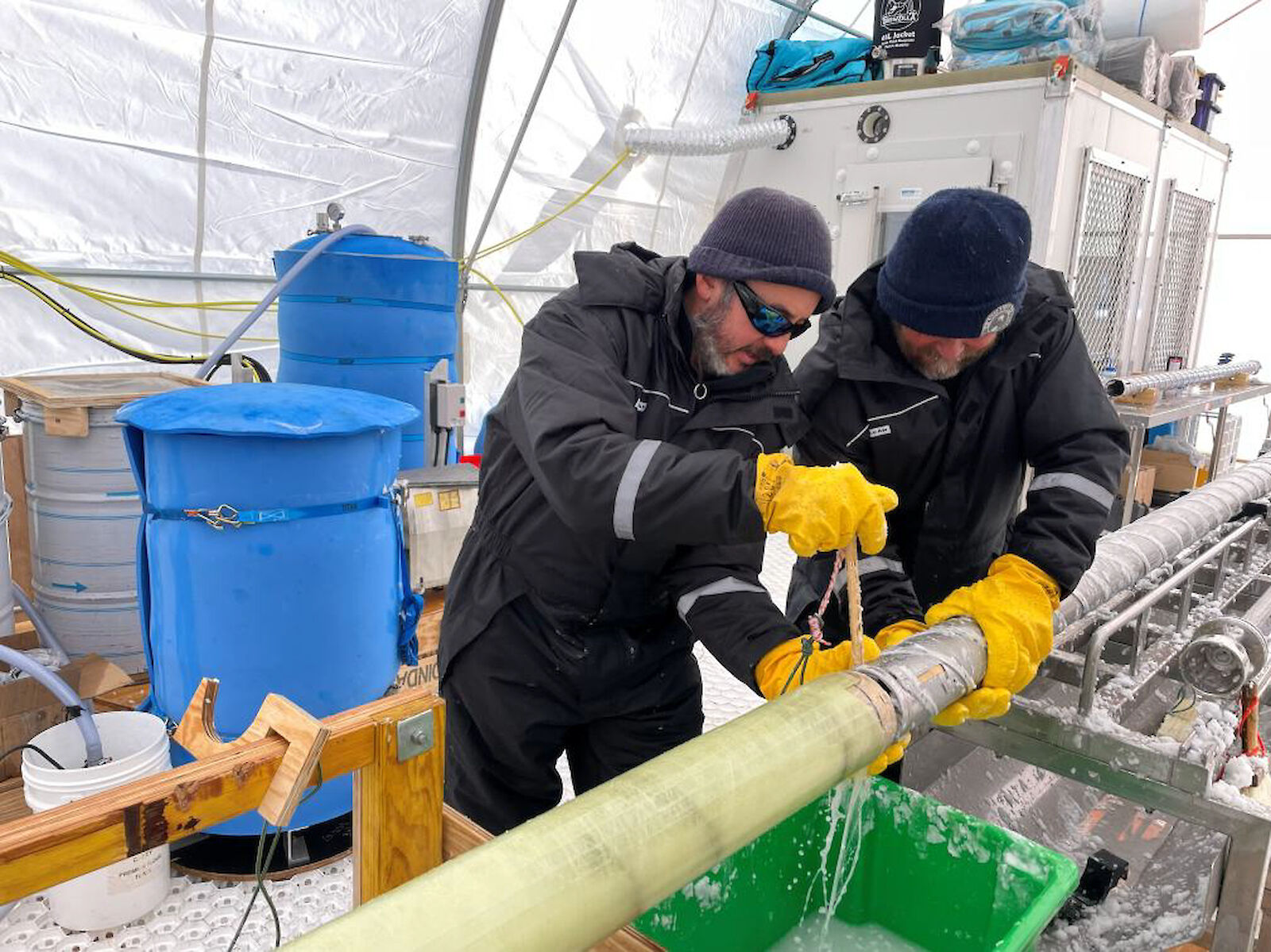
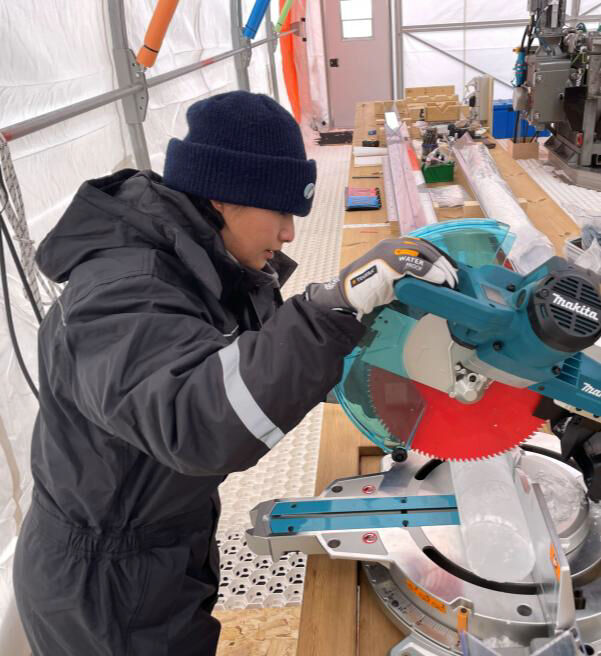
A good start to the drilling shifts today with no significant issues and 14 metres drilled by 7 pm, with the evening shift still underway until 11 pm. Chris P and Mingxia have joined the ice core processing shifts from today and we’ve started moving full boxes of ice cores into the buried storage container.
Members of the traverse crew are preparing to travel the 40 km (about four hours by tractor) to the Beyond EPICA camp tomorrow to help them lift containers onto sleds with our Challenger tractors.
7 January
Location: Dome C North (DCN) – MYIC Inland Station, 75.0422°S, 123.6312°E, 3239 m ASL
Personnel at DCN: Damien Beloin (traverse leader), Derryn Harvie (deputy traverse leader & drill engineer), David Holley (carpenter), Ed Maguire (diesel mechanic), Kris Keen (diesel mechanic), Andy Lewis (electrician), Meg O’Connell (medical doctor), Dane Eden (diesel mechanic), Thom Whyte (electrician), Lenneke Jong (MYIC glaciologist), Julius Rix (MYIC driller), Joel Pedro (MYIC science lead), Chris Richards (MYIC drill technician), Chris Young (MYIC drill technician), Dave Burdon (diesel mechanic), Josh Kassulke (communications technician), Mingxia Lai (ice core processor, PhD student), Chris Plummer (ice core processor).
Weather at DCN: • −25˚C, snow showers, winds: SE 140˚, 9 knots • Forecast for next 24 hours: Mostly cloudy. Winds: S/SW 5/10 knots. Min/Max: −31/−23 °C
Inland Station Operations, Science, Drilling
- Start depth (loggers): 241.5 m
- End depth (loggers): 256.6 m (at 7pm, evening shift continues)
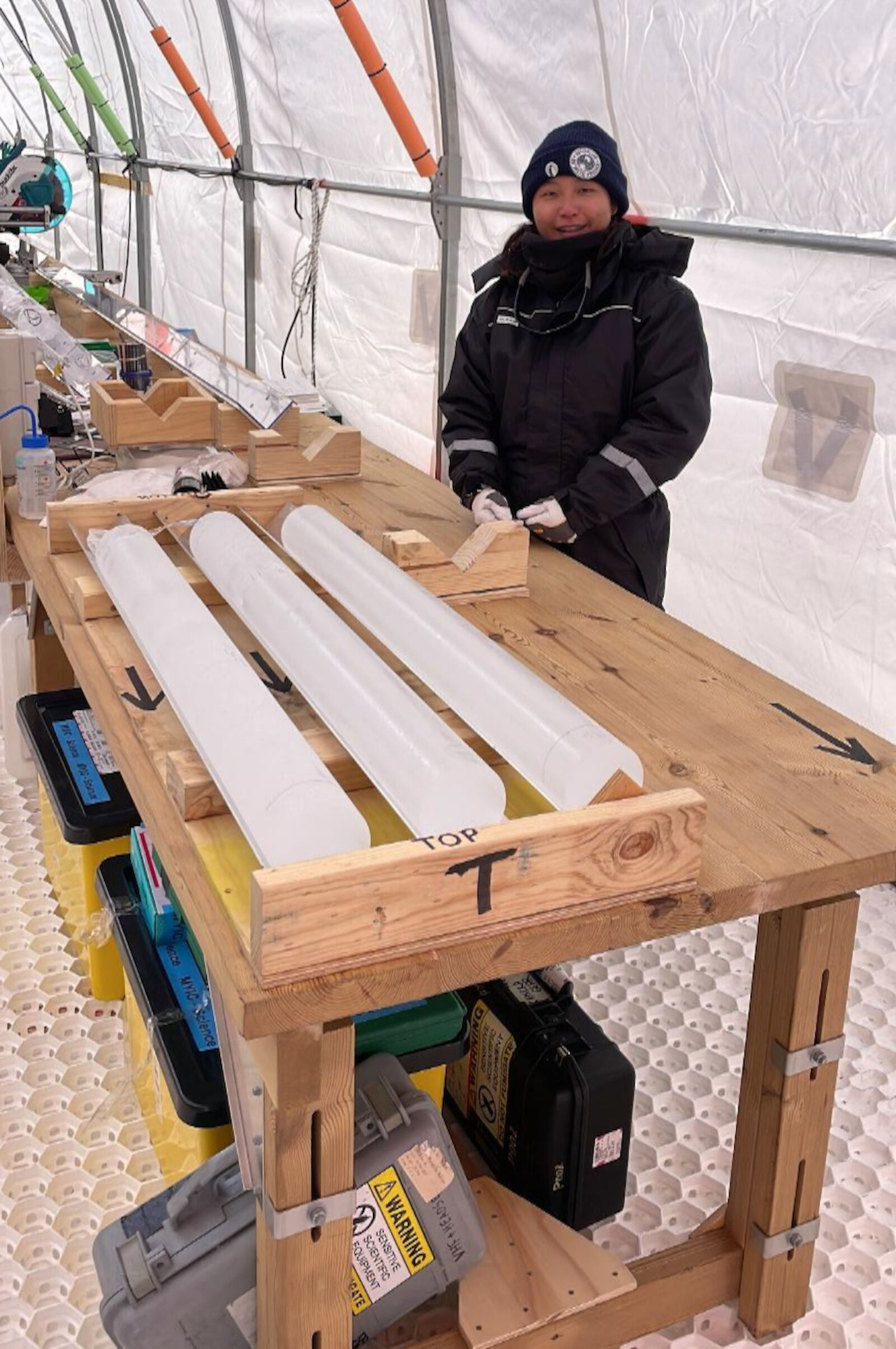
We are part way through the second day of shift drilling and have passed 250 metres drill depth, and 100 metres drilled since starting on Boxing day. We continue to work through some issues today with poor penetration and short runs. Getting consistent runs and core quality is a fine balance between cutting pitch, anti-toque settings, chip transport, fluid levels, cutter and dog sharpness and multiple other factors. On writing, the evening shift have just pulled up a nice 2.85 metre core.
Four members of the traverse crew drove four hours to Beyond EPICA camp today and helped them move containers onto sleds using the Challenger crane. The assistance was much appreciated. It is good to be able to give back to the Beyond EPICA project who have assisted us scientifically and logistically in our own deep drilling project.
Our first Basler flight to return ice cores to cold storage in Casey is scheduled tomorrow. It will bring in 1000 kg of cargo and return the first 100 metres of core (pending weather).


8 January, 2026
Location: Dome C North (DCN)—MYIC Inland Station, 75.0422°S, 123.6312°E, 3239 m ASL
Personnel at DCN: Damien Beloin (traverse leader), Derryn Harvie (deputy traverse leader & drill engineer), David Holley (carpenter), Ed Maguire (diesel mechanic), Kris Keen (diesel mechanic), Andy Lewis (electrician), Meg O’Connell (medical doctor), Dane Eden (diesel mechanic), Thom Whyte (electrician), Lenneke Jong (MYIC glaciologist), Julius Rix (MYIC driller), Joel Pedro (MYIC science lead), Chris Richards (MYIC drill technician), Chris Young (MYIC drill technician), Dave Burdon (diesel mechanic), Josh Kassulke (communications technician), Mingxia Lai (ice core processor, PhD student), Chris Plummer (ice core processor).
Weather at DCN: • −23˚C, mostly cloudy, S/SW 5–10 knots • Forecast for next 24 hours: Partly cloudy. Winds: S/SW 10/15 knots. Min/Max: −32/−24 °C
Inland Station Operations, Science, Drilling
- Start depth (loggers): 256.6 m
- End depth (loggers): 279.6 m
- 23 m drilled
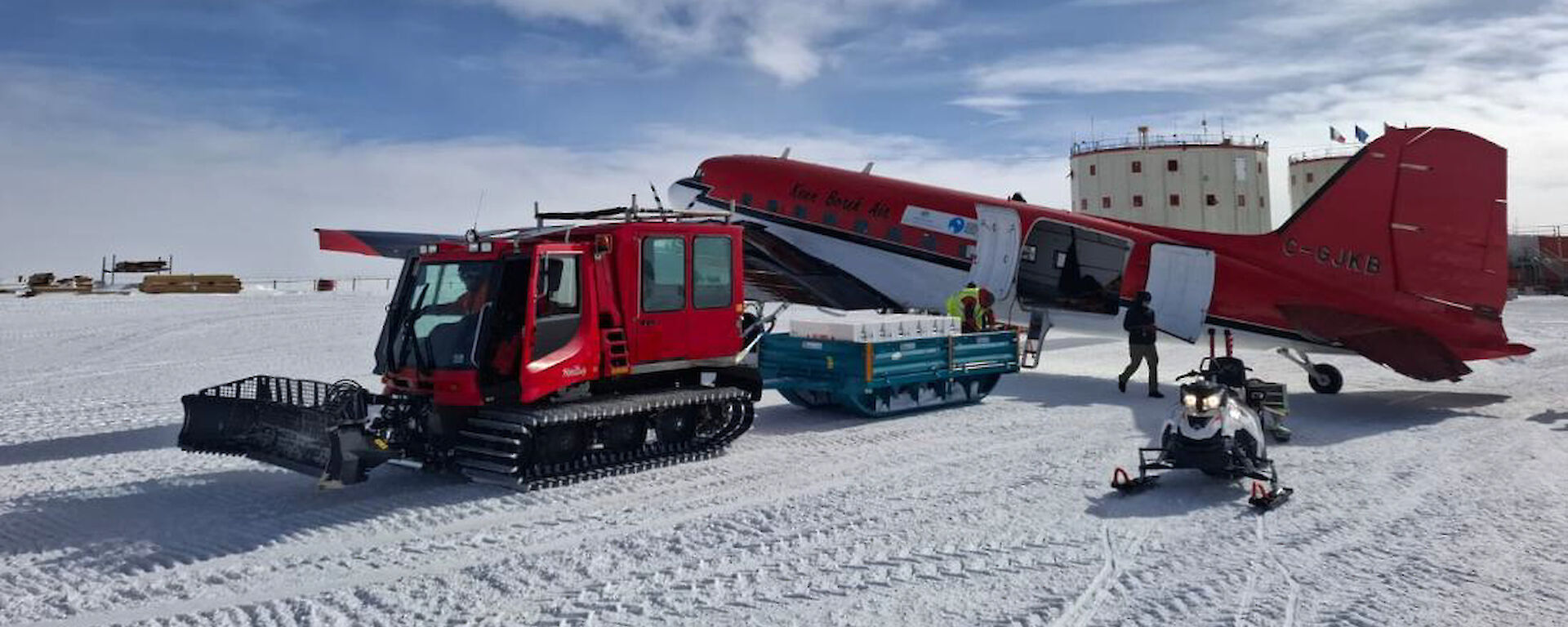
We were up early this morning to load the first 100 m of ice core onto a sled for transport to Concordia and retro to Casey by Basler.
The cores went smoothly behind our snow groomer and were loaded with help from Concordia to Basler JKB. But part way into the flight we got a call that fog was coming in at the Casey Skiway and that the flight would need to return to Concordia.
Riccardo Scipinotti, Station Leader at Concordia, quickly arranged that the cores would be unloaded and stored in one of their balloon trenches at −50˚C. So that is where they lay for the night, which is happy place for ice cores – with thank you, Concordia. The flight home to Casey is now planned tomorrow, weather permitting. Good to have friends in high cold places.
We drilled 23 m today, which is our record for the season. One we are keen to improve on in the next days as we gain more experience with the drill system. Today each shift made a filtering run to remove chips and cuttings from the borehole, we feel this is helping with consistent runs. Chippy Dave has made a ply hot box which the Andy has connected to a 5 kW heater, this will be running soon to help clean and dry out the hollow shaft and chip pump. We reckon this will also help our ability to clear chips and improve drilling.


9 January, 2026
Location: Dome C North (DCN) – MYIC Inland Station, 75.0422°S, 123.6312°E, 3239 m ASL
Personnel at DCN: Damien Beloin (traverse leader), Derryn Harvie (deputy traverse leader & drill engineer), David Holley (carpenter), Ed Maguire (diesel mechanic), Kris Keen (diesel mechanic), Andy Lewis (electrician), Meg O’Connell (medical doctor), Dane Eden (diesel mechanic), Thom Whyte (electrician), Lenneke Jong (MYIC glaciologist), Julius Rix (MYIC driller), Joel Pedro (MYIC science lead), Chris Richards (MYIC drill technician), Chris Young (MYIC drill technician), Dave Burdon (diesel mechanic), Josh Kassulke (communications technician), Mingxia Lai (ice core processor, PhD student), Chris Plummer (ice core processor).
Weather at DCN: • −28˚C, partly cloudy, 9 knots, blowing snow
Inland Station Operations, Science, Drilling
- Start depth (loggers): 279.67 m
- End depth (loggers): 299.29 m @ 7pm, night shift continues
- 19.62 m drilled
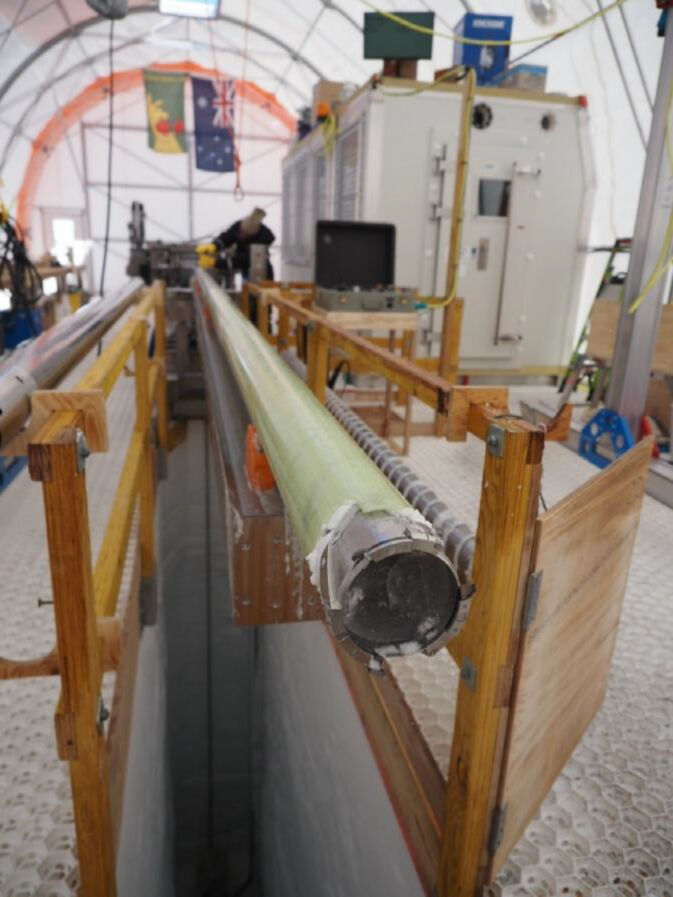
A good day of drilling today with some of the most consistent runs we’ve seen: 2.61, 2.47, 2.52, 2.35, 2.48, 2.62, 1.93, 2.50 m. The 300 metre mark is just inches away. But it is not like clockwork, getting the full runs requires careful attention to cutting pitch, cleaning out of the hollow shaft and chip chamber, sharpening of cutters and core dogs and load on the drill head.
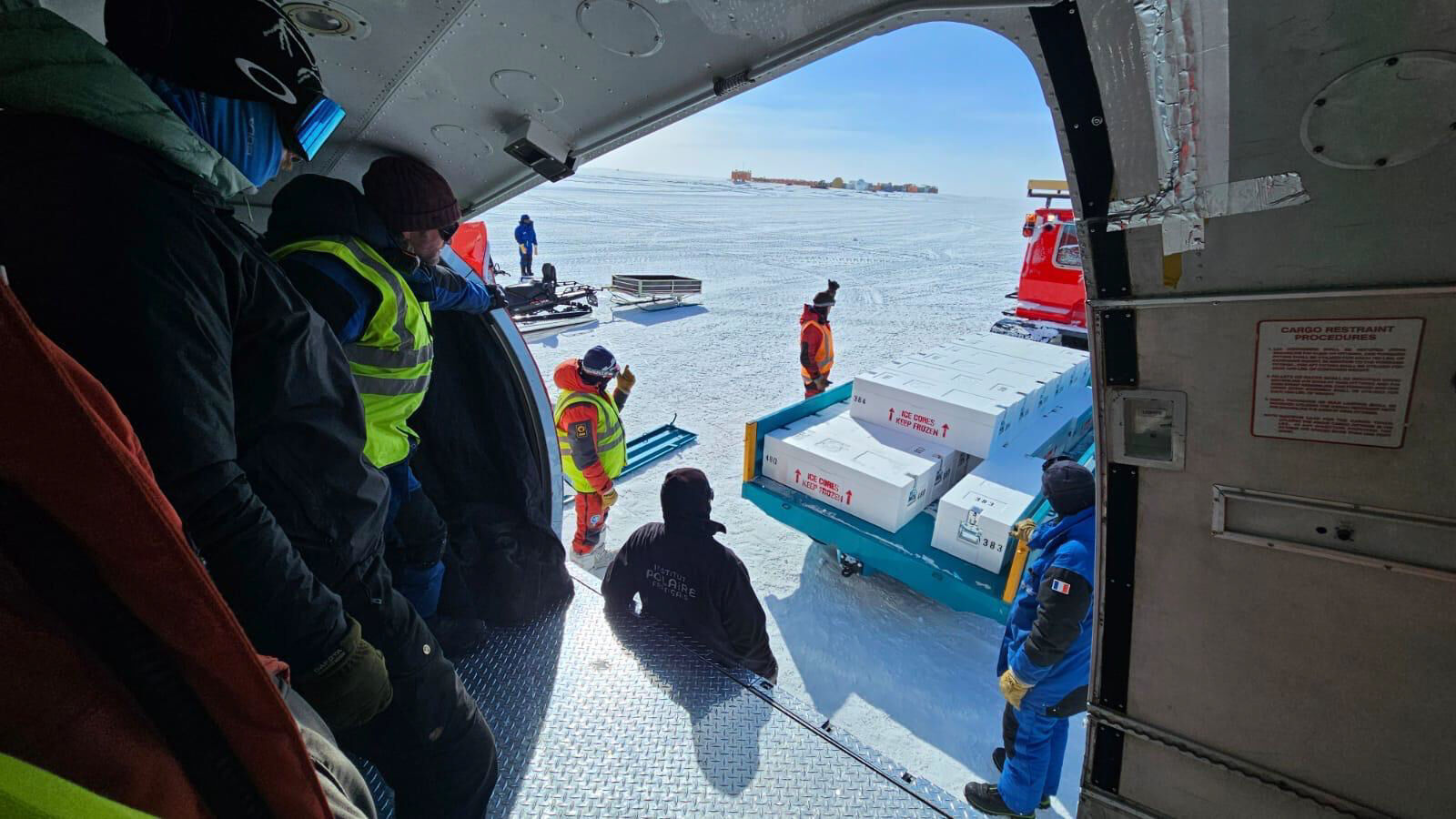
After their night in the -50˚C balloon cave at Concordia the first 17 Skufa boxes of ice (102 metres of ice cores) were loaded again into Basler JKB and flown to Casey this afternoon.
The ice cores made it safely to storage in a -30˚C refrigerated container at Casey. We have a back-up refrigerated container standing by in case of any problem with the primary. Thanks very much to the infrastructure and electrical team at Casey and back at Kingston who have got the reefers in place, running and closely monitored for us. Later in the season, all cores will be part of the cargo returning to Hobart by C-17 flights supported by the ADF.
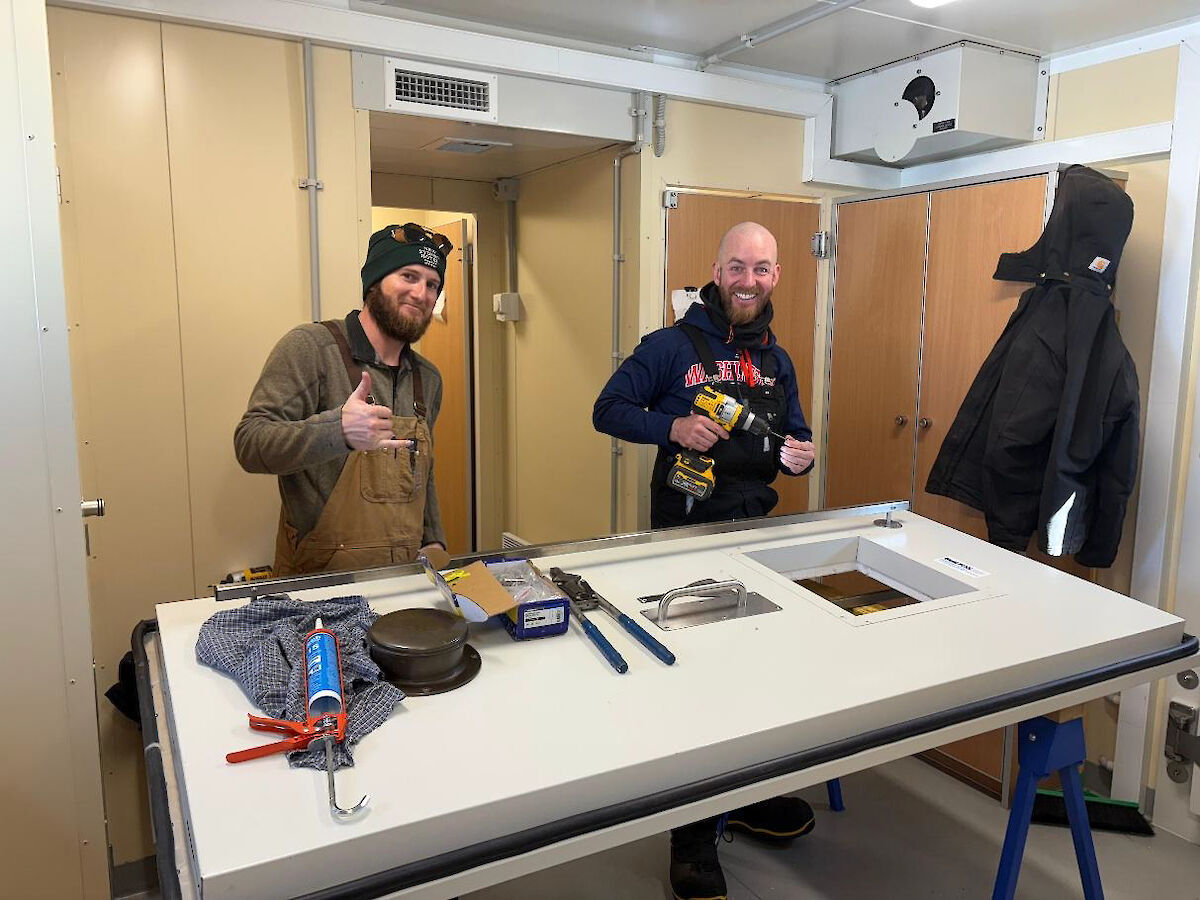
Elsewhere on this piercingly cold day, sparkies Thom and Andy put up more power poles, and Chippy Dave, and Josh, are replacing windows that we’ve found do not survive the extreme cold.
The ‘Inland Station’ facilities currently supporting the MYIC project will stay in place until completion of drilling scheduled 2028/29 and then are designed to be redeployed in support of other deep field science projects away from the main coastal stations.
10 January
Location: Dome C North (DCN) – MYIC Inland Station, 75.0422°S, 123.6312°E, 3239 m ASL
Personnel at DCN: Damien Beloin (traverse leader), Derryn Harvie (deputy traverse leader & drill engineer), David Holley (carpenter), Ed Maguire (diesel mechanic), Kris Keen (diesel mechanic), Andy Lewis (electrician), Meg O’Connell (medical doctor), Dane Eden (diesel mechanic), Thom Whyte (electrician), Lenneke Jong (MYIC glaciologist), Julius Rix (MYIC driller), Joel Pedro (MYIC science lead), Chris Richards (MYIC drill technician), Chris Young (MYIC drill technician), Dave Burdon (diesel mechanic), Josh Kassulke (communications technician), Mingxia Lai (ice core processor, PhD student), Chris Plummer (ice core processor).
Weather at DCN: • −28˚C, partly cloudy, up to 20 knots S, with blowing snow • Forecast for next 24 hours: Partly cloudy. Winds: S 10/15 knots. Min/Max: −32/−26 °C
Inland Station Operations, Science, Drilling
- Start depth (loggers): 299.3 m
- End depth (loggers): 315.0 m @ 7pm, night shift continues
- 15.7 m drilled
The evening shift passed the 300 mark mark last night, which takes us to an estimated age of 9,300 years.
At this time, global sea levels were continuing to rise after melt of the great ice sheets of the last glacial period, as recorded in oral traditions of many Australian Aboriginal peoples (see Ancient Aboriginal stories preserve history of a rise in sea level in The Conversation).
To see the modelled age of the ice versus depth from the surface through to bedrock at our DCN drilling site, check out the online tool at the bottom of our Million Year Ice Core page, based on data from Dr Ailsa Chung.
On this morning’s shift the drilling metres were harder to find. We had two good runs, but several very short runs with current increasing as the drill bit in and the anti-torque springs at the top of the drill slipped. The anti-torque is needed to oppose the rotation force produced by the cutting head, when it slips it effectively ends the drill run. Adjusting the cutting pitch in the range that has been working for us (3 mm, 3.5 mm, 4 mm) did not fix the problem. At smaller pitch the drill was not penetrating and at larger pitch the anti-torque would slip.
This evening it was noticed that fasteners in the anti-torque section of the drill were loose. We expect this has happened progressively over days and may explain our trouble balancing the cutting pitch and anti-torque. On writing, the evening shift has just finished work on the anti-torque and Derryn re-terminated electrical connections into the sonde that were causing intermittent problems. After this work the drillers and core processors collected a full core, finishing the week on a good note.
The 20 knot winds today and blowing snow made it tougher work than normal in the core processing tent. We needed to clear the ramp with shovels several times to be able to get in safely with cores.
Tomorrow we will have a rest from the shift work and take time to discuss what we have learned and plan the final week of drilling here at DCN for the season.