29 December, 2025
Location: Dome C North (DCN)—MYIC Inland Station, 75.0422°S, 123.6312°E, 3239 m asl.
Personnel at DCN: Damien Beloin (traverse leader), Derryn Harvie (deputy traverse leader & drill engineer), David Holley (carpenter), Ed Maguire (diesel mechanic), Kris Keen (diesel mechanic), Andy Lewis (electrician), Meg O’Connell (medical doctor), Dane Eden (diesel mechanic), Thom Whyte (electrician), Lenneke Jong (MYIC glaciologist), Julius Rix (MYIC driller), Joel Pedro (MYIC science lead), Chris Richards (MYIC drill technician), Chris Young (MYIC drill technician).
Weather at DCN: • Air temp: -20˚C • Wind speed: 10 knots, NNE 40˚ • Forecast for next 24 hours: Mostly cloudy. Winds: E 5/10 knots. Min/Max: -20/-15 ˚C
Inland Station Operations, Science, Drilling
Drilling stats:
- Start depth (loggers): 159.34 m
- End depth (loggers): 169.42 m
- Meters drilled: 10.08m
- Drill runs: 5
- Run lengths: 2.52, 2.83, 0.28, 3.00, 1.45 m
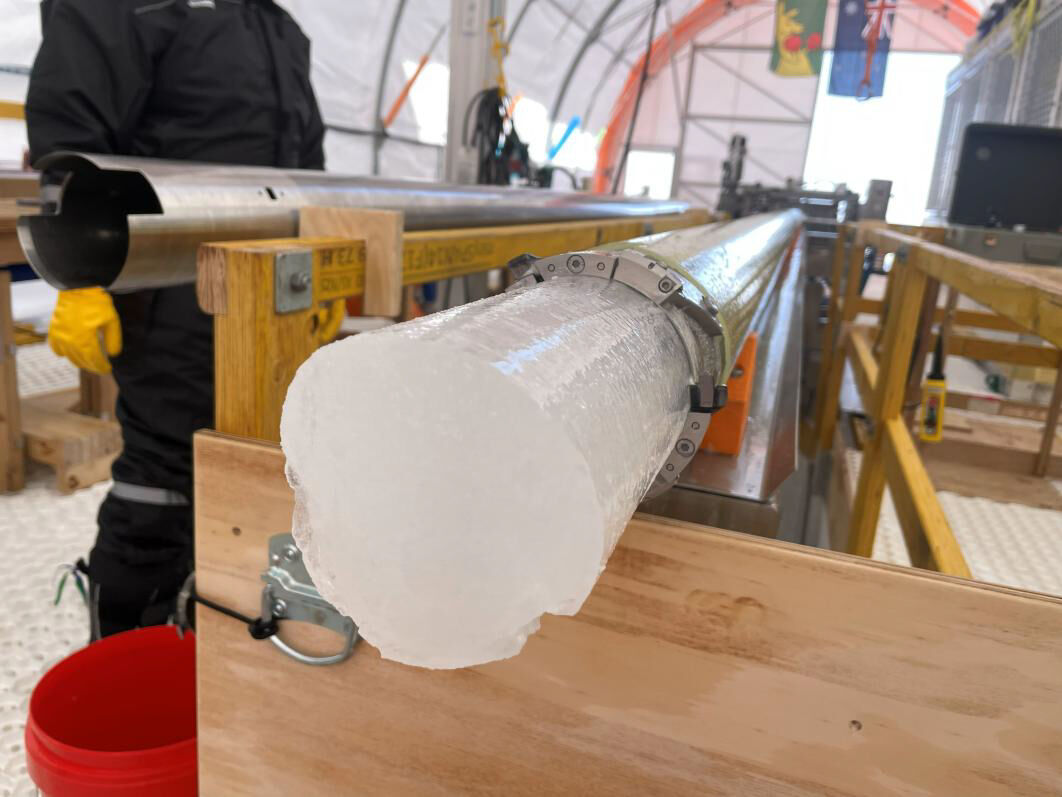
Today was the second day of drilling with the AAD deep drill. We had several good runs with drill lengths in the range 2.5 to 3 metres. Adjustments made on Saturday have greatly improved chip capture in the chip chamber and the software adjustments have kept the winch heaters on and the winch in its operating temperature range all day. This is good progress from Friday.
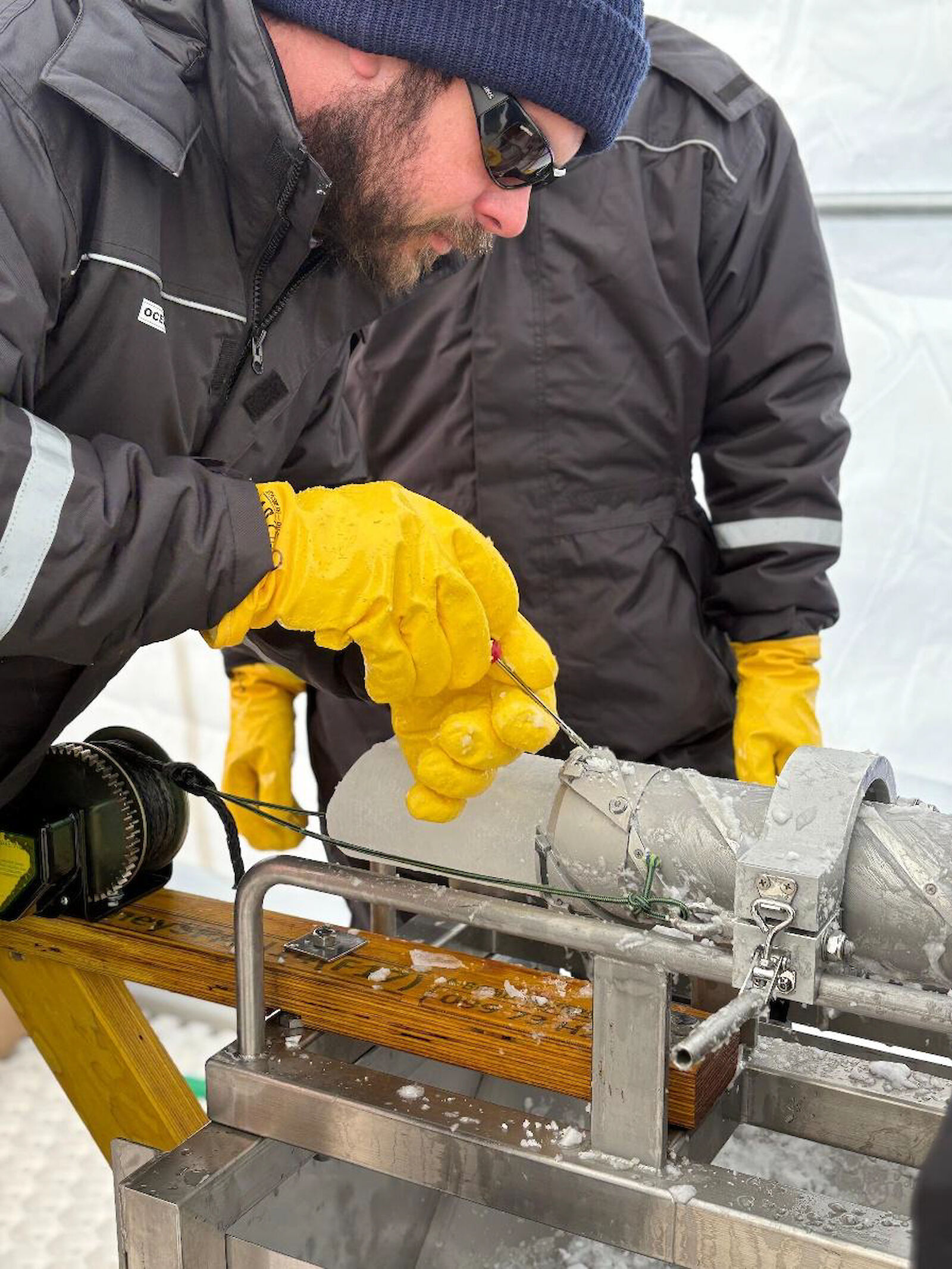
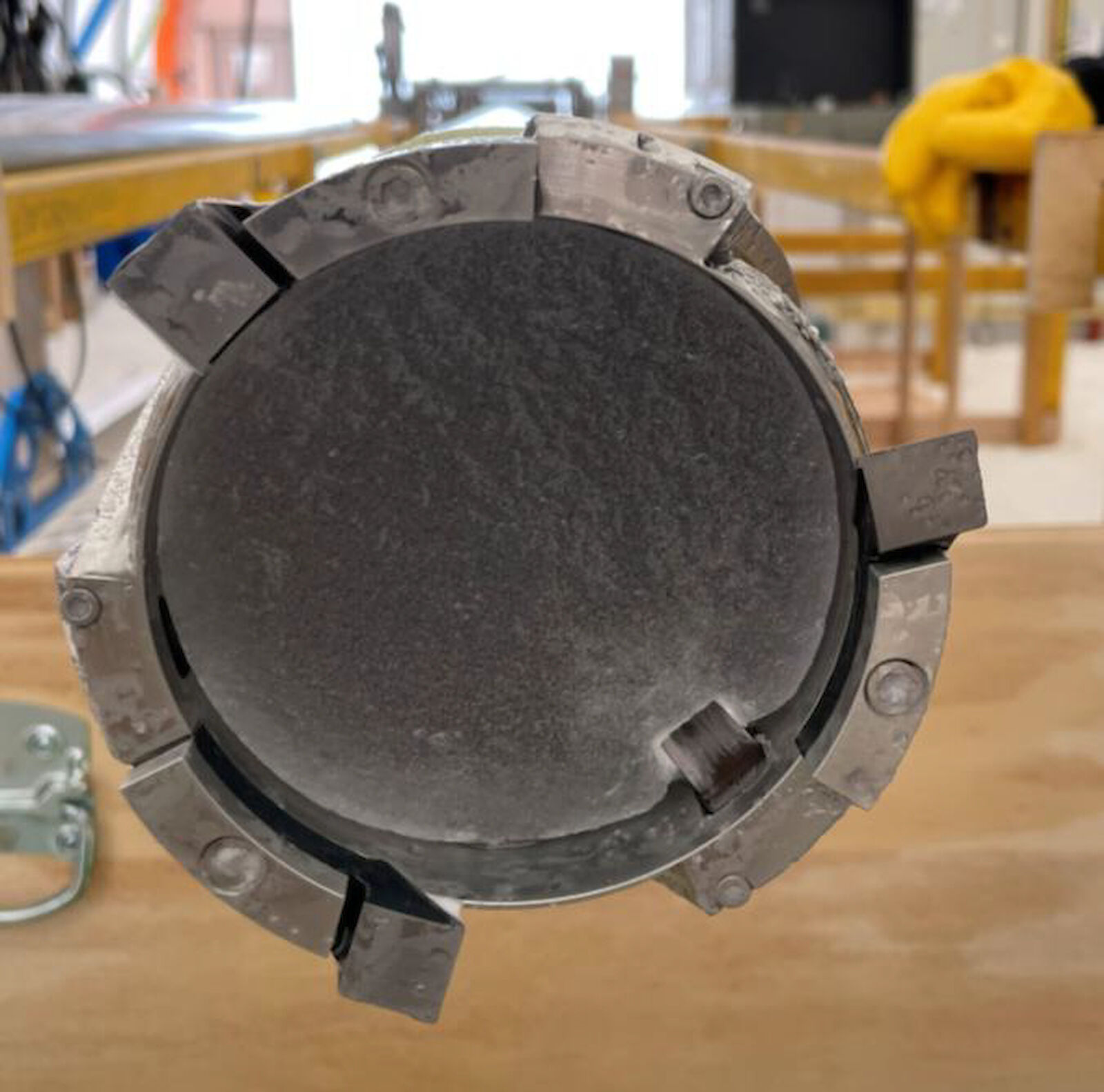
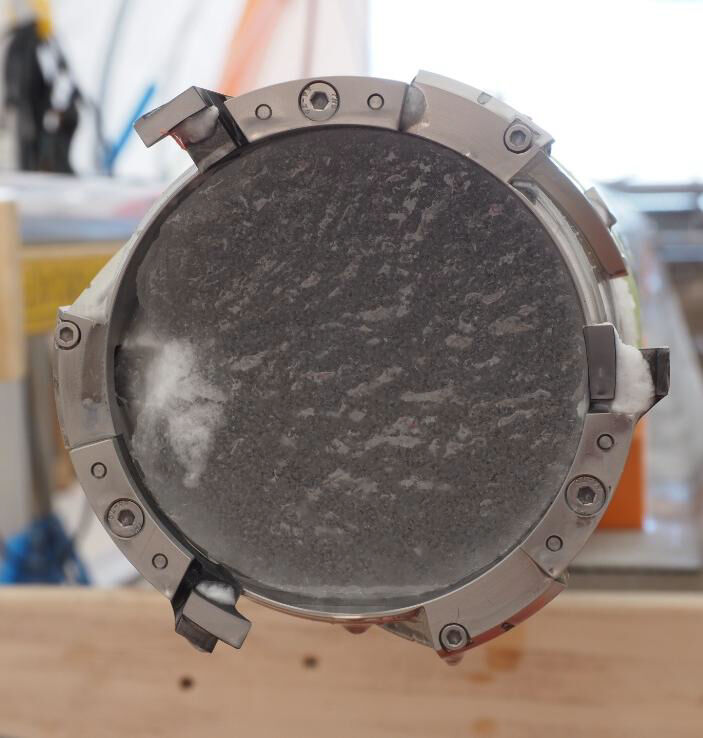
But there are always things to improve, and we continue to have some issues with core breaks. Core breaks are achieved by sprung sharp ‘core dogs’ biting into the core when you pull up with the winch after completing a run to crack the core away from the glacial ice.
In several of the cores drilled today we can see evidence that when we try to break the core, the dogs are sliding up and over the drilled core by up to 30 cm before biting in and achieving the break. On a few occasions this led to core being left at the base of the borehole, which then needs to be drilled over and recovered on the next run.
Later in the day we pulled up to find ‘hangers’, where the core was protruding from the end of the drill head by up to 20 cm. We tried to get cleaner breaks by putting more tension on the core dog springs and by switching from longer to shorter core dogs. Neither improved the situation.
Tomorrow we have a couple ideas to try in the pursuit of cleaner breaks, including faster or slower winch speed during the break. None of this is particularly unusual, core breaks are always something of an art form, even for tried and tested drill systems. We’ll work methodically at it and you shall hear how we go.
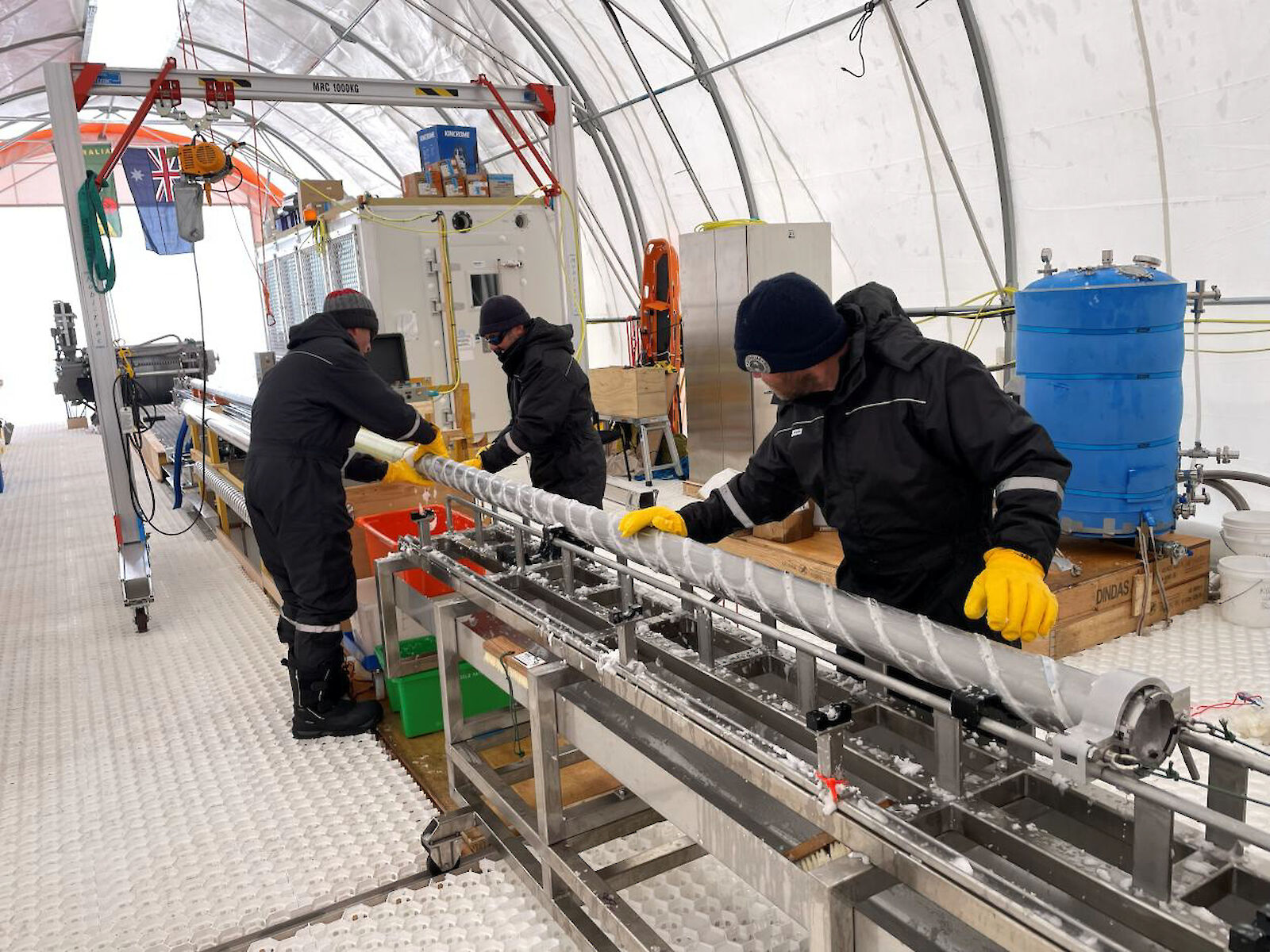
We took water isotope samples from the cores drilled on Friday and bagged them in the processing shelter. The drill fluid drainage racks recessed into the firn in the core processing shelter are working well.
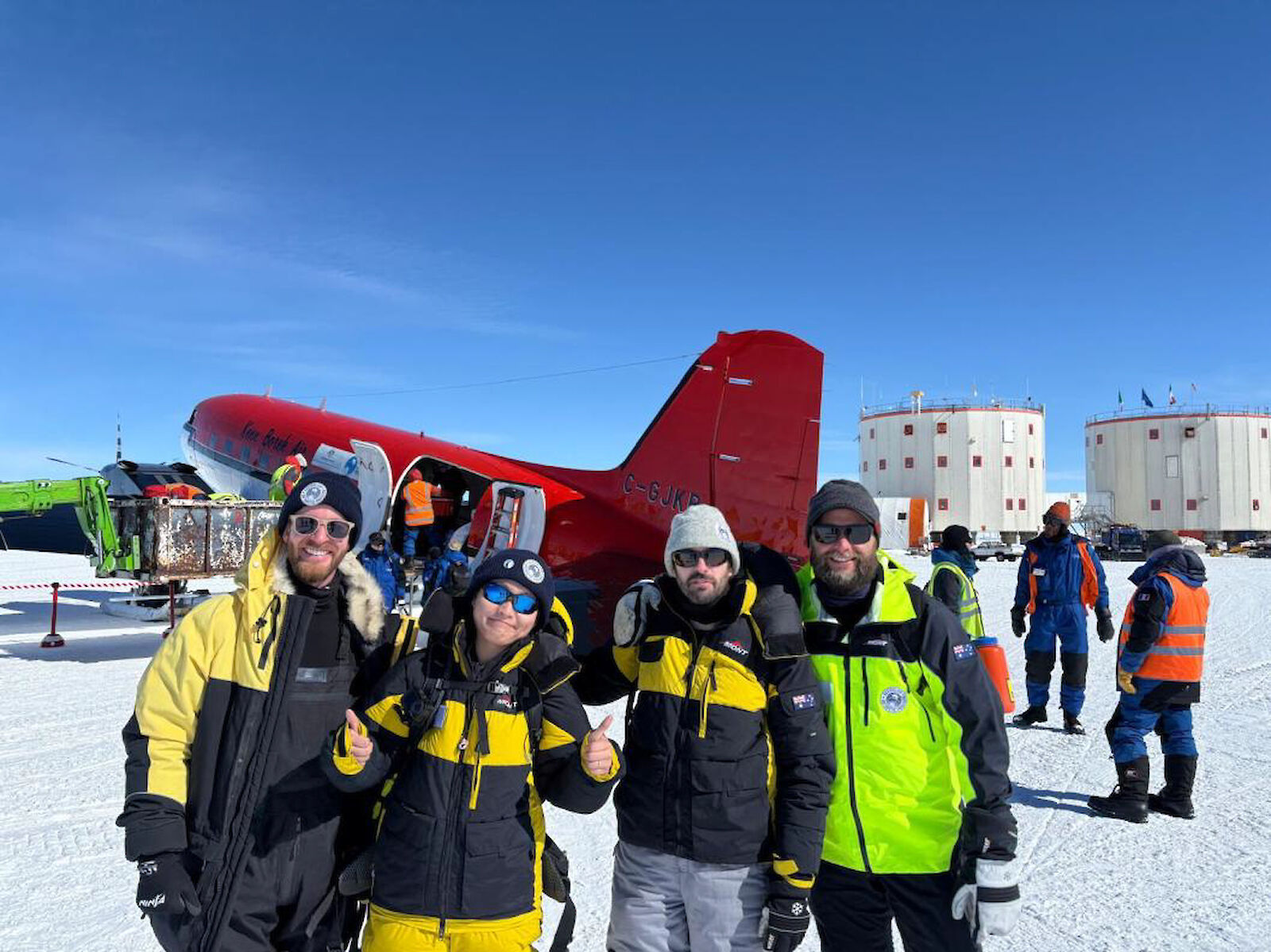
Several members of the traverse team drove to Concordia and completed the cooperative work with the French and Italians moving containers for them using our Challenger tractors. The operation is now complete and the AAD is pleased to have been able to support Concordia Station operations at a critical time in the season and after their assistance bringing in our winch on the IPEV traverse.
30 December, 2025
Location: Dome C North (DCN)—MYIC Inland Station, 75.0422°S, 123.6312°E, 3239 m asl.
Personnel at DCN: Damien Beloin, Derryn Harvie, David Holley, Ed Maguire, Kris Keen, Andy Lewis, Meg O’Connell, Dane Eden, Thom Whyte, Lenneke Jong, Julius Rix, Joel Pedro, Chris Richards, Chris Young.
Weather at DCN: • Air temp: -22˚C • Wind speed: 3 knots, SE 140˚ • Forecast for next 24 hours: Partly cloudy. Morning Fog possible. Drifting snow in the evening, with blowing snow possible. Light snow showers possible. Min/Max: -20/-18 ˚C.
Inland Station Operations, Science, Drilling
Drilling stats:
- Start depth (loggers): 169.42 m
- End depth (loggers): 173.47 m
- Meters drilled: 4.05 m
- Drill runs: 5
- Run lengths: 0, 0.64, 0.21, 0.53, 2.67 m
Our third day of drilling with the AAD deep drill. We spent some time in the morning making improvements to the system, including installing some 3D printed bushes in the cable routing wheel at the base of the tower.
The good news today was that the core breaks were greatly improved by going for a slower winch speed during the break. Our next move was going to be to remove one of the three core dogs, but that step is not yet needed. Instead, we encountered some new issues.
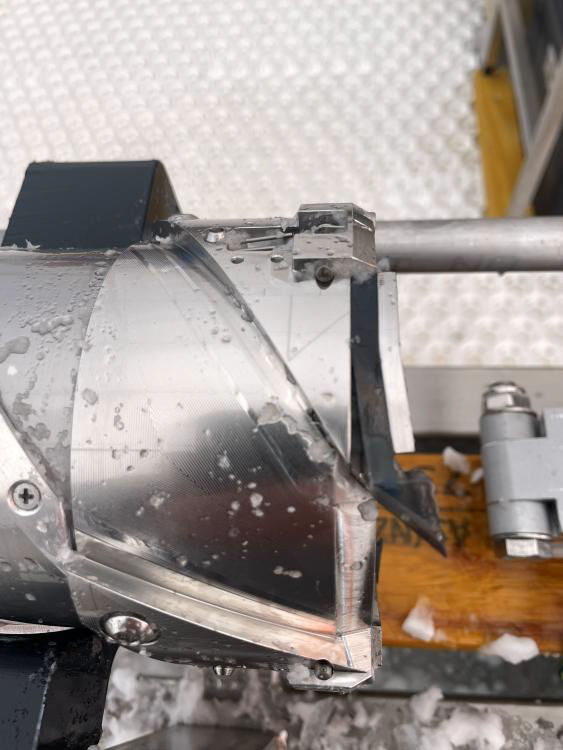
After the final run of the previous day, one of the step-cutters on the drill head was found bent down. This must have been caused by the cutter catching on the bottom of the bore casing when we were retrieving the drill. A spike in the cable load was seen at the depth of the base of the casing and fragments of fibreglass. We only have a limited number of step cutters, so we removed the terminally damaged cutter and changed over to standard (non-stepped) cutters.
As you see from the first four short drill runs, we did not manage to get good penetration using the standard cutters. This was despite trying a range of different cutting pitches (2, 3, 4 and 5 mm) and adjustment of the anti-torque and weight on the drill head. After these four short and runs we switched back to the step cutters and at once got much better penetration at lower drill motor current and drilled an ideal 2.7 m core with a good break.
This would be all jolly.. and we pulled up very slowly past the base of the casing given yesterday’s cutter damage fresh in mind. But sadly, once again, an outer step-cutter hooked on the bottom of the casing and was also irreparably bent!
So we need to make the standard cutters work for us or prevent the step cutters from catching the casing. No panic, there are some ideas for both to pursue tomorrow.
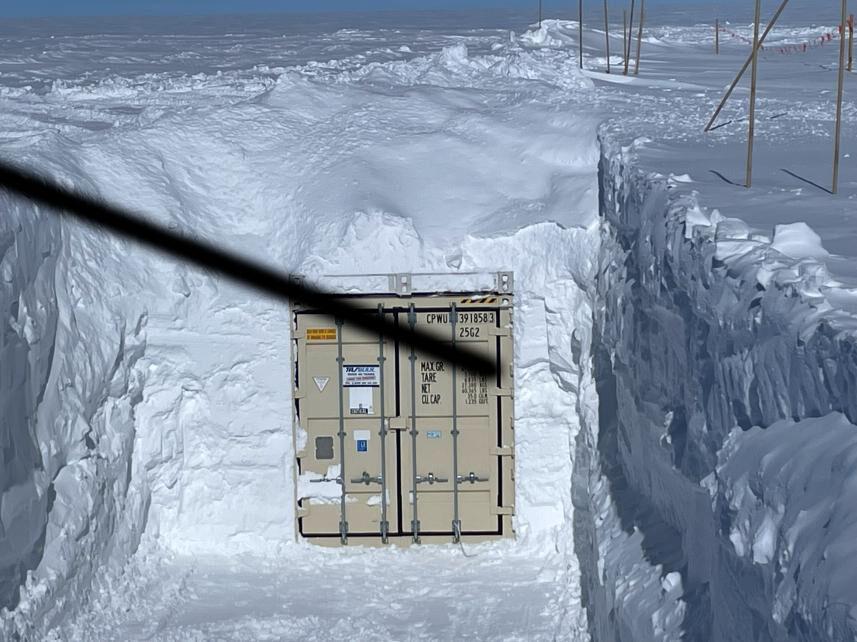
Away from the travails in the drill shelter, Eddie started on burying the container for ice core storage. Chippy Dave completed a new ice core rack for the processing shelter and others continued with the many tasks of servicing and maintenance required to run the camp.
31 December, 2025
Location: Dome C North (DCN)—MYIC Inland Station, 75.0422°S, 123.6312°E, 3239 m asl.
Personnel at DCN: Damien Beloin, Derryn Harvie, David Holley, Ed Maguire, Kris Keen, Andy Lewis, Meg O’Connell, Dane Eden, Thom Whyte, Lenneke Jong, Julius Rix, Joel Pedro, Chris Richards, Chris Young.
Weather at DCN: • Air temp: -15˚C • Wind speed: 15/20 kn, SE 140˚ • Forecast for next 24 hours: Drifting snow. Winds SE 15/20 kn. Min/Max: -23/-18 ˚C.
Inland Station Operations, Science, Drilling
Drilling stats:
- Start depth (loggers): 173.47 m
- End depth (loggers): 181.1 m
- Meters drilled: 7.63 m
- Drill runs: 3
- Run lengths: 2.50, 2.63, 2.50 m
Happy New Year everyone!
After some maintenance in the morning we made three good runs today of near-full capacity in three attempts.
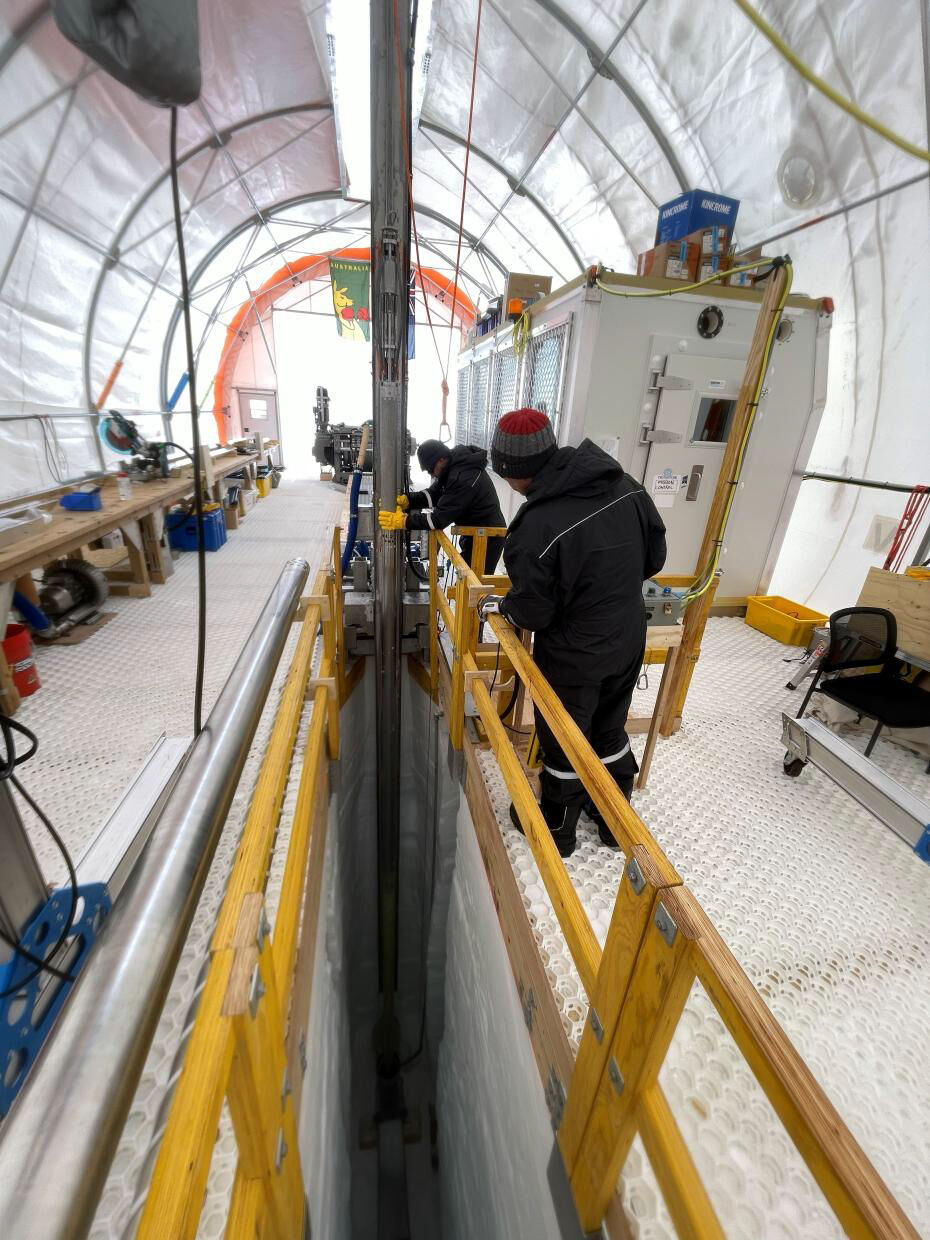
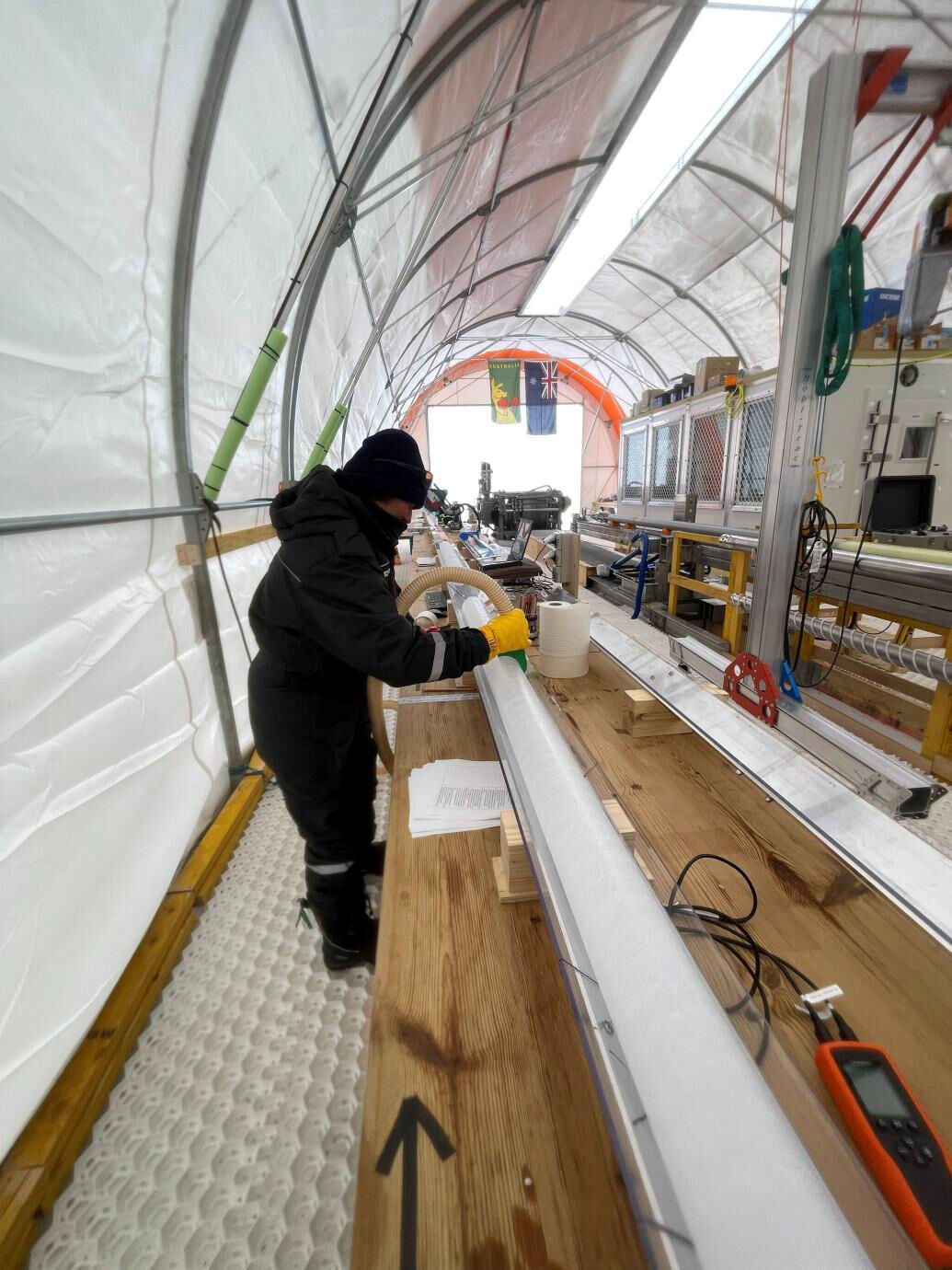
The issue we had with the outer step cutter of the drill snagging on the casing on the way back up was tackled by Chris R adding a chamfered edge to the back of the cutters and by creeping the drill very slowly past the base of the casing. All three runs were made with these chamfered step cutters and slow core breaks. Chip recovery and core quality was excellent. A good way to finish the year!
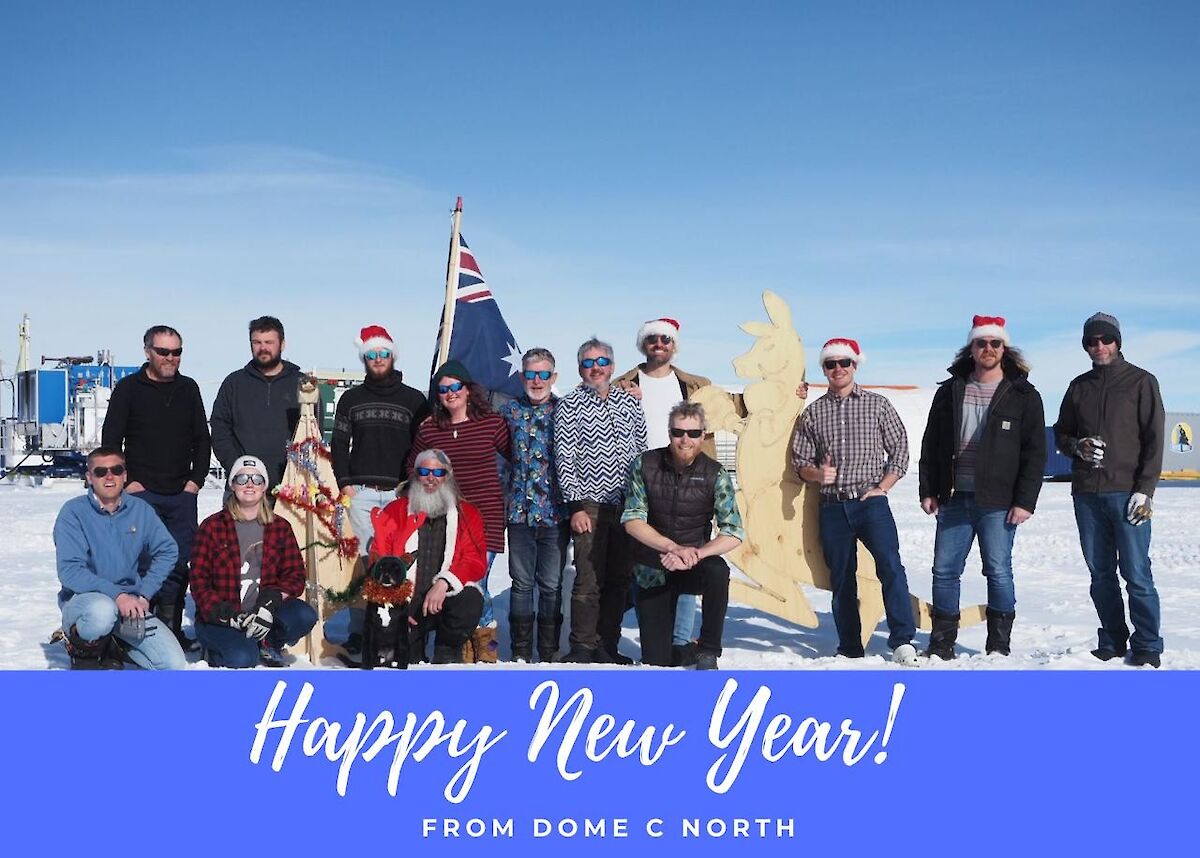
The team is now preparing to leave for Concordia station who have kindly invited us for dinner and a New Year party. Spirits are up with the successful drilling today and our friends from Beyond EPICA are also coming in from Little Dome C for the night.
Catch you next year! We have about 3 weeks left in our season here to continue the drilling. Dearly hoping for good weather in the next days to get the rest of the team up here from Casey to join us.
1 January, 2026
Location: Dome C North (DCN)—MYIC Inland Station, 75.0422°S, 123.6312°E, 3239 m asl.
Personnel at DCN: Damien Beloin, Derryn Harvie, David Holley, Ed Maguire, Kris Keen, Andy Lewis, Meg O’Connell, Dane Eden, Thom Whyte, Lenneke Jong, Julius Rix, Joel Pedro, Chris Richards, Chris Young.
Weather at DCN: • Air temp: -23˚C • Winds: 5-10 kn S • Forecast for next 24 hours: Mostly clear. Winds S 5-10 kn. Min/Max: -31/-24 ˚C.
Inland Station Operations, Science, Drilling
- Start depth (loggers): 181.1m
- End depth (loggers): 186.84
- Meters drilled: 5.74 m
- Drill runs: 3
- Run lengths: 2.52, 0.68, 2.54 m
After blowing out the cob-webs with a memorable dinner and space-themed New Year’s Eve party at Concordia, we were back in the drill shelter on the 1st.
We made two excellent full length (~2.5 metre) runs in the morning using the step cutters. An attempt was then made to drill with the standard cutters (fitted with step-cutter shoes), but the drill struggled to penetrate and resulted in a short 0.68 metre run.
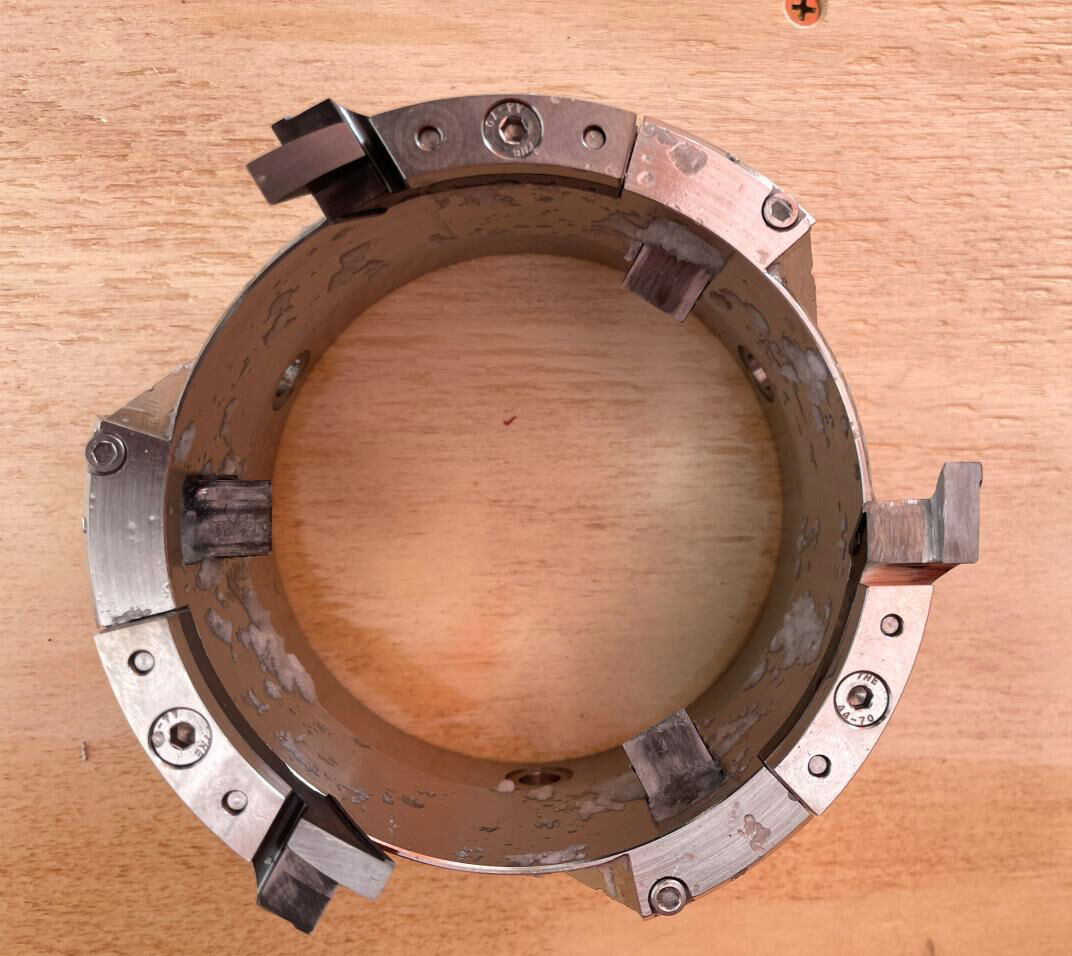
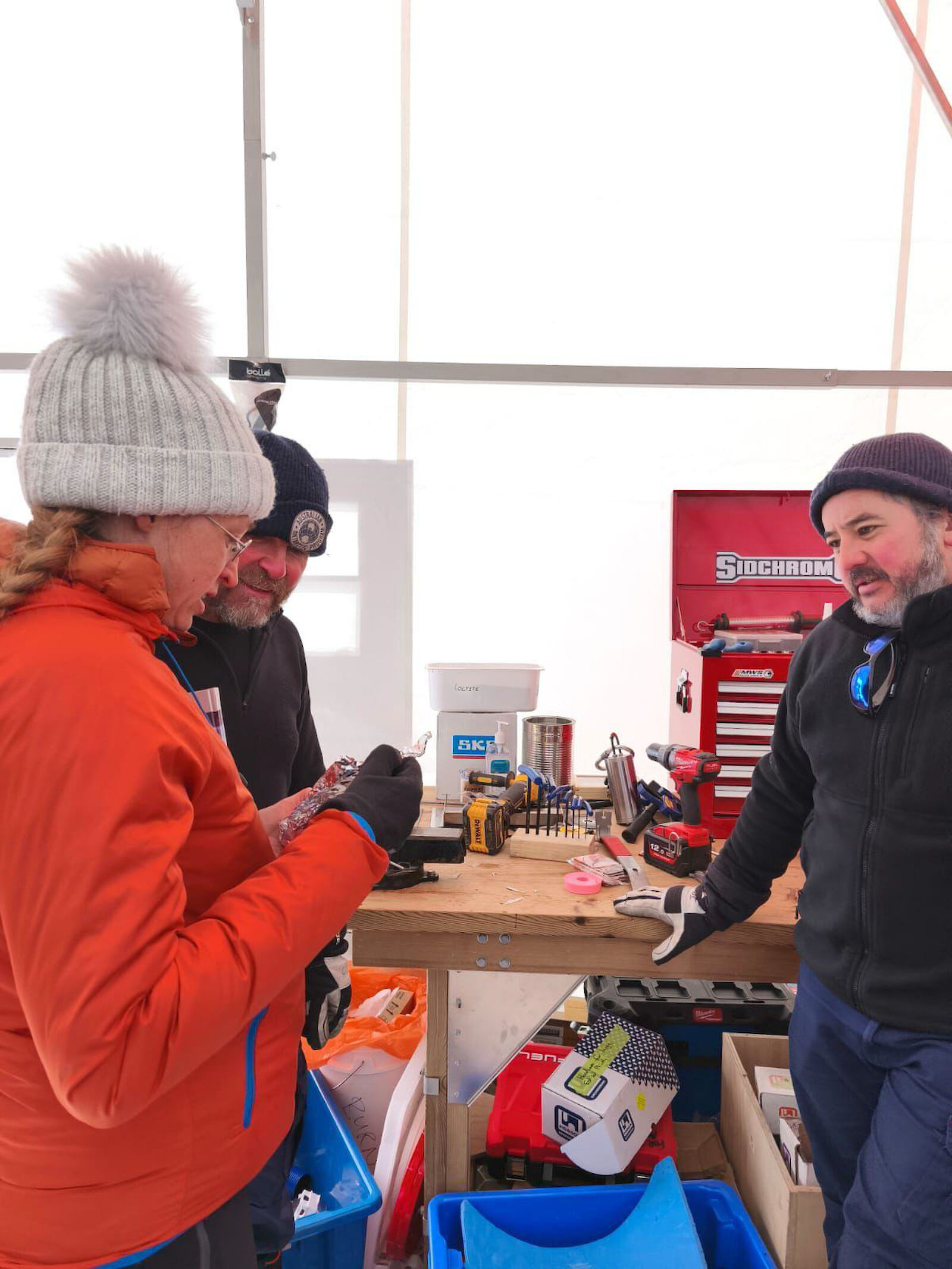
Regular readers will know that we were down to the last complete set of step cutters after damaging two earlier in the week by snagging on the bottom of the casing. To get us out of the vulnerable situation of not having any more spares of the only cutter type that appears to be working for us, Chris Richards had the idea to modify one of our regular cutters into a step-cutter profile. See the picture, showing his impressive handywork using only angle grinder and Dremel.
Later in the morning we had pleasure to welcome the old-ice conquering Beyond EPICA team to our camp. Beyond EPICA completed drilling a continuous ice core to bedrock last season, 40 km from us at Little Dome C.
This season they have focused on rock drilling, and are currently milling the side of their borehole at just over 2000 m ice depth in attempt to deviate and take a replicate record of the bottom few hundred metres of ice.
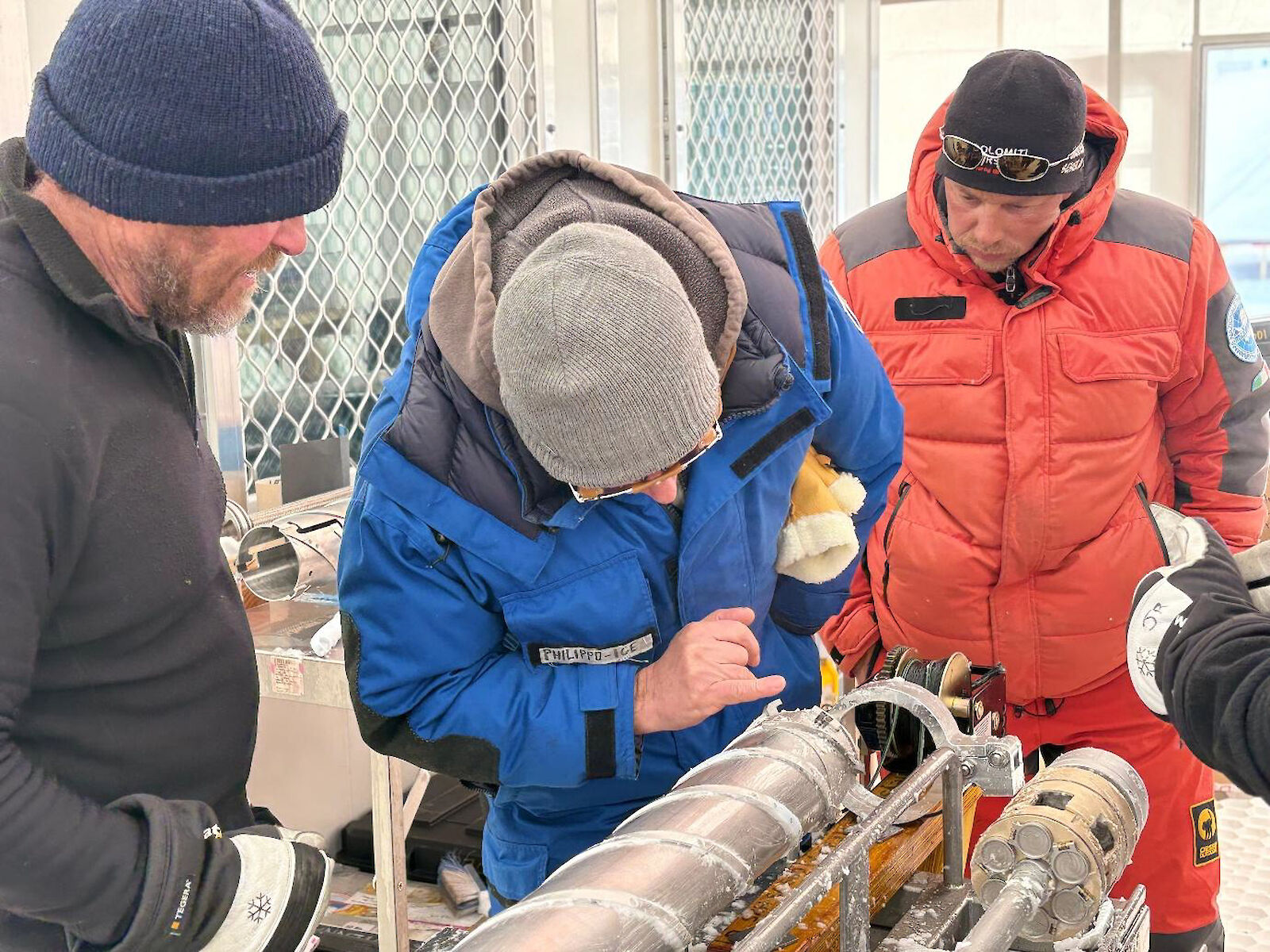
We gave a tour of our camp, ate some Aussie tucker together (meat pies) and had some invaluable discussions about details of deep ice drilling and core processing. The Beyond EPICA team is extremely experienced and generous in sharing their advice on the science and what often seems like black-magic of deep ice drilling. They presented us with two full sets of spare cutters after hearing of our short supply.
The goodwill and cooperation on the science and logistics of oldest ice is strong – thank you Beyond EPICA!
2 January, 2026
Location: Dome C North (DCN)—MYIC Inland Station, 75.0422°S, 123.6312°E, 3239 m asl.
Personnel at DCN: Damien Beloin, Derryn Harvie, David Holley, Ed Maguire, Kris Keen, Andy Lewis, Meg O’Connell, Dane Eden, Thom Whyte, Lenneke Jong, Julius Rix, Joel Pedro, Chris Richards, Chris Young.
Weather at DCN: • Air temp: -23˚C • Winds: 5-10 kn S • Forecast for next 24 hours: Mostly clear. Winds S 5-10 kn. Min/Max: -31/-24 ˚C.
Inland Station Operations, Science, Drilling
- Start depth (loggers): 186.84 m
- End depth (loggers): 195.77 m
- Meters drilled: 8.93 m
- Drill runs: 5
- Run lengths: 1.85, 0.12, 1.97, 2.39, 2.6 m
Our task in the 2-3 weeks we have left at DCN is to try and move into a production drilling and core processing mode. After consistent runs the last few days using the step-cutters we considered it was time to switch the focus from set up and tuning toward production. Maybe we said this too loudly as the drill had other ideas for the morning.
For the first three runs, we struggled again to get the drill to penetrate. Maybe this was due to chip build-up at the bottom of the borehole. In the afternoon the drill team had set up a second hollow shaft assembly which captures chips in the chip chamber above the drill barrel. Now we can alternate between the two assemblies for each new run, which allows for better cleaning and drying out and, in theory, better chip capture.
For the last three runs of the day, Chris Richards’ hand-modified outer step cutter was installed and the hollow shafts were swapped out between runs. From there the going got good again. Let’s (quietly) see how we go tomorrow.
Our team members in Casey are still delayed by weather preventing their flight to Concordia. It is difficult to run the drill in shifts as we intended until the rest of the team are up here and acclimatised. Today Chippy Dave lent us a hand with ice core logging and was characteristically precise.
The next opportunity for a flight is currently Sunday. If you know any weather gods, please put in a good word!
3 January, 2026
Location: Dome C North (DCN)—MYIC Inland Station, 75.0422°S, 123.6312°E, 3239 m asl.
Personnel at DCN: Damien Beloin, Derryn Harvie, David Holley, Ed Maguire, Kris Keen, Andy Lewis, Meg O’Connell, Dane Eden, Thom Whyte, Lenneke Jong, Julius Rix, Joel Pedro, Chris Richards, Chris Young.
Weather at DCN: • Air temp: max -24˚C • Winds: S 5-10 knots • Forecast for next 24 hours: Possible morning fog. Winds 5-10 kn. Min/Max: -32/-24 ˚C.
Inland Station Operations, Science, Drilling
- Start depth (loggers): 195.77 m
- End depth (loggers): 213.45 m
- Meters drilled: 17.68 m
- Drill runs: 7
- Run lengths: 2.58, 2.50, 2.62, 2.56, 2.15, 2.52, 2.75 m
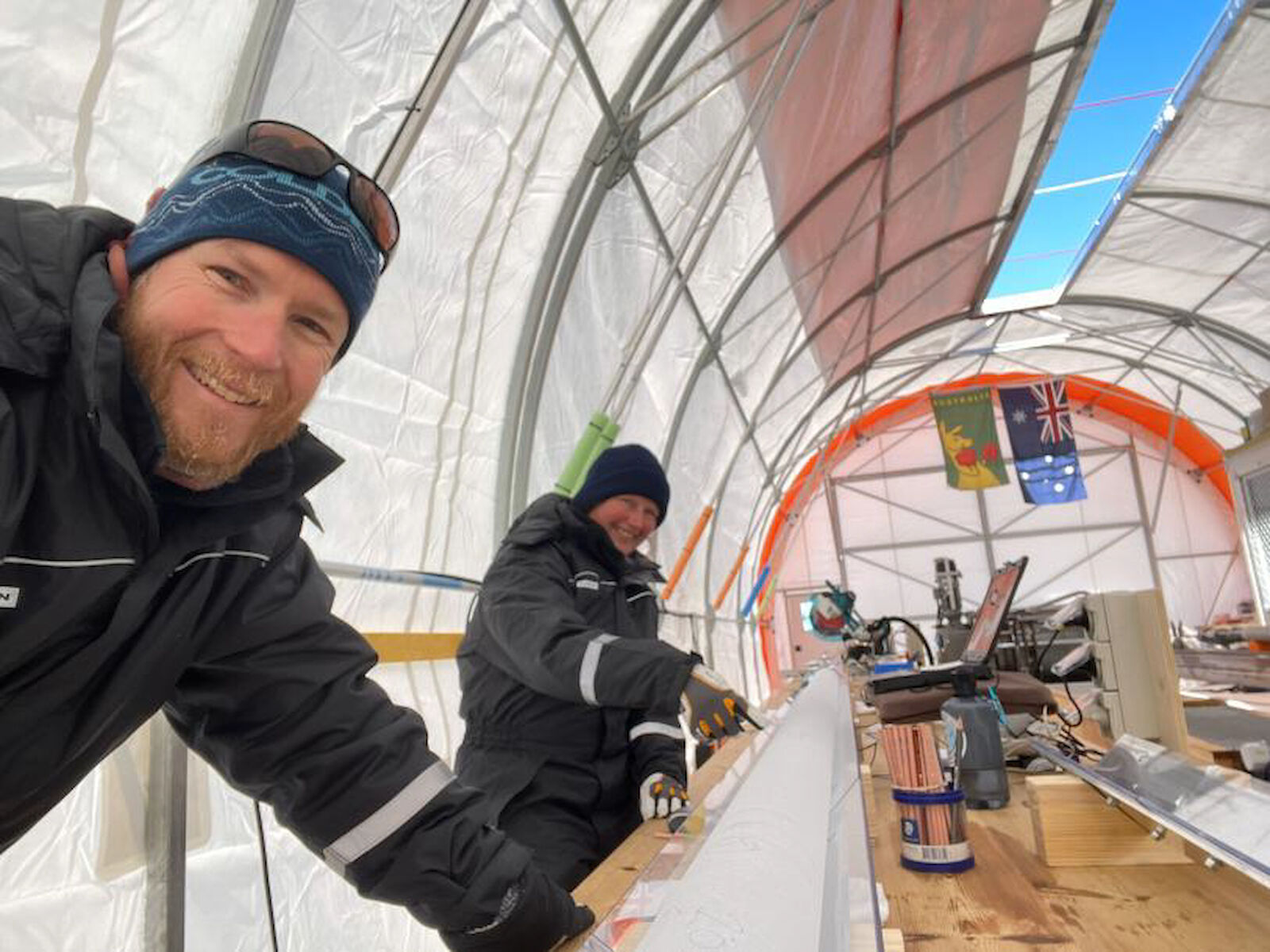
Seven solid runs today and we passed the 200 metre milestone. Sure, it’s a very long way to bedrock at about 3064 metres depth. But we are very happy to have the deep drill system designed and built over six years at the AAD now on the ice sheet, assembled, and returning good quality ice cores at this exciting site for recovery of Antarctica’s oldest continuous ice core.
The configuration working for us is the step cutters, with 4 mm shoes and with the drill descending typically at 2-3mm per second during cutting (15 to 20 min of drilling for a full 2.5 metre run), and with swapping out and cleaning the drill-chip catching hollow shaft assemblies between runs.
Estisol level is at 110 to 120 metres. Core quality is very good – generally the runs are coming out as almost full 2.5 metre lengths.
Overall, a drill run takes around an hour, including the time to lower and raise the drill in the borehole, extract the core and clean and swap out components. It takes a further hour to handle, log and rack the core. Of course, both can take much longer if there are complications to deal with!
The ice from 200 metres has an age of approximately 6000 years – around the time of the invention of pottery and the earliest cuneiform writing.
4 January, 2026
Location: Dome C North (DCN)—MYIC Inland Station, 75.0422°S, 123.6312°E, 3239 m asl.
Personnel at DCN: Damien Beloin (traverse leader), Derryn Harvie (deputy traverse leader & drill engineer), David Holley (carpenter), Ed Maguire (diesel mechanic), Kris Keen (diesel mechanic), Andy Lewis (electrician), Meg O’Connell (medical doctor), Dane Eden (diesel mechanic), Thom Whyte (electrician), Lenneke Jong (MYIC glaciologist), Julius Rix (MYIC driller), Joel Pedro (MYIC science lead), Chris Richards (MYIC drill technician), Chris Young (MYIC drill technician). Finally arrived today from Casey: Dave Burdon (diesel mechanic), Josh Kassulke (communications technician), Mingxia Lai (ice core processor, PhD student), Chris Plummer (ice core processor).
Weather at DCN: • Air temp: max -25˚C. • Winds: variable 5-10 knots • Forecast for next 24 hours: Cloud increasing. Winds 5-10 kn. Min/Max: -31/-25 ˚C.
Inland Station Operations, Science, Drilling
Clear skies here at Dome C North on this Sunday. In them appeared the long-awaited Basler with our four teammates and cargo from Casey. Hooray!
Thanks to the Casey and Concordia teams who have persevered for so many weeks to get these critical team members and cargo in for us – including Air Ground Support Officers loading and unloading the plane after cancellations, weather observers taking obs so many times through the night and early hours, and many others.
The Basler touched down in Concordia just after 11 am local with our four relieved passengers and cargo. Damien and Kris in our snow groomers made the 20 km return trip to pick them and our cargo up and three of the team from DCN walked or jogged to Concordia to meet them and caught a lift back in the groomers, where the icicles on their faces melted.
There was no drilling today as we take Sunday to rest and get ready for the week. This week we aim to start drilling 16 hours a day by running the drill in two 8-hour shifts. Two core processors and at least two drillers are needed to staff each shift. Arrival of our two additional core processors now gives us the numbers to run the shifts. But before we launch into that some days are needed first for their acclimation to the 3239 metre altitude and familiarisation with the set up.