
11-12 January, 2026
Location: Dome C North (DCN)—MYIC Inland Station, 75.0422°S, 123.6312°E, 3239 m asl.
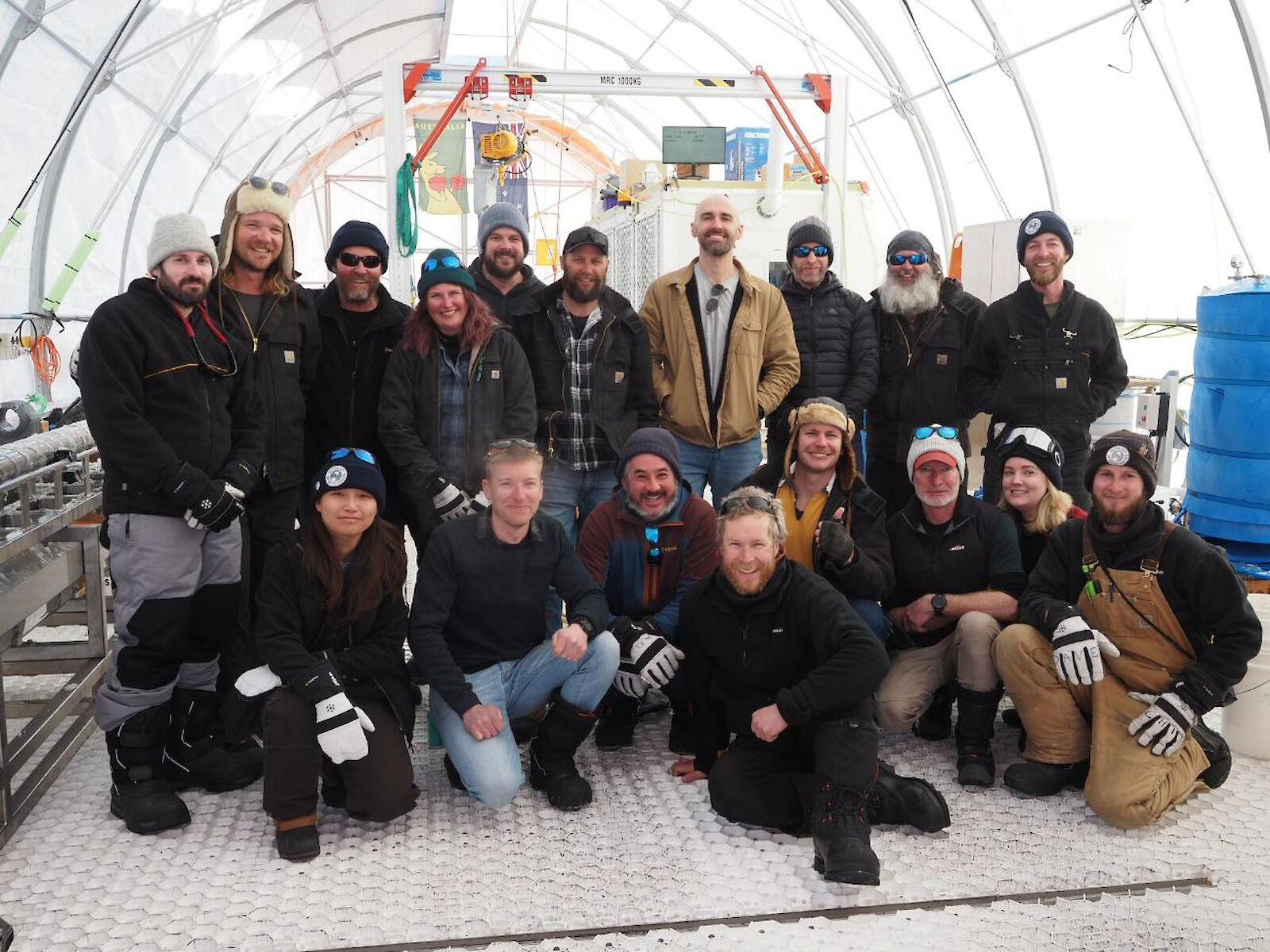
Personnel at DCN: Damien Beloin (traverse leader), Derryn Harvie (deputy traverse leader & drill engineer), David Holley (carpenter), Ed Maguire (diesel mechanic), Kris Keen (diesel mechanic), Andy Lewis (electrician), Meg O’Connell (medical doctor), Dane Eden (diesel mechanic), Thom Whyte (electrician), Lenneke Jong (MYIC glaciologist), Julius Rix (MYIC driller), Joel Pedro (MYIC science lead), Chris Richards (MYIC drill technician), Chris Young (MYIC drill technician), Dave Burdon (diesel mechanic), Josh Kassulke (communications technician), Mingxia Lai (ice core processor, PhD student), Chris Plummer (ice core processor).
Weather at DCN: • -30˚C, mostly cloudy, 9 knots SSE 160˚ • Forecast for next 24 hours: Partly cloudy. Winds: S/SE 10/15 knots. Min/Max: -35/-27 °C
Inland Station Operations, Science, Drilling
- Start depth (loggers): 315.0 m
- End depth (loggers): 327.0 m, night shift continues.
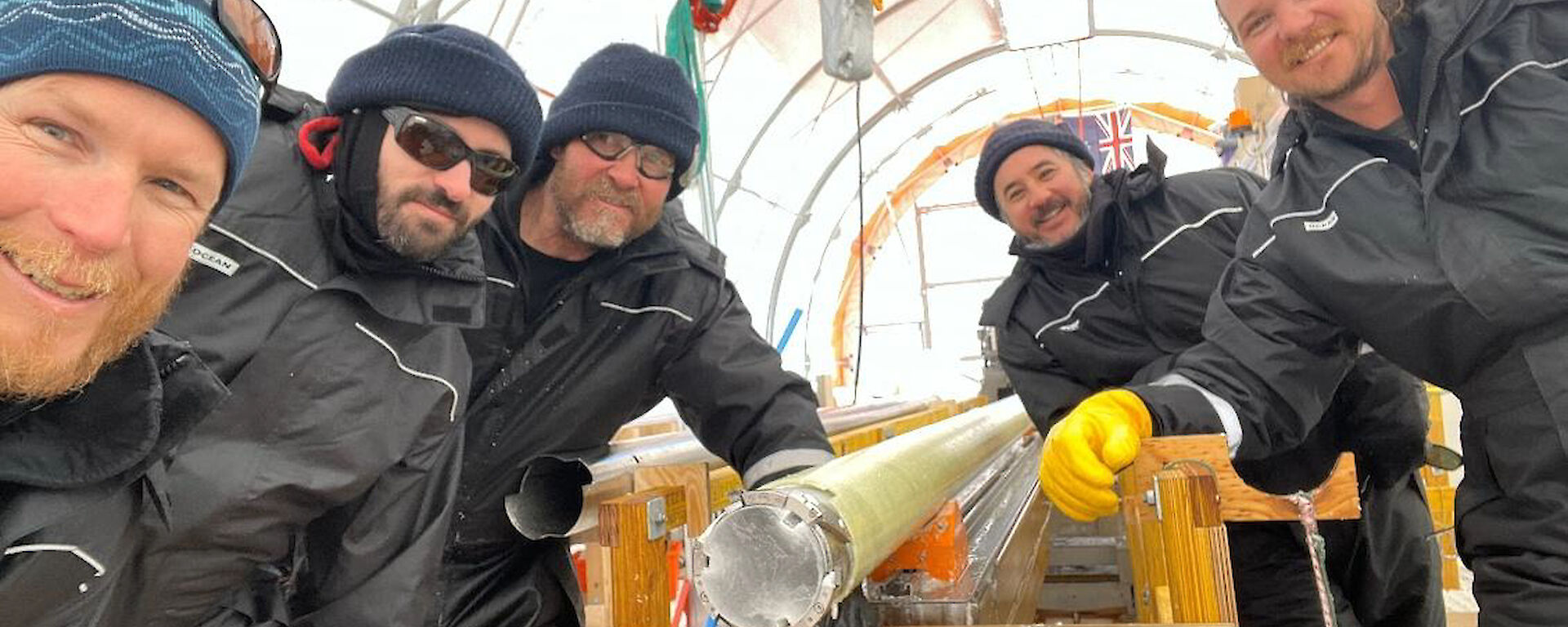
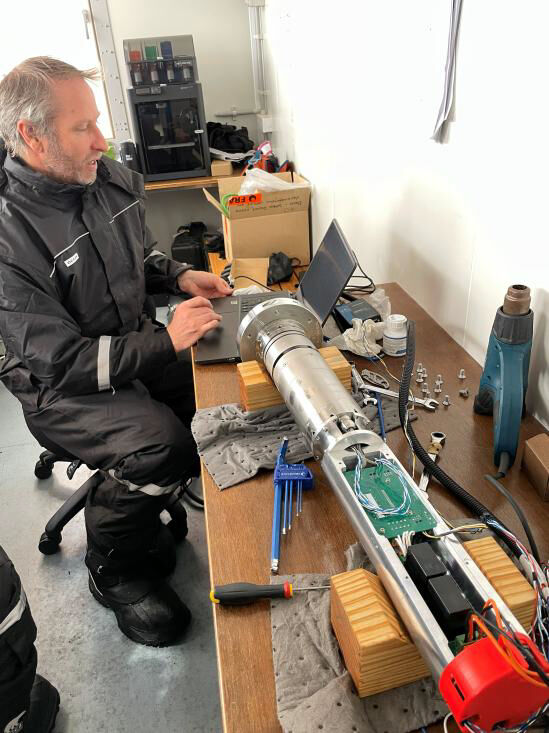
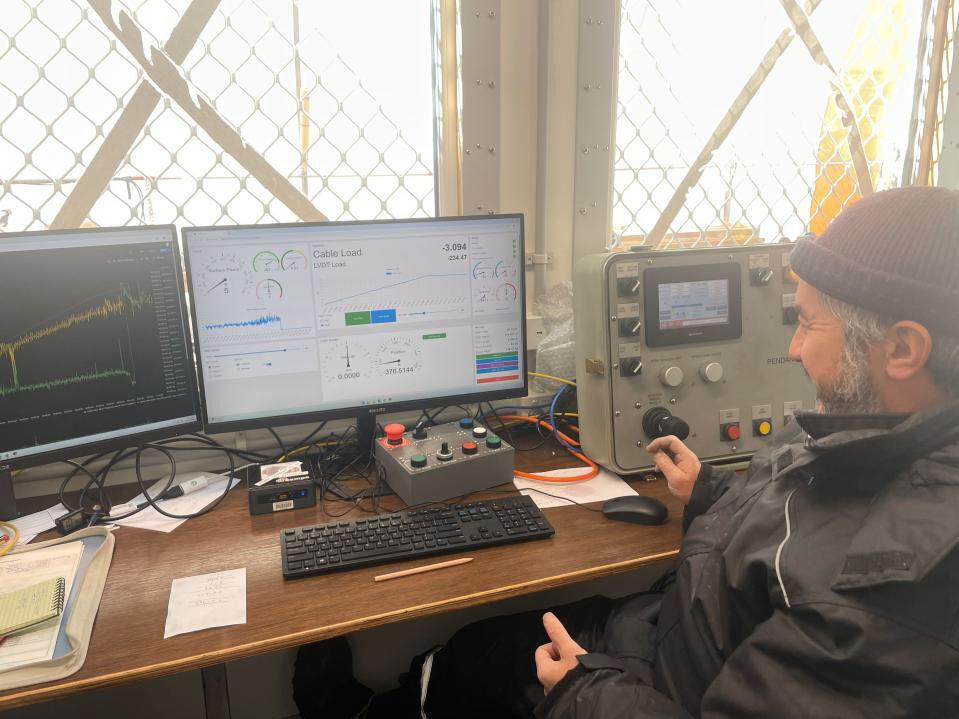
On Sunday afternoon it was found that there was no communications getting to the sonde. Derryn diagnosed an electrical fault inside the sonde pressure housing. This set the first task for Monday morning as opening the pressure housing and finding and repairing the fault. This is a not a simple task. The pressure housing is sealed to cope with the pressure of a three kilometre column full of drill fluid, so must be opened and resealed with extreme precision. The wiring is also compact and difficult to access and the freezing temperature in the drill shelter and off the metal sonde don’t make precision work easier. After Chris R opened the housing and some hours of careful work finding and repairing the wiring faults the sonde was reassembled and drilling resumed.
With the anti-torque work on Saturday and now the wiring repairs, we were hopeful that issues were solved and drilling could be back underway. But the drill stopped communicating again after only the first core break. On return to the surface and inspection it was clear that the repairs inside the pressure housing, while needed, had not fully solved the power and comms issues. The electronic slip ring at the top of the sonde was packed with ice chips inside its protective cover and this was likely the source of the recent ongoing comms issues. The slip ring was replaced with a spare and drilling resumed a couple hours ago. Since then, two full runs have been recovered and the drill is operating very well (dare we say the best it has yet).
All this is a reminder that we are still in the first weeks of drilling with this custom-made system that is exposed to some of the toughest conditions you can imagine. And that we have a skilled team to identify and make these repairs in such conditions. Working through and fixing faults is part of commissioning and learning, and of getting us ready for the next big goal, which is to drill past one kilometre next season.
The traverse team is beginning camp shutdown operations, with packing and traverse assets maintenance. They also completed repairs on a 15 KVa back-up generator. Josh and Eddie travelled to Concordia station to work with the Concordia technicians to program the AAD VHF radios with Concordia channels, which will make communications and logistics easier.
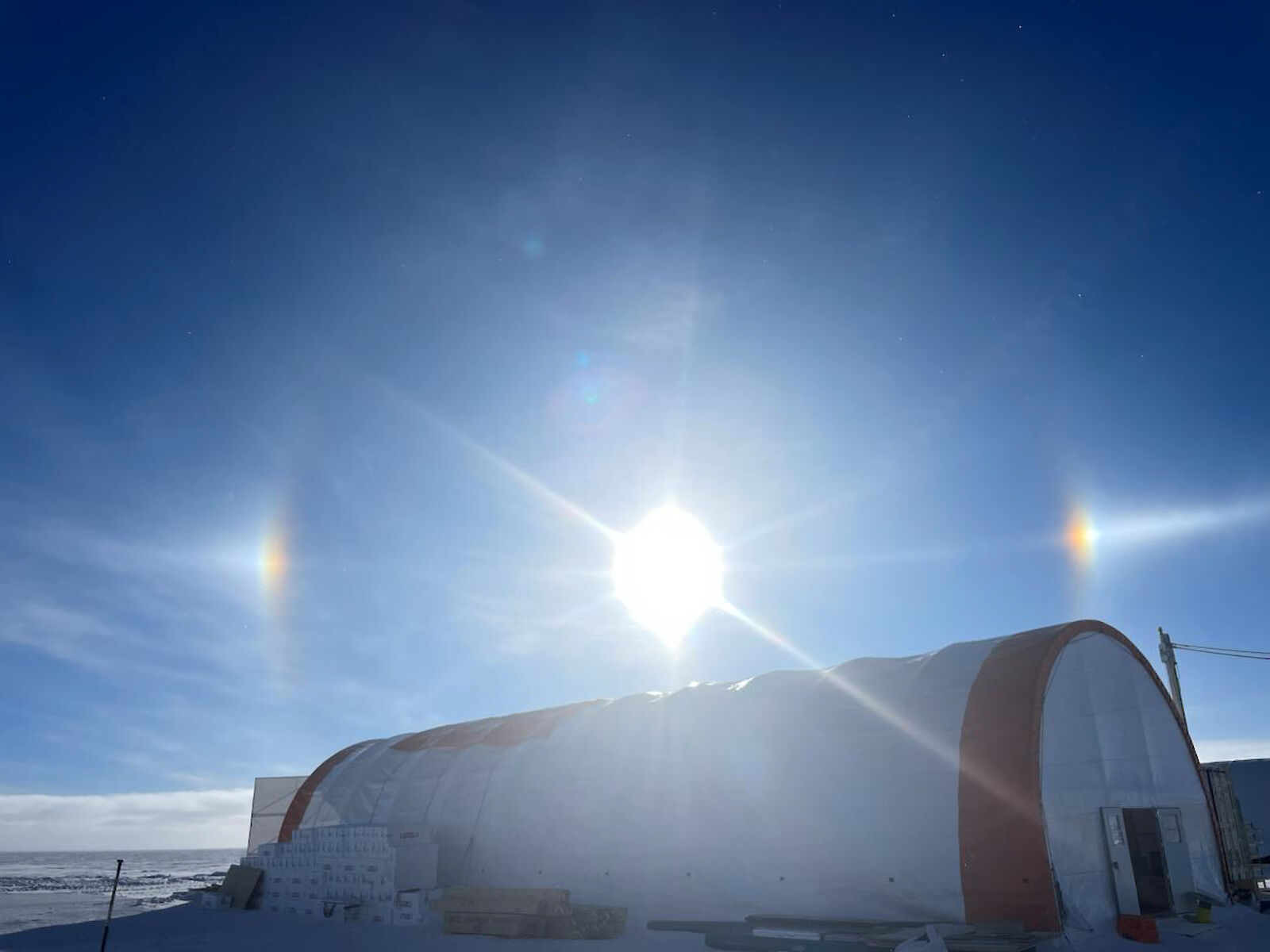
No photos today of the sonde repair work as everyone was very focused. But you can see a spectacular parahelia over the drill tent, there have been many lately with the light playing in the cold dry atmosphere and diamond dust snow crystals.
13 January, 2026
Location: Dome C North (DCN)—MYIC Inland Station, 75.0422°S, 123.6312°E, 3239 m asl.
Personnel at DCN: Damien Beloin (traverse leader), Derryn Harvie (deputy traverse leader & drill engineer), David Holley (carpenter), Ed Maguire (diesel mechanic), Kris Keen (diesel mechanic), Andy Lewis (electrician), Meg O’Connell (medical doctor), Dane Eden (diesel mechanic), Thom Whyte (electrician), Lenneke Jong (MYIC glaciologist), Julius Rix (MYIC driller), Joel Pedro (MYIC science lead), Chris Richards (MYIC drill technician), Chris Young (MYIC drill technician), Dave Burdon (diesel mechanic), Josh Kassulke (communications technician), Mingxia Lai (ice core processor, PhD student), Chris Plummer (ice core processor).
Weather at DCN: • -27˚C, partly cloudy, 5-10 knots SSE 160˚ • Forecast for next 24 hours: Mostly cloudy. Winds: S/SE 5/10 knots. Min/Max: -34/-26 °C
Inland Station Operations, Science, Drilling
- Start depth (loggers): 327.0 m
- End depth (loggers): 349.02 m at 7 pm, night shift continues.
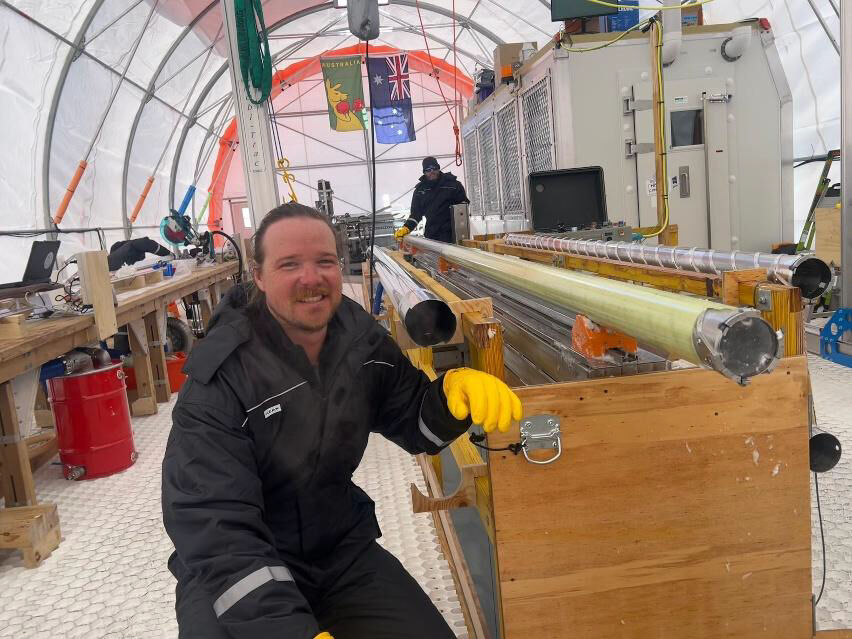
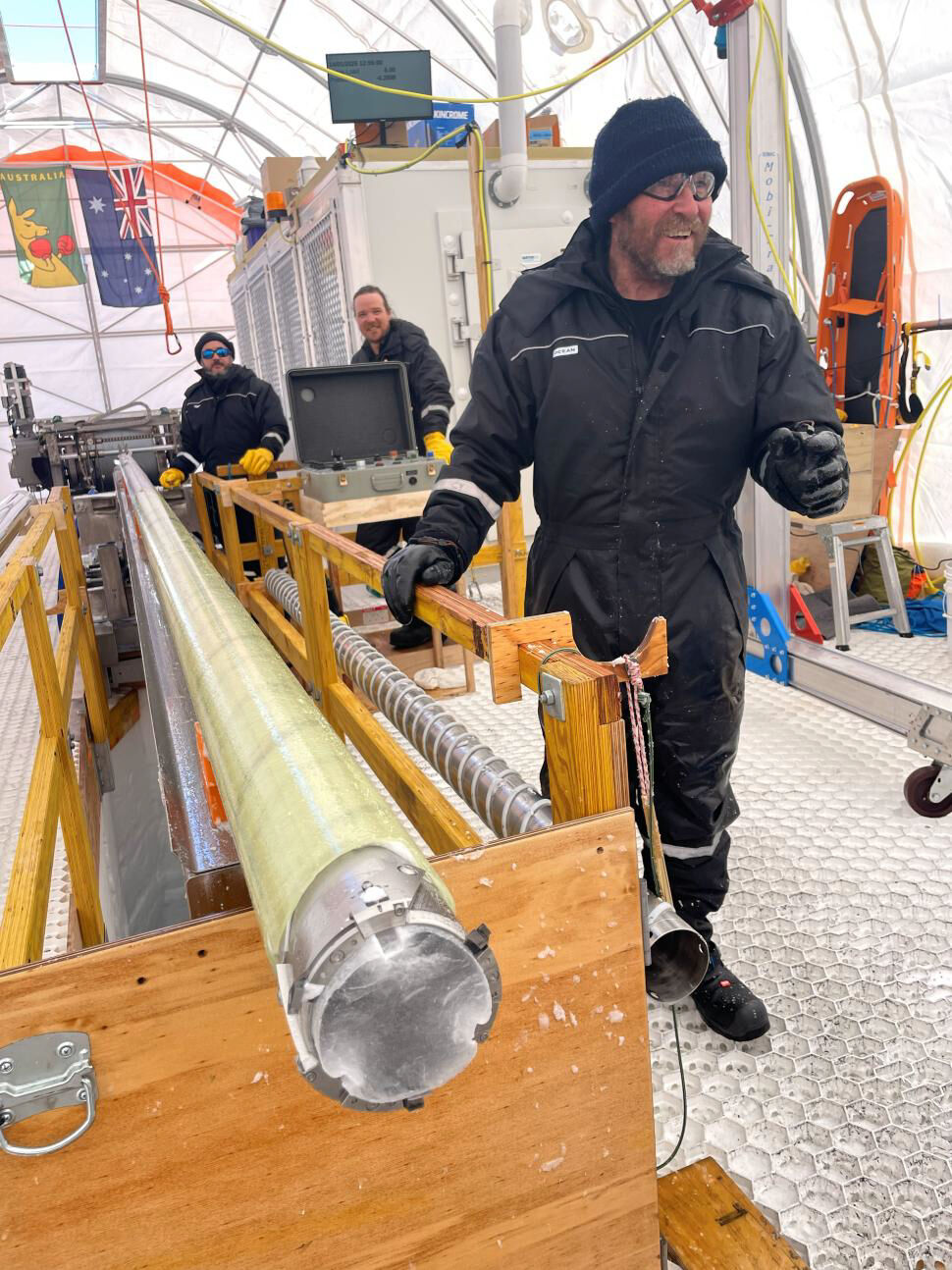
After the work inside the sonde pressure housing on the electronics yesterday and the anti-torque section over the weekend we enjoyed some of the best drilling of the season. The run lengths speak for themselves: 3.05 m, 2.61 m, 3.0 m, 0.56 m, 2.75 m, 2.01 m, 2.75 m, 2.75 m, 2.75 m, 0.15 m, 2.6 m. All cut with 3 mm pitch using the step cutters at a feed of about 3 mm per second and no adjustment to the anti-torque needed all day.
It’s a pleasure to drill and log such cores. They are coming up in excellent quality without breaks. It is very satisfying for everyone to see the commissioning work delivering a system that is progressively drilling more uniformly and predictably. The two short runs above were both ended by the snapping of the aluminium shear key in the motor. Previously the amount of motor current that today snapped the shear keys would likely have spun the anti-torque instead. But with our anti-torque working as it should, there is more force that can be driven through the drill. Solving one issue raises the next.
The choice is to go on shearing pins and risking damage to the gear box, or open up the pressure housing of the sonde again and program in a protection limit that will cut out the drill before there is enough stress to shear the pin. We are here for the long run (3064 m to bedrock), so in the afternoon shift Chris Richards again opened the housing and Derryn has programmed in a more protective limit to the motor control software.
The sonde is back together now and the evening shift have recovered a 2.6 m run.
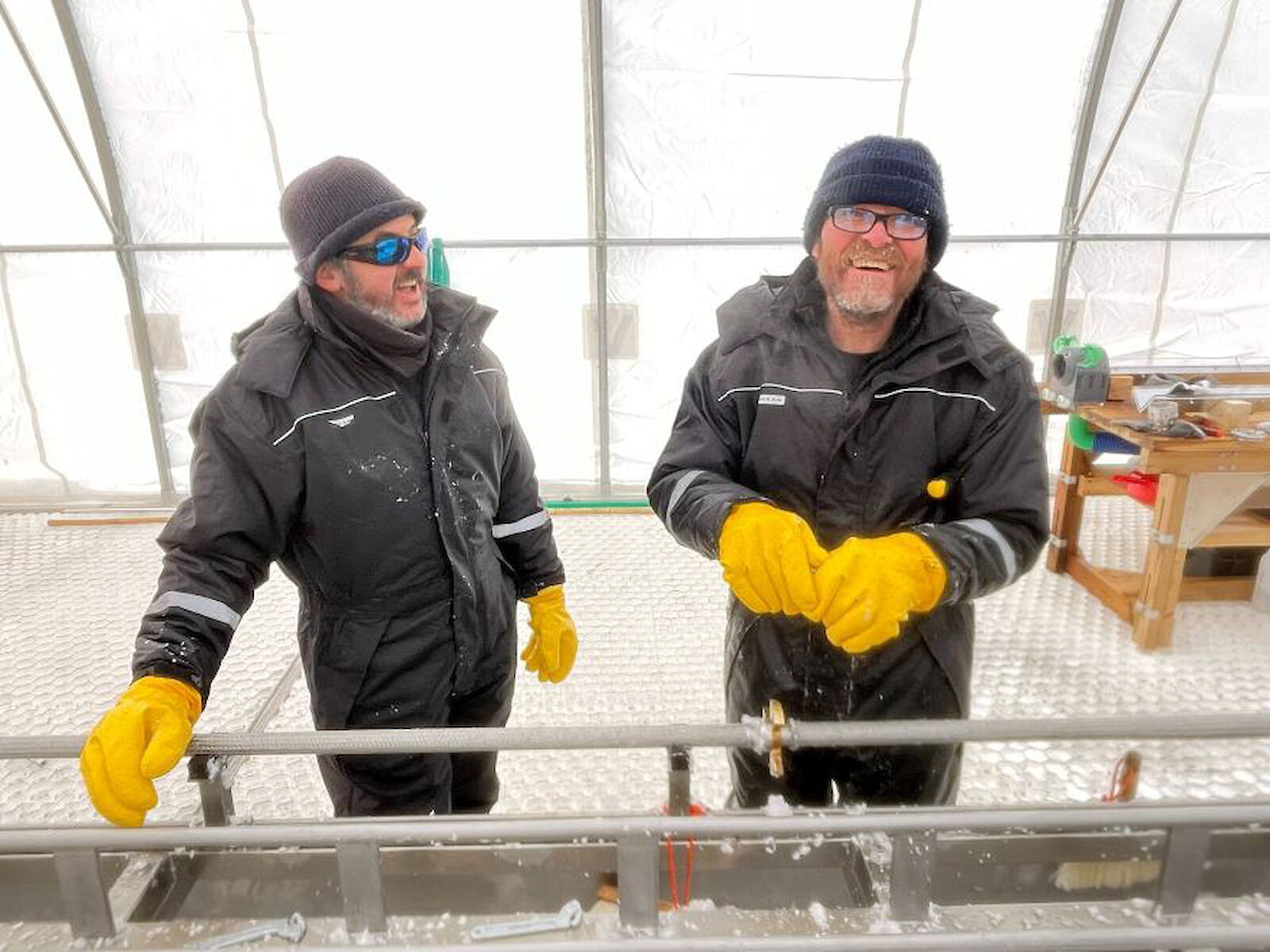
In addition to the electronics work Julius and Chris Y have been working on improving chip transport through the drill and into the chip chamber, experimenting with different positions of the chip ‘booster’. The conclusions are not in on that yet.
14 January, 2026
Location: Dome C North (DCN)—MYIC Inland Station, 75.0422°S, 123.6312°E, 3239 m asl.
Personnel at DCN: Damien Beloin (traverse leader), Derryn Harvie (deputy traverse leader & drill engineer), David Holley (carpenter), Ed Maguire (diesel mechanic), Kris Keen (diesel mechanic), Andy Lewis (electrician), Meg O’Connell (medical doctor), Dane Eden (diesel mechanic), Thom Whyte (electrician), Lenneke Jong (MYIC glaciologist), Julius Rix (MYIC driller), Joel Pedro (MYIC science lead), Chris Richards (MYIC drill technician), Chris Young (MYIC drill technician), Dave Burdon (diesel mechanic), Josh Kassulke (communications technician), Mingxia Lai (ice core processor, PhD student), Chris Plummer (ice core processor).
Weather at DCN: • -29˚C, 2 knots, beautiful sunny day at DCN. • Forecast for next 24 hours: Partly cloudy. Winds: SW 5/10 knots. Min/Max: -36/-27 °C
Inland Station Operations, Science, Drilling
- Start depth (loggers): 349.02 m
- End depth (loggers): 373.35 m at 7pm, night shift continues.
Today we drilled beyond the current geological epoch—the Holocene. The Holocene refers to the last 11,700 years of the Earth's history, a period of relatively stable and mild climate that has coincided with and helped sustain the expansion and growing impacts of human civilisations across the planet.
Beyond the Holocene, where the drill goes now, is the Pleistocene; defined by the ice age cycles that extend back in time the next 2.6 million years. The rest of our drilling will be into these ice age cycles with the objective to understand what drove the major shifts in their timing and intensity and in the accompanying long-term changes in temperature and greenhouse gas levels in the atmosphere.
Breaking into the next geological epoch seems big enough news for the day. But we can’t neglect the technical work that enables the continued progress! An important step today was that we now have a second complete sonde (motor, gear box, motor controller) in use for the first time this season after completing installing connectors and other required work on it during the evening shift. We can now swap between sondes and continue drilling if work is required on one.
The Traverse team completed servicing the cabbed snow groomer inside the mechanical tent, and prepared equipment for the load-cell testing using a traverse tractor. The data will be used to better understand and plan future traverse operations. The electricians are organising the camp closure and preparing equipment for next season.
We have a flight scheduled in the next days to collect more ice cores, but the Antarctic weather is again not cooperating with that plan.
Our last day of drilling is set for Saturday. We are closing in on our season target of 400 m ice depth. It may feel like the middle of summer in Australia but here it is growing colder and logistic support to the high plateau can not be sustained for much longer.

15 January, 2026
Location: Dome C North (DCN)—MYIC Inland Station, 75.0422°S, 123.6312°E, 3239 m asl.
Personnel at DCN: Damien Beloin (traverse leader), Derryn Harvie (deputy traverse leader & drill engineer), David Holley (carpenter), Ed Maguire (diesel mechanic), Kris Keen (diesel mechanic), Andy Lewis (electrician), Meg O’Connell (medical doctor), Dane Eden (diesel mechanic), Thom Whyte (electrician), Lenneke Jong (MYIC glaciologist), Julius Rix (MYIC driller), Joel Pedro (MYIC science lead), Chris Richards (MYIC drill technician), Chris Young (MYIC drill technician), Dave Burdon (diesel mechanic), Josh Kassulke (communications technician), Mingxia Lai (ice core processor, PhD student), Chris Plummer (ice core processor).
Weather at DCN: • -35˚C, 4 knots, sunny cold day at DCN. • Forecast for next 24 hours: Partly cloudy. Winds: SW 5/10 knots. Min/Max: -37/-30 °C
Inland Station Operations, Science, Drilling
- Start depth (loggers): 373.35 m
- End depth (loggers): 379.25 m at 7pm – no night shift tonight.
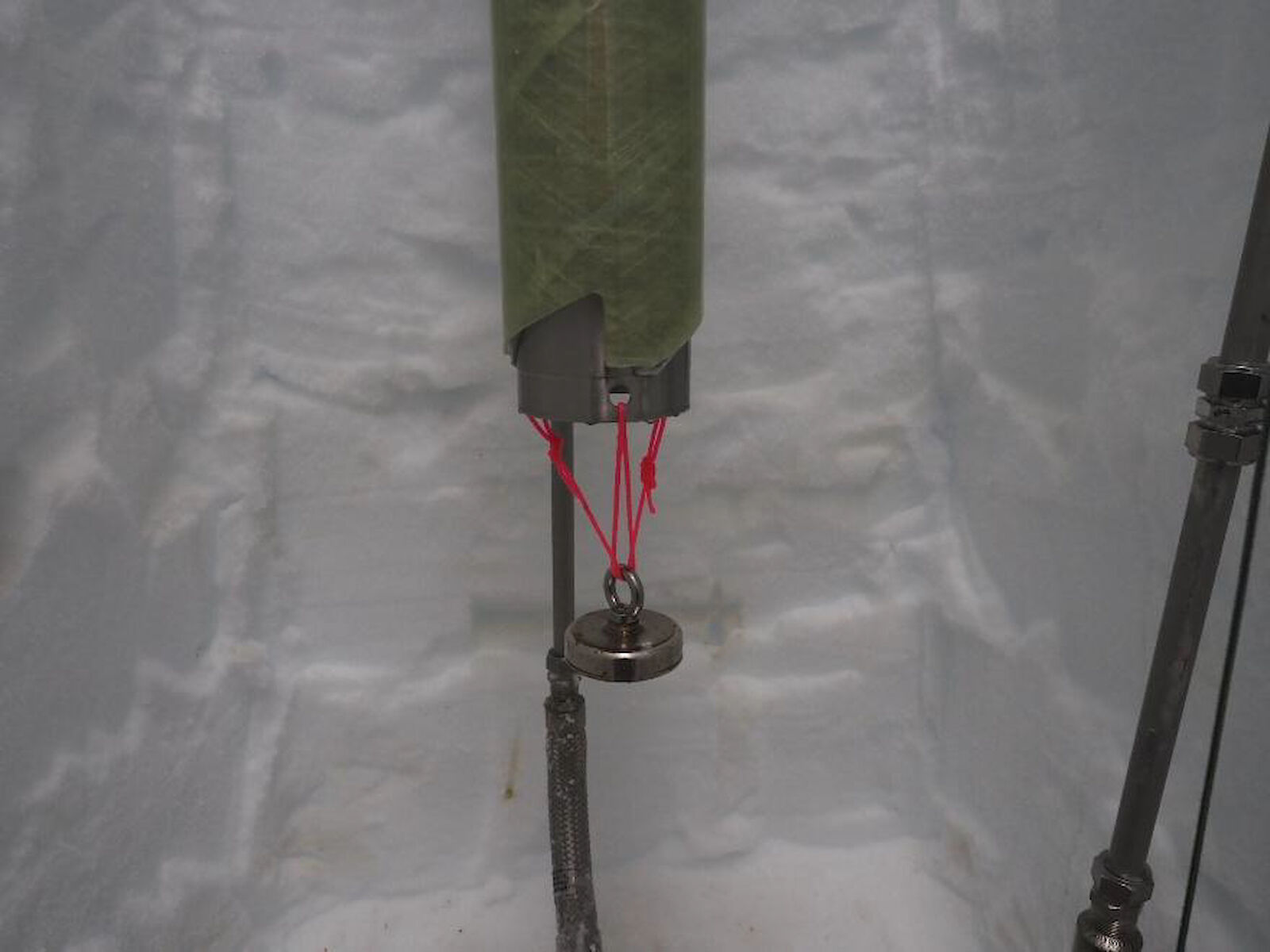
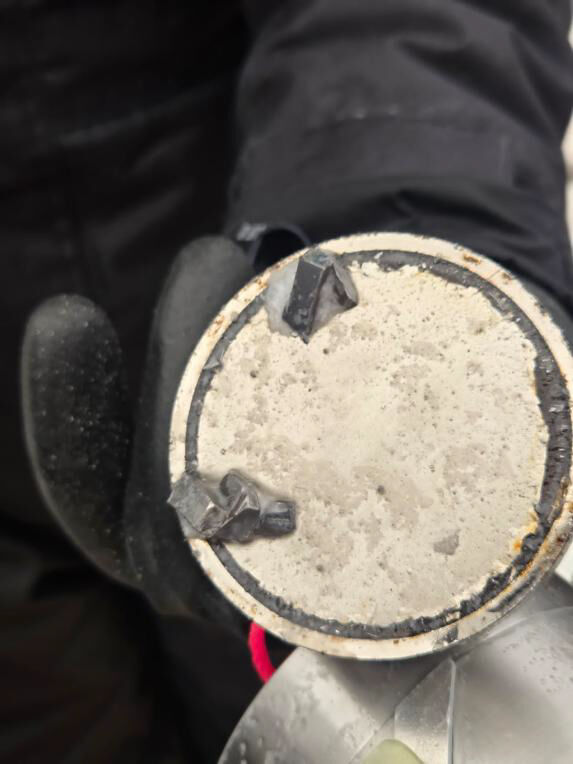
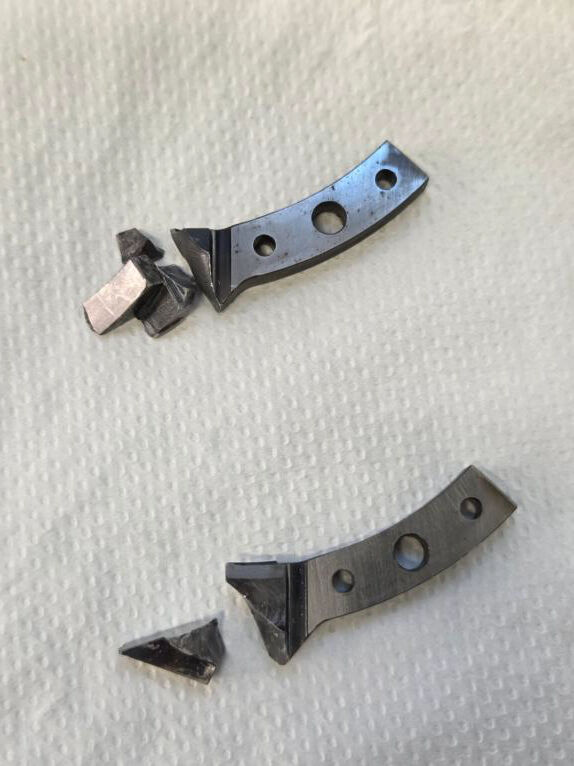
Late yesterday two pieces of cutter broke off when the drill made a harder than planned start to drilling at the bottom of the borehole. The bad news is that these pieces of steel are large enough to seriously damage the head and flights of the core barrel if drilled over. The good news is that they are magnetic. And so today was a fishing day.
We tried first with a powerful magnet suspended from the bottom of the core barrel. Lowering down to the bottom of the borehole, bobbing then pulling up slowly. But there was nothing collected by the magnet. We then searched the chip melter using the magnet after this, nothing there either. Possibly the metal fragments could be impacted into the side of the borehole or covered by a layer of chips?
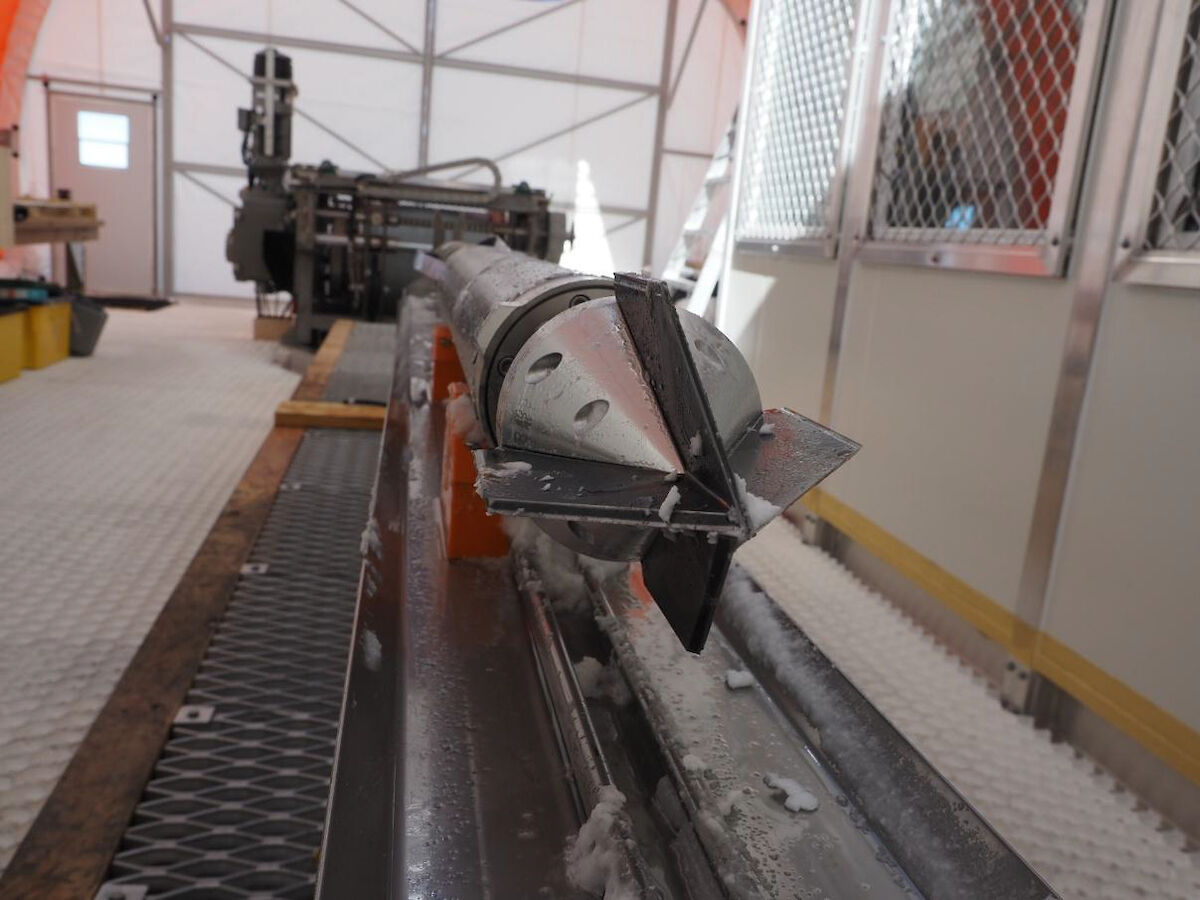
Enter Arnold – the medieval-looking weapon made back in Kingston by Chris R. The principle is that the sharp tool's steel blades on the conical reamer head, cut a cone shaped depression into the base of the borehole, and the unwanted object falls into the bottom of the depression. Then you pray and send down the drill, to drill over the cone, and the object is sitting in the cone at the top of the ice core.
So down went the Arnold carrying our hopes. Julius was on the controls and reamed 90 mm into the base of the borehole before returning the reamer to the surface. The whole exercise took a nervous hour.
There was clear evidence the blades of the reamer had struck metal—a good sign. Rather than switch to the drill, the team decided to try once more with the magnet as the lower risk option, in case there was still metal in the path of the cutters.
The magnet came up this time with the fragments of cutters well stuck on. Small fish, but the smiles and relief on the faces of everyone, were like we'd landed a very big one.
With the broken cutters out of the borehole we were able to resume drilling, and recovered two cores with the standard cutters. Then we had a drink to settle the nerve endings.
There is no evening shift tonight as the whole team was involved in the effort today to recover the pieces in the borehole. We are back in action for the two days of drilling left and I won’t tempt fate by mentioning depth targets again.
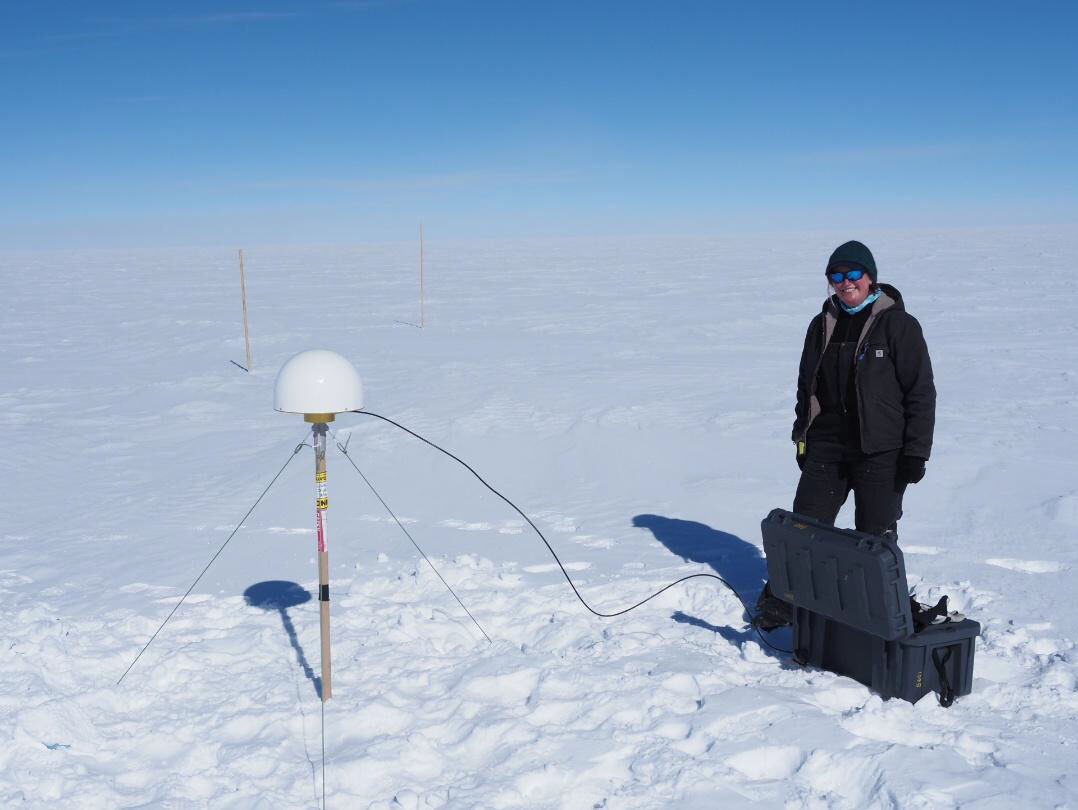
Also today, Lenneke deployed a GPS station as part of our geophysics work here monitoring the (extremely slow) ice movement. The GPS will be redeployed at the same survey point in future seasons.
The traverse team returned four traverse vehicles into service, which had been parked since early December and were not needed over the summer at the Inland Station.
Two team members completed load-cell testing using a traverse tractor and a combination of sleds over different terrain, to help plan future traverse train configurations.
The electricians completed the light installation in the mechanical tent, and are organising the camp closure.
The weather still prevents our scheduled flight to exchange two personnel and send out full ice core boxes.
16 January, 2026
Location: Dome C North (DCN)—MYIC Inland Station, 75.0422°S, 123.6312°E, 3239 m asl.
Personnel at DCN: Damien Beloin (traverse leader), Derryn Harvie (deputy traverse leader & drill engineer), David Holley (carpenter), Ed Maguire (diesel mechanic), Kris Keen (diesel mechanic), Andy Lewis (electrician), Meg O’Connell (medical doctor), Dane Eden (diesel mechanic), Thom Whyte (electrician), Lenneke Jong (MYIC glaciologist), Julius Rix (MYIC driller), Joel Pedro (MYIC science lead), Chris Richards (MYIC drill technician), Chris Young (MYIC drill technician), Dave Burdon (diesel mechanic), Josh Kassulke (communications technician), Mingxia Lai (ice core processor, PhD student), Chris Plummer (ice core processor).
Weather at DCN: • -30˚C max, 5-10 knots, partly cloudy. • Forecast for next 24 hours: Mostly clear. Winds: SW 5/10 knots. Min/Max: -42/-30 °C
Inland Station Operations, Science, Drilling
- Start depth (loggers): 379.25 m
- End depth (loggers): 389.4 m at 7pm, night shift continues.
This morning we brought up 4.5 metres of ice core for the shift, which made a quiet morning for the core processors. Neither freshly sharpened standard nor step cutters across a range of pitches made much headway. The evening shift are currently doing better with 2.8 and 2.4 metre runs, but the going is slow. It’s suspected now that we are getting too much chip build up, which is not easy to solve with current equipment. We are down to the last 24 hours now of scheduled drilling and chasing just a few more good runs to cap off our season.
Cold weather is coming in with a minima tomorrow of -42˚C and wind chill forecast down to -60˚C as the winds increase, the short summer on the high plateau is quickly coming to an end.
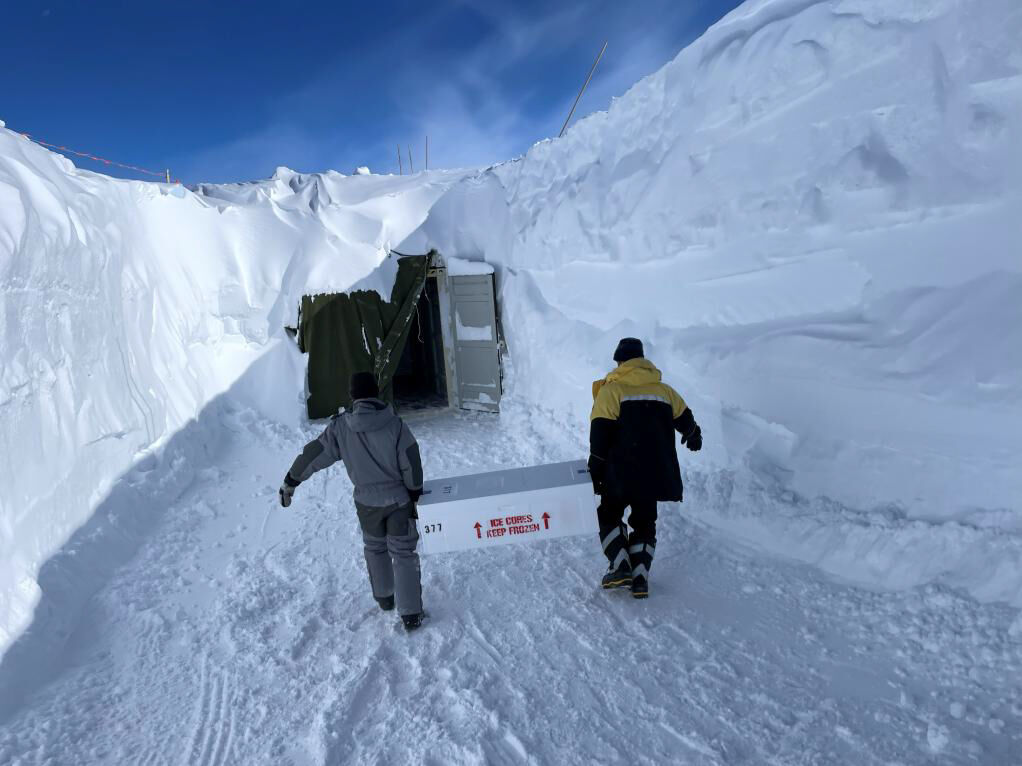
We had what is likely a last visit for the season from our good friends from Concordia. We can see the Concordia towers on the horizon and feel all part of the same community up here in the vast cold. Yesterday the Concordia team inaugurated an Ice Memory Sanctuary in a 15 metre-deep ice cave near the station (similar to the one our MYIC ice cores were stored in a week ago on their transport through Concordia). Temperatures in the cave are -52˚C.
The Ice Memory Sanctuary aims to preserve the memory of glaciers that are disappearing around the world. Under current climate trends and emission pledges, two-thirds of all glaciers outside Greenland and Antarctica are projected to disappear by the end of the century [see Rounce et al., Science, 2023].
The first ice cores from vulnerable European and Asian glaciers were transported to the cave in recent weeks. This will not save the glaciers themselves, but at least preserves a record of the environmental information stored in them (their memory) as an archive for future research and a powerful symbol of our changing climate.
Congratulations to Concordia and the supporters of the Ice Memory Sanctuary.
17 January, 2026
Location: Dome C North (DCN)—MYIC Inland Station, 75.0422°S, 123.6312°E, 3239 m asl.
Personnel at DCN: Damien Beloin (traverse leader), Derryn Harvie (deputy traverse leader & drill engineer), David Holley (carpenter), Ed Maguire (diesel mechanic), Kris Keen (diesel mechanic), Andy Lewis (electrician), Meg O’Connell (medical doctor), Dane Eden (diesel mechanic), Thom Whyte (electrician), Lenneke Jong (MYIC glaciologist), Julius Rix (MYIC driller), Joel Pedro (MYIC science lead), Chris Richards (MYIC drill technician), Chris Young (MYIC drill technician), Dave Burdon (diesel mechanic), Josh Kassulke (communications technician), Mingxia Lai (ice core processor, PhD student), Chris Plummer (ice core processor).
Weather at DCN: • -29˚C max, winds W 5-10 knots, partly cloudy. • Forecast for next 24 hours: Blowing snow. Winds: W/NW to 25 knots. Min/Max: -39/-29 °C
Inland Station Operations, Science, Drilling
- Start depth (loggers): 389.4 m
- End depth (loggers): 400.68 m (!)
The groundwork for this season stretches back many years: 2016, for the start of work to restore traverse capability to the Antarctic Program; 2019, for the start of building our own Australian deep ice drilling system; and 2010 for collaborative survey work with other nations to identify the most promising sites in Antarctica for the recovery of the oldest continuous ice core records of earth’s climate and atmospheric composition.
Work in Antarctica is never easy or routine. Our success this season rests on support from right across the Antarctic Program. Thanks to all of you for the work which granted us the opportunity of time and logistics support at DCN. We have tried to make the very most of every day. Thanks too to all our families and loved ones at home, we miss you and you are also part of the team that has given us this time and opportunity, and who share in the results of our work in such a special place.
It is now 78 days since the traverse team left Casey in support of this seasons’ work and 58 days since the first group of the MYIC drilling and science team flew to Dome C, where we joined together to start the work here at Dome C North. Our main goal for the season has been to set up the new drill system, start drilling, and improve and gain experience with it.
On day five, after arrival, we completed installing the bore casing. On day 15 the drill tower was built, secured down and operating. On day 18 we received our deep drill winch through cooperation with French and Italian traverse logistics.
After completion of the electrical and communications connections for the winch, and coupling in the with the tower and sonde, and completing the drill fluid handling system, we drilled the first ice core on 26 December.
In the three weeks since, we have indeed improved the drill system and gained experience. We also completed all the planned geophysics survey work around the drill site and carefully logged, sampled and stored the drilled ice cores.
We were tested along the way: damaging cutters on the base of the bore casing; needing to pull apart the drill pressure housing to recover power and communications to the sonde; and needing to remove metal fragments from the bottom of the borehole.
The team has worked through these issues with skilled and creative solutions, fashioning replacements in the field for the damaged drill cutters, opening the sonde several times to fix the power and communications issues and improve limits to protect the motor and gear box, and using a conical reamer and magnets to recover the metal fragments. Every day new ingenuity is required!
We found ourselves at 389 m at the start of this last day of drilling. Pre-season we had the somewhat arbitrary target to reach a round 400 metre drill depth. This target was always much less important than the bigger picture, of getting the system up and running and gathering information on what we need to work on in the off-season, to come back next summer and drill to over 1000 metres. And then on to bedrock at 3064 metres by the 2028/29 season.
But damn it, we were keen to hit the 400 metre target and cap ofr the season with all objectives met! We had just the one shift to do it. We decided to all work together on the one shift for this last day.
The final metres were not given up easily. Repairs were needed in the morning to the borehole lid and tundish. Chris Young attended to these with characteristic toughness in the -55˚C temperatures at the bottom of the trench. The drilling was then quite slow with several short runs. The slow progress illustrates one of our key learnings this year - that we need to work in the off-season on our recovery and transport of the ice cuttings, which has not been efficient enough and slowed drilling especially in the past week.
In this sense it is a good time to stop and come back with improvements to be able to drill more efficiently next summer.
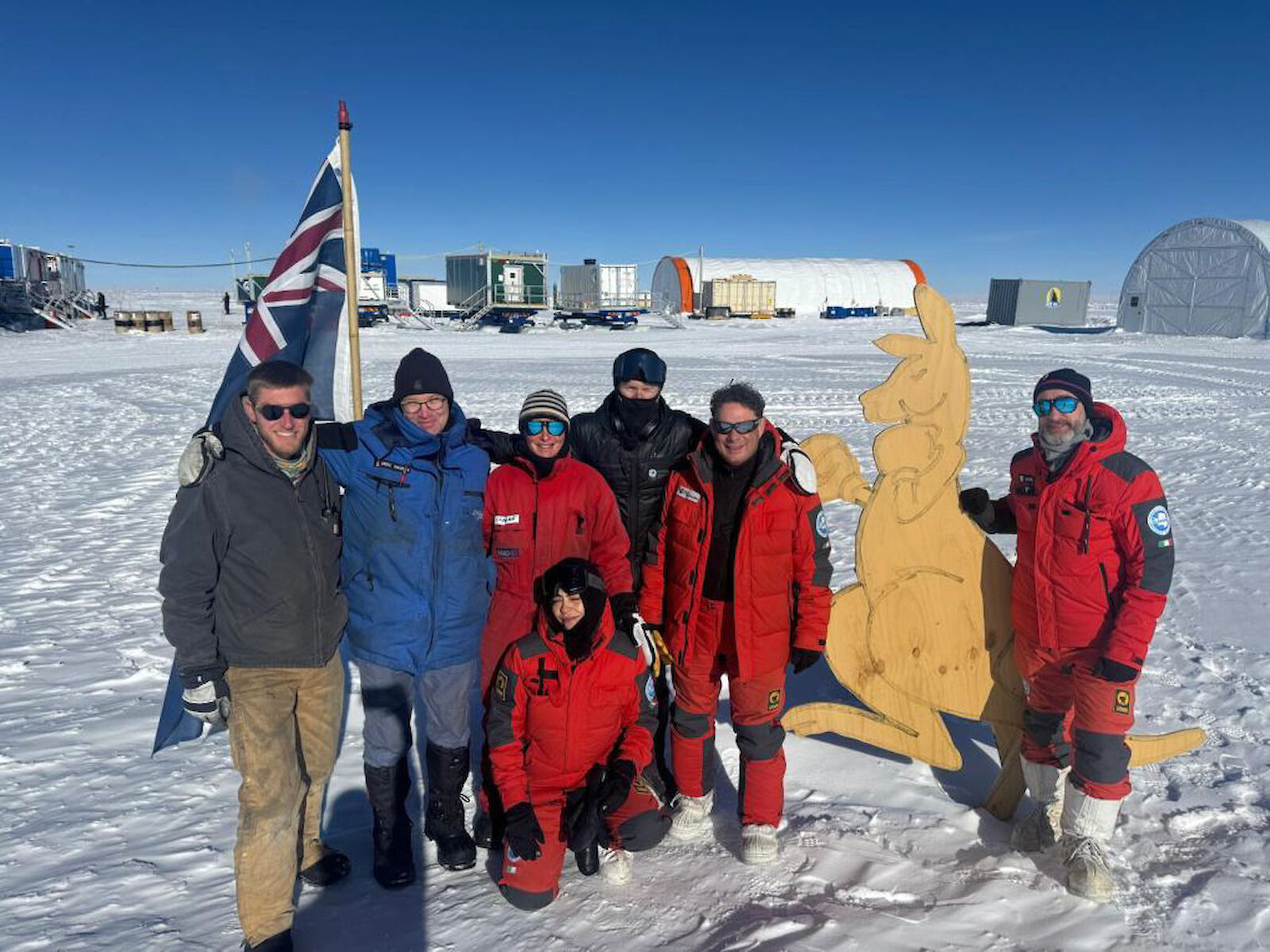
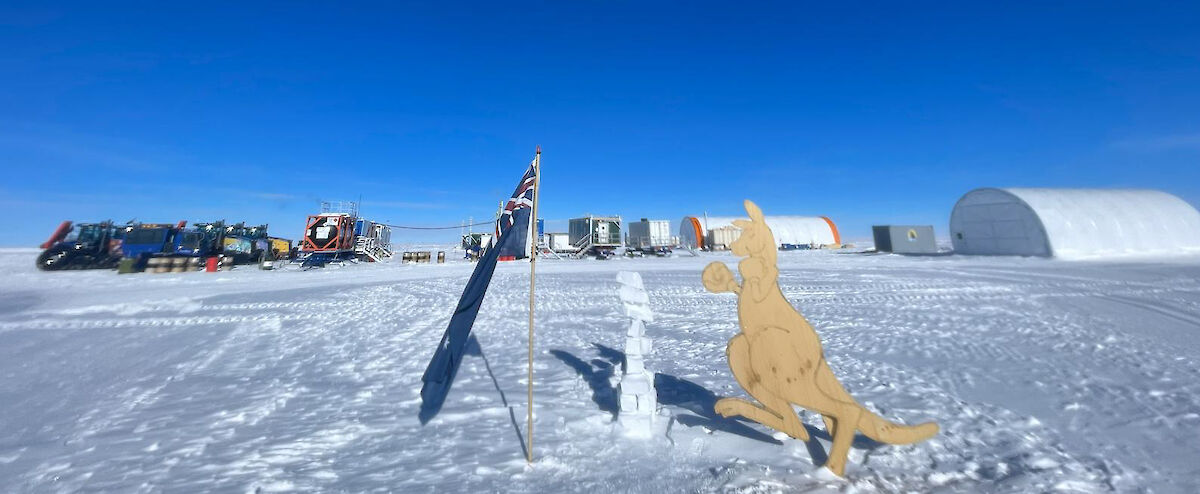
We reached 400.68 m at 4 pm and celebrated the shared success with the whole camp. The ice at this depth is estimated at 13,100 years, from during the termination of the last ice age. Everyone in camp has played their part in helping us reach it.
Our focus now turns in earnest to pack down the drill system and ready the Inland Station for the long winter, so that it is all safe and in good order to return to next summer.
Sensitive equipment that may be damaged by the sub -80˚C temperatures that will soon descend on the high plateau, needs to be pulled out for safe storage, either with our colleagues at Concordia, in our buried container (in which the temperature will not reach the extremes at the surface) or through return to Casey or Australia. We will also inventory and pack cargo for return and seal up the structures so that they are not filled with snow over winter.
The science and drilling team has flights scheduled to Casey over the coming week and the traverse team is scheduled to start their two-week journey back to Casey on the 26th.
We’ll then wait for the Wilkins blue ice runway to cool enough to re-open and join other Antarctic expeditioners flying back to Hobart in February. The traverse team still has the 1,100 km return journey to Casey ahead, and are scheduled to fly back later in February to early March.
Our ice cores will be transported back to Casey in a refrigerated container on traverse and/or by Basler, depending on weather and other logistics. The ice cores will be analysed this year in our Australian Antarctic Program ice and gas labs in Hobart.
The data from this year and the deeper ice to come, will contribute to reconstructing climate and greenhouse gas composition of the atmosphere well beyond a million years into the past, and help improve understanding of long-term past and future climate stability.
This is the last entry to share for the season, as we wrap up and focus on return of people, cargo and ice. Thanks for following along and see you next year!