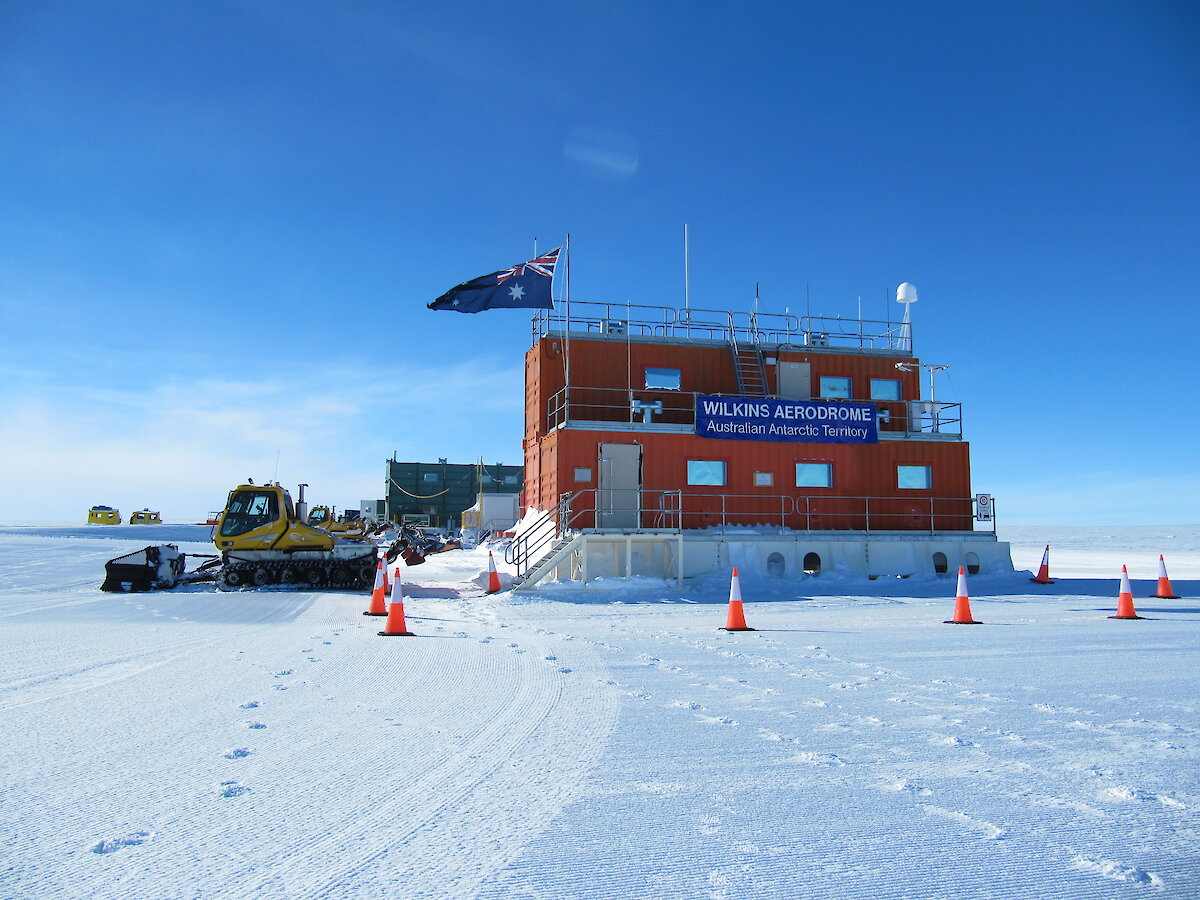


Situated in an area of Antarctica known as Wilkes’ Land, the aerodrome has been sited 700 metres above sea level to minimise the likelihood of melt, as the coast is relatively warm by Antarctic standards during the summer months.
Demonstration flights to Wilkins Aerodrome occurred during the austral summer of 2006–07 and regular passenger flights commenced during the 2007–08 season. The facility operates between October and March each year. It closes for around six weeks at the height of summer, due to warmer temperatures causing sub-surface melt.
Wilkins is named after the legendary patron and pioneer of early Antarctic aviation, Sir Hubert Wilkins.
Aerodrome facts
- Location: 66°41'27"S, 111°31'34.98"E (-66.6908, 111.5264)
- Strip Dimensions: 3,500 m × 100–150 m
- Runway Dimensions: 3,200 m x 30 m (60 m width strength tested and tilled)
- Visual aids: single sided PAPI and end lighting threshold, lead in and distance to run markers
- Distance from Casey: 70 km
- Elevation: 720–780 m ASL
- Center line slope: 1.58% down to the west
- Cross slope: <1.0% down to the south
- Glacial movement: 12 m/year to the southwest
- Ice thickness: approx 500 m
- Mean temperature: −14°C
Construction
The Wilkins site is approximately 70% exposed ice and 30% snow cover that is less than one metre deep. The foundation of the runway is natural glacial ice, rolled with proof rollers to ensure that the surface ice has suitable bearing strength and integrity to support the aircraft. The runway surface is tillered by a snowgroomer to manufacture higher friction levels prior to each flight of a wheeled aircraft.
Operations
Wilkins Aerodrome supports personnel transfer for the Australian Antarctic Program with A319 flights. The Airbus A319‑115LR is a commercial aircraft operated by Skytraders Pty Ltd from Hobart to Wilkins Aerodrome under contract to the Department of Agriculture, Water and the Environment. Around half of the 500 people Australia takes south each season, are taken on these flights.
Since 2016, the Department of Defence has operated up to 6 seasonal flights per year with heavy-lift C17-A aircraft to Wilkins Aerodrome in support of Australia’s Antarctic Program.
Intracontinental flights operate from Wilkins Aerodrome to ski landing areas that are established seasonally at all 3 Australian year-round research stations. These sites require on-site personnel and infrastructure to operate.
The Australian Antarctic Program also supports other National Antarctic Programs and facilitates access to and from Antarctica. Intracontinental flights are operated to the skiways of other National Antarctic Programs such as Italy, France and China.
Living at Wilkins
Up to eight expeditioners live and work at Wilkins Aerodrome during the flying season.
Extreme weather conditions at the site can make it difficult for a daily routine to become established. There are periods of blizzard, with high wind and blowing snow, when little work can be completed. These are punctuated with windows of fine weather when most outdoors work is undertaken. During fine weather, long work days can be expected. These can be up to 12 hours.
Living in this isolated environment, all team members must contribute to a range of additional duties that are essential to maintaining the Wilkins accommodation and facilities.
Facilities
Wilkins Aerodrome operates as a certified aerodrome in accordance with Civil Aviation Safety Authority regulations.
Due to the dynamic nature of the runway, a series of tests are conducted on the pavement immediately prior to any use by aircraft to ensure that prescribed hardness and friction requirements are met.
Infrastructure at Wilkins includes:
- Transit facilities
- Cold and warm storage
- Basic emergency response facilities, including medical
- Airfield markers
- Navigation and aircraft approach equipment
- Power generation equipment
- Basic fire fighting equipment
- Shelters for:
- aircraft communications site office
- medical services
- meteorological services
- living and emergency accommodation
- light workshop
- storage facilities
- Vehicle and sled parking areas
- Refuelling equipment
- Fuel storage for vehicle and airfield operations