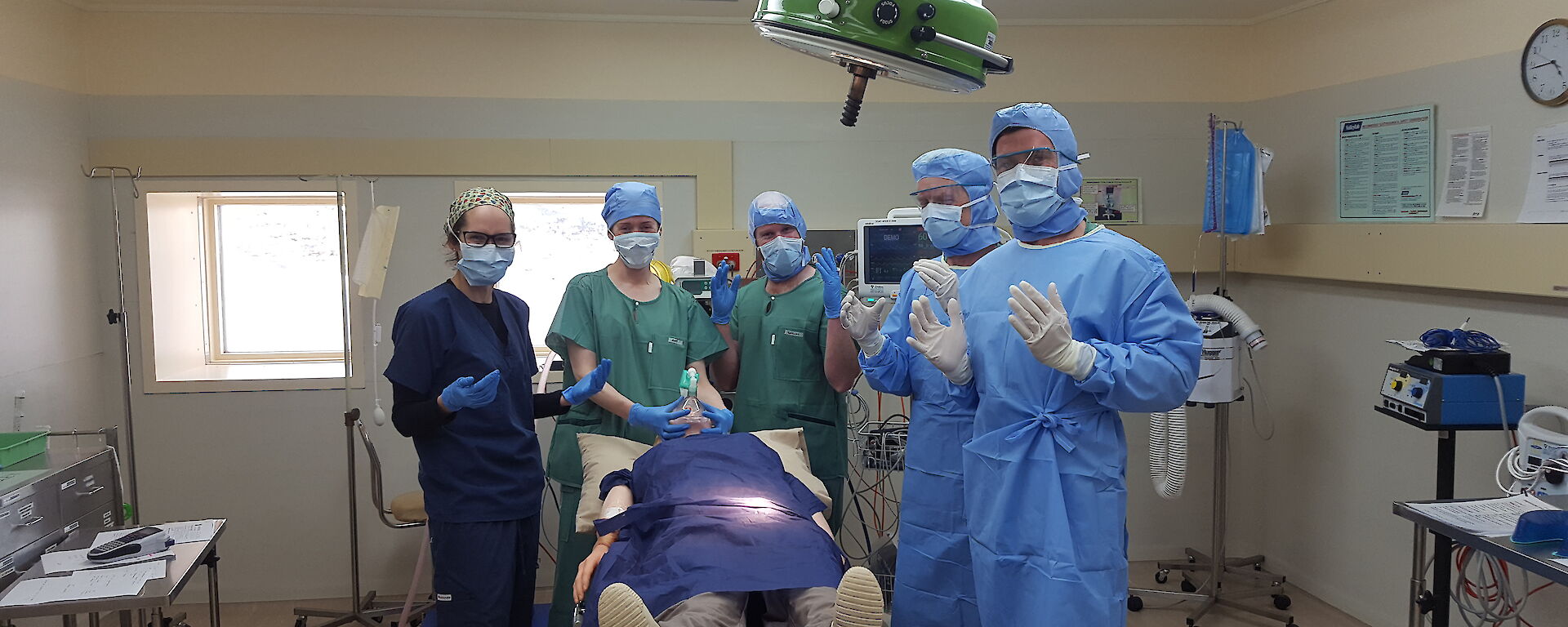

Doctors provide support for expeditioners on Australian Antarctic stations and on ships in the Southern Ocean. Advanced telehealth systems also enable the remote diagnosis and treatment of patients. We can monitor the vital signs of an ill expeditioner from Hobart.
A well-established network of specialists in Tasmania and around the country support healthcare delivery for the Australian Antarctic Program.
Research
Antarctic doctors provide health care to expeditioners on Australia’s stations. Working with this isolated population in an extraordinary environment, also presents a unique opportunity for medical research. Research findings may have important long–term health implications.
Our research has particular emphasis on studies that aid living and working in Antarctica. This includes research on:
- health and behaviour
- thermal adaptation
- nutrition
- epidemiology
- cardiovascular studies
- photobiology.
Antarctic human biological research has made a major contribution to the knowledge of human adaptation in Antarctica. It suggests that expeditioners undergo physiological and psychological changes in response to the Antarctic conditions.
Research shows a lowered responsiveness of the immune system in the isolation and confinement of the Antarctic winter. More precise laboratory studies over the past 10 years have shown that 30% of those working in Antarctica have altered immune responses. Collaborative research continues with universities and research institutions in Australia and the United States of America. These studies include mechanisms for changing immunity and the influence of factors such as stress and other psychological influences. Research on viral reactivation in humans is also underway. This work has potential value for health care on long duration space flights.
Centre for Antarctic, Remote and Maritime Medicine
The Centre for Antarctic, Remote and Maritime Medicine (CARMM) delivers healthcare in remote and extreme environments, training, education, clinical services, research and innovation. Established in 2020, CARMM is an opportunity to share highly specialised medical skills, honed in the extreme Antarctic environment.
The Centre is a partnership between the Australian and Tasmanian Governments and the University of Tasmania. It draws on expert knowledge developed by the Australian Antarctic Program to inform medical care providers in other remote and maritime settings across Australia.
For more information, contact the Australian Antarctic Division and ask to be directed to the Polar Medicine Unit.