
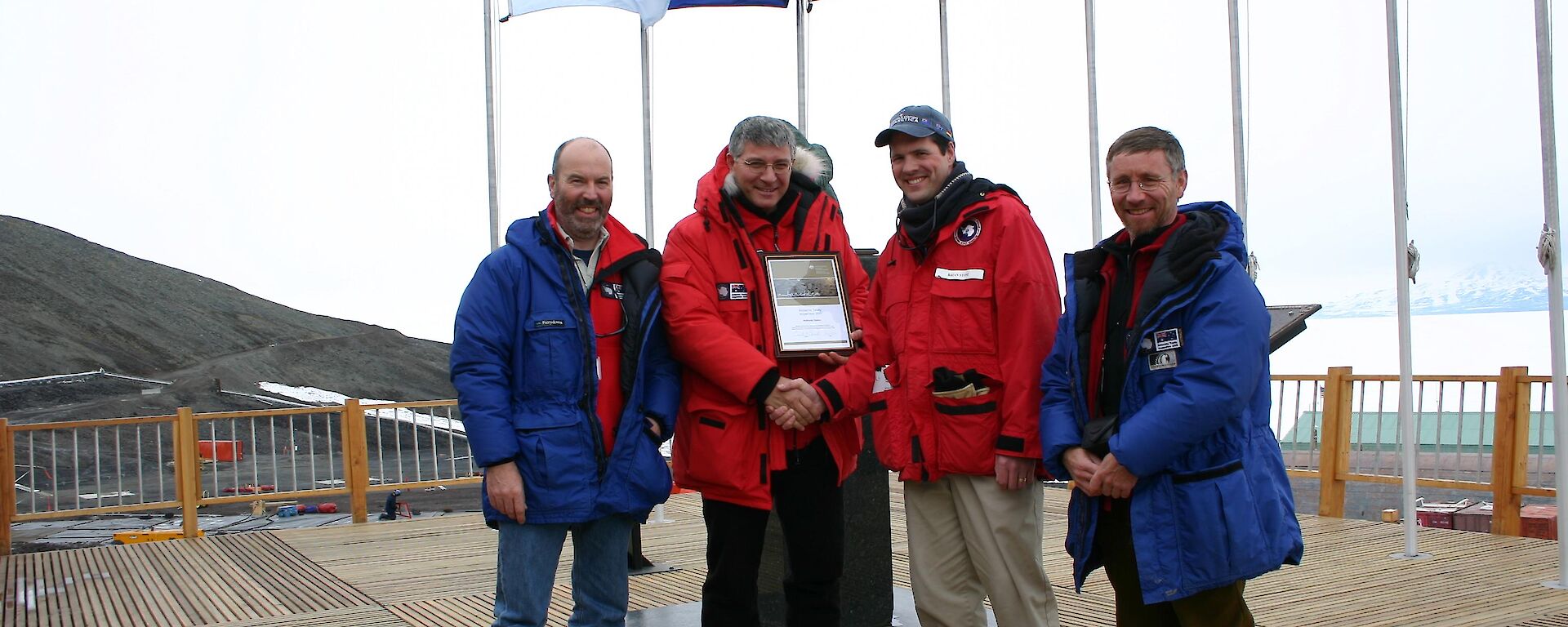


Three significant contributors to the Australian Antarctic program, and members of the Australian Antarctic Division’s Executive, have recently or will soon ‘retire'. In the next three pages, former General Manager of Policy, Andrew Jackson, former Chief Scientist, Michael Stoddart, and former Head of Operations, Kim Pitt, reflect on their time with the Division and what they hope for their future and that of Antarctica and the Australian Antarctic program. Andrew Jackson provides the first story in this 'Changing of the Guard' series.
In 1974 I won a university vacation position in the public service, assisting the Australian Antarctic Division translate the titles of a huge pile of Russian science publications (I studied Russian at school) the library had accumulated over many years. It took me two summers to get through them. Soon after I won a permanent job at the Antarctic Division because I had worked there before; then one door after another opened and I became immersed in the Antarctic business. It was a far cry from previous jobs stuffing teddy bears with crumbed foam in a long-gone toy factory in Melbourne, and teaching in Victoria, where I only lasted four terms.When I joined the Division I wanted to learn as much as I could about Antarctica, and make a difference to how we did our business. I worked in many parts of the organisation — information services, science administration, international affairs, strategic planning and, finally, as a member of the Executive.
My main area of responsibility has been Antarctic policy. I came into the Antarctic Treaty family at the end of the debate on Antarctic minerals development and was closely involved in negotiating the environmental Protocol, which provides a long-lasting framework for Antarctica’s future. It’s been a privilege to help shape part of the globe’s future. The shift from a resources view of Antarctica to an environment protection view is an important change in attitude in achieving a sustainable future.
Most recently, I worked with others on a project to define Australia’s long term strategic engagement with Antarctica. I hope that some of the vision we developed can be brought to reality. It’s quite simple really — a future that protects Antarctica and the relationships between nations interested in the region; maximises the remarkable scientific opportunities so that the world can benefit; and gives us flexibility to pursue our national Antarctic interests. We need to protect the options for coming generations in the region.
I think it is a privilege to visit the Antarctic; even once. I made the journey 17 times between being a wide-eyed trainee to a Treaty inspector. But first impressions will never leave. I was in awe at having seen my first iceberg and then, at midnight, on one of those calm, silent Antarctic nights, when one feels infinitesimally small and insignificant, Thala Dan's bow slid into the pack ice. At the very moment we entered the pack the full moon rose directly astern along our arrow-straight track. We left the heaving sea behind and I passed through the ice barrier into another world.Of course there were challenges in my work, but working on Antarctic issues is easy with so many experts around. That said, the 2001 Treaty meeting in St Petersburg let me dust off my Russian again, but with less impressive results. In charge of ordering meals in the local restaurant one evening, through some slip of mispronunciation, I succeeded in ordering cake and salad for the entire delegation. To my colleagues, I offer my sincerest apologies.
I have no specific plans on leaving the Antarctic Division, but I hope that whatever comes my way will provide some opportunities to keep me involved in Antarctic affairs.
ANDREW JACKSON
Former General Manager, Policy