
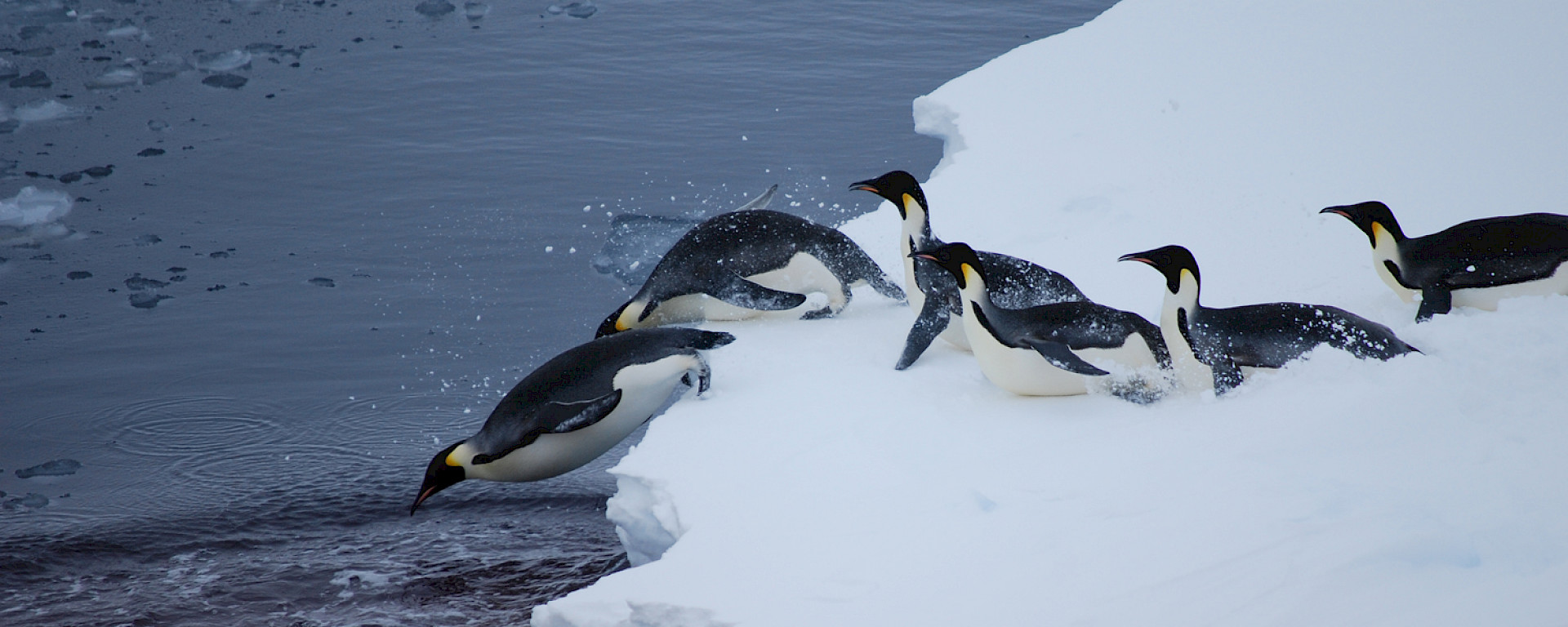


We cannot follow emperor penguins out to sea, so we rely on electronic instruments to record their activities.
How deep can they dive?
Time-depth recorders are mini-computers that record the time when a penguin dives, how long it dives for and to what depth it dives. From these records we also learn how much time the birds spend in the water, how long they rest between dives and at what time of day they are most active.
Emperor penguins dive deeper than any other bird. Most of their dives are between 100 and 200 m but occasionally they go a lot deeper. The deepest dive we have on record was an incredible 565 m deep! The penguin had been diving to over 450 m quite regularly until it finally reach this enormous depth.
Penguins have to hold their breath when they dive. How long they hold their breath for depends on how deep they dive and how fast they move. On average, emperor penguins dive for three to six minutes, but they can dive for longer. Among many thousands of dives we recorded two that lasted 22 minutes! That is a very long time, even for an excellent diver like an emperor penguin.
Where do they go?
To find out where emperor penguins go when they enter the water we attach small satellite tracking devices to their backs. These devices transmit signals every 90 seconds and if satellites are somewhere above them these signals are picked up and we get a location for the penguin. The aerial of the satellite tracker has to be exposed to air to work. So when the penguin is diving a lot we are less likely to get a location.
We equipped female emperor penguins with satellite trackers just before they spent the winter in the pack-ice. In the 76 days or so they were absent from the colony they travelled 2,600 km. Interestingly, they were not more than 130 km away from the colony travelling backwards and forwards along the continental shelf break.
In summer, the adult penguins travelled much farther. They tended to go north into very deep waters and then return to the fast-ice off the continent from 180 to more than 550 km west of their colonies. All these emperor penguins had left their chicks and were fattening up before their moult.
Read more about where juvenile emperor penguins go when they first leave the colony in Young emperor penguins: where do they go (Australian Antarctic Magazine, Issue 15, 2008).

